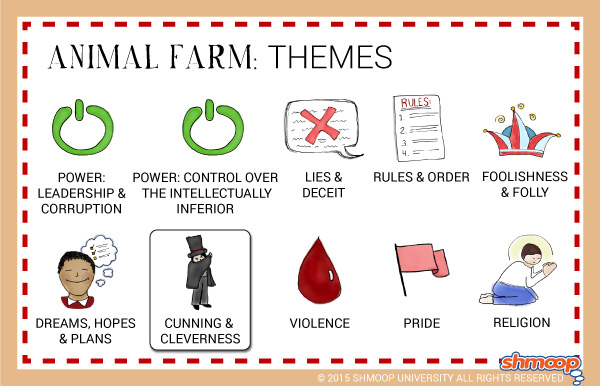
 (Click the themes infographic to download.)
Keep an eye on your local Mensa chapter: they may look like harmless nerds, but they're just waiting for the right opportunity to oppress us all. Or, something like that. In Animal Farm, the communist revolution quickly sours when it turns out that the animals all have different innate gifts—and some of those gifts, like cleverness, are particularly good at oppressing animals with other gifts, like brute strength. Is Orwell suggesting that smart people are always going to end up oppressing us because they understand financial derivatives and we can barely balance our checkbook?
Questions About Cunning and Cleverness
- One of the coolest things about Animal Farm, besides the talking pigs, is the fact that we know all these things the animals don't. Unfortunately, the real world doesn't work that way—usually. Look around: do you feel like you're being oppressed? Are you a pig or a sheep? Or a horse? Or a cynical donkey?
- The animals are really concerned about controlling the image of their farm in the outside world. Is this the same kind of manipulation that the pigs perform within the farm? Are the working class animals also responsible, in some ways, for the attempted deception of the outside world?
- Is Orwell suggesting that we need to be extra suspicious of clever people?
Chew on This
In Animal Farm, cleverness is more powerful than strength.
When Napoleon violently ousts Snowball, Orwell suggests that brute force is more important than intellect.