If you've ever been confused whether it's spelled disk or disc, you are not alone. "Disk" is from the Greek diskos and "disc" is from the Latin discus, so go with whichever language you like better. The Greek or Latin to English lesson being over, let's toss around a few disks and see what we volumes we get.
We are going to begin with a solid of revolution, and we can slice it perpendicular to the axis of rotation. We get slices that look like disks or washers. If there's no hole in the middle of the slice, we call the slice a disk because it resembles a frisbee disk.

If there's a hole in the middle of the slice, we call the slice a washer because it looks like a washer used with a nut and bolt.

Here's a video that shows a solid of revolution with a washer-shaped slice taken out.
We make a disk by beginning with a region that touches the axis of rotation along the whole length of the solid. There won't be any holes in the middle of the solid, so all the slices will look like frisbees. Frisbee coming our way. Heads up!

To find the volume of the solid we first, we find the volume of a single disk. Then we figure out the appropriate limits of integration and write down an integral.
Because a disk is shaped like a circular, we can find the volume of the by finding the area of its circular side and multiplying by its thickness. It's thin disk, so it shouldn't hurt too much if we miss the disk and it beans us in the face.
Sample Problem
Let R be the region bounded by the curve y = x2, the x-axis, and the line x = 4. Write an integral expression for the volume of the solid obtained by rotating R around
(a) the x-axis
(b) the line x = 4
Answer.
The region R looks like

(a) When we rotate R around the x-axis we get a solid that looks like

R lies along the x-axis for the entire length of R. If we take slices perpendicular to the axis of rotation, each slice is a disk. The radius of the disk at position x is
y = x2.

This means the volume of that disk is
π(x2)2 Δ x = π x4 Δ x.
The variable x goes from 0 to 4 in the region R, which means we have disks from x = 0 to x = 4. We integrate from 0 to 4 to find the volume of the solid:

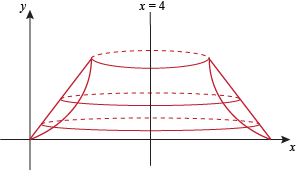
(b) Rotating R around the line x = 4 produces this solid:

Slices perpendicular to the line x = 4 are horizontal. Since R lies along the line x = 4, each slice will be a disk. By looking at the slice at height y, we see from the line x = 0 to the edge of the slice is a distance of
. From the edge of the slice to the center of the slice is a distance of r. Since the distance from x = 0 to the center of the slice is 4, we get

so the radius of the slice at height y is

The volume of the slice is

The variable y ranges from 0 to 16 in the region R, so we have disks from y = 0 to y = 16. This means the volume of the entire solid is

Be Careful: square the radii separately and then subtract. You want
π[(router)2 – (rinner)2],
not
π(router – rinner)2.
To figure out what the outer and inner radii are, we can draw pictures if it helps. We don't need any complicated formulas.
Practice:
Let R be the region bounded by y = x and y = x2. Find the volume of the solid obtained when R is rotated around the (a) x-axis (b) y-axis | |
The region R looks like 
(a) When R is rotated around the x-axis we get the solid 
A slice perpendicular to the x-axis is a washer. The radius of the washer is x and the radius of its hole is x2. This means the area of the side of the washer is π(router)2 – π(rinner)2 = π(x)2-π(x2)2 = π[x2 – x4]. The volume of the washer is π[x2 – x4] Δ x. Since x goes from 0 to 1 in this region, the volume of the solid is 
(b) Rotating R around the y-axis gives us the solid 
A slice perpendicular to the y-axis is a washer with inner radius y and outer radius . The area of the side of the washer is 
and the volume of the washer is π[y – y2] Δ y. Since y goes from 0 to 1 in the region R, the volume of the solid is 
| |
Let R be the region bounded by y = x and y = x2. Find the volume of the solid obtained by rotating R around (a) the line y = -1 (b) the line x = 4 | |
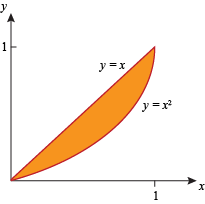
We're getting pretty familiar with this region by now: 
(a) When we rotate R around the line y = -1, we get a solid with a hole in its middle. This means a slice of this solid will look like a washer. The outside of the solid is bounded by the line y = x. However, since the center axis of the solid is not the x-axis, the outer radius is not just x. If we look at the picture we can see that the outer radius is router = x + 1. Similarly, the inside of the solid is bounded by the line y = x2. Since the center axis of the solid is at y = -1, which is a distance of 1 away from the x-axis, we have to add 1 to get the inner radius rinner = x2 + 1. We have router = x + 1 and rinner = x2 + 1, so the volume of the washer is π[(router)2 – (rinner)2] Δ x = π [(x + 1)2 – (x2 + 1)2 ] Δ x. The variable x goes from 0 to 1 in the region, so the volume of the solid is 
(b) When we rotate R around the line x = 4 we get the solid 
Slices perpendicular to the line x = 4 are washers. The outer boundary of the solid is at the line y = x. However, the center line of the solid is at x = 4. By looking at the picture we can see that the outer radius of the slice at height y is router = 4 – x = 4 – y. The inner boundary of the solid is the line y = x2, or . By looking at the picture, we can see that the inner radius of the slice at height y is . The volume of the slice is 
The variable y goes from 0 to 1 in the original region R, so the volume of the solid is 
We are being bombarded with a multitude of pitched frisbee disks because it's important. Even the most experienced volume-making, cake baking, frisbee tossing expert draws pictures to avoid making mistakes. | |
Let R be the region bounded by y = ln x and the x-axis on the interval [1,2]. Find an integral expression for the volume of the solid obtained by rotating R around
(a) the x-axis
(b) the line x = 2
Answer
The region R looks like

(a) When we rotate R around the x-axis we get the solid

Slicing perpendicular to the x-axis gives us disks of radius y = ln x.
The volume of the disk at position x is
π (ln x)2 Δ x.
Since x goes from 1 to 2 in the region R, the volume of the entire solid is

(b) Rotating R around the line x = 2 produces the solid

Slices perpendicular to the line x = 2 are horizontal disks.
Looking at the disk at height y, we see that ey + r must equal 2, so the radius of the disk is
r = 2 – ey.
The volume of the disk is
π(2 – ey)2 Δ y.
The variable y ranges from 0 to ln 2 in the region R, so the volume of the entire solid is

Let R be the region bounded by y = x3, the y-axis, and the line y = 8. Find an integral expression for the volume of the solid obtained by rotating R around
(a) the y-axis
(b) the line y = 8
Answer
Here's the region R:

(a) When R is rotated around the y-axis it gives us the solid

Since R lies along the y-axis for the whole height of R, slices perpendicular to the y-axis are disks.
The disk at height y has radius x = y1/3 and volume
π(y1/3)2 Δ y = π y2/3 Δ y.
Since y goes from 0 to 8 in the region R, the volume of the entire solid is

(b) When R is rotated around the line y = 8 we get a solid volume

R lies along the line y = 8 for the entire x-interval [0,2], so slices perpendicular to y = 8 are disks. The radius of the disk at position x is
8 – y = 8 – x3.
The volume of this disk is
π(8 – x3)2 Δ x.
Since x goes from 0 to 2 in the region R, the volume of the solid is

When the region doesn't lie along the axis of rotation, a slice perpendicular to the axis of rotation usually looks like a washer, which is just a disk with a hole in the middle. Lucky for us, a frisbee with a hole in it doesn't fly nearly as far. Our faces should be safe from lofted washers.
The volume of a washer is the area of a side multiplied by the thickness. A washer has an outer radius and an inner radius.

To find the area of the side we find the area using the outer radius and subtract out the area of the hole.s
Since the area using the outer radius is
π (router)2
and the area of the hole is
π (rinner)2,
we get a simple equation for the area of the side of the washer:
π[(router)2 – (rinner)2].
Then we multiply by whatever thickness is appropriate (Δ x or Δ y) to find the volume of the washer.
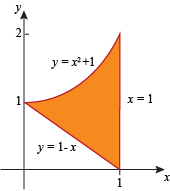
Let R be the region bounded by the graphs y = 1 – x, y = x2 + 1, and the line x = 1.
Find an integral expression for the volume of the solid obtained by rotating R around the line
(a) y = 0
(b) y = 2
(c) y = -2
(d) y = 5
Answer
The region R looks like this:

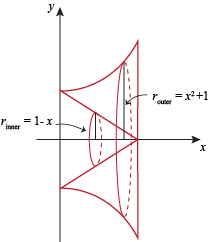
(a) When we rotate the region R around the line y = 0 we get the solid

We can see from the picture that the outer radius is the distance from the x-axis to the graph y = x2 + 1, and the inner radius is the distance from the x-axis to the graph y = 1 – x.
So
router = x2 + 1
rinner = 1 – x.
Since the thickness of a disk is dx, the volume of the disk is
π[(x2 + 1)2 – (1 – x)2 ] Δ x.
There are disks from x = 0 to x = 1. The volume of the solid is

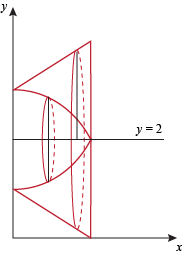
(b) When we rotate R around the line y = 2 we get

The outer radius is the distance from the graph y = 1 – x to the axis of rotation y = 2.
This distance is
router = 2 – (1 – x) = 1 + x
The inner radius is the distance from the graph y = x2 + 1 to the axis of rotation y = 2
This distance is
rinner = 2 – (x2 + 1) = 1 – x2
This means the volume of a disk is
π[(router)2 – (rinner)2] Δ x = π[(1 + x)2 – (1 – x2)2 ] Δ x
Put the pieces together, we get the volume of the solid:

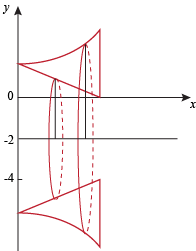
(c) When R is rotated around the line y = -2 we get the solid

The outer radius is the distance from the axis of rotation y = -2 to the graph y = x2 + 1.
This distance is
router = (x2 + 1) + 2 = x2 + 3.
The inner radius is the distance from the axis of rotation y = -2 to the graph y = 1 – x.
This distance is
rinner = (1 – x) + 2 = 3 – x.
The volume of a disk is
π[(router)2 – (rinner)2] Δ x = π[(x2 + 3)2 – (3 – x)2 ] Δ x,
and the volume of the entire solid is

(d) Rotating R around the line y = 5 produces a solid with a very large hole in the middle.
The outer radius is the distance from the axis of rotation y = 5 to the graph y = 1 – x.
This is
router = 5 – (1 – x) = 4 + x.
The inner radius is the distance from the axis of rotation y = 5 to the graph y = x2 + 1.
This is
rinner = 5 – (x2 + 1) = 4 – x2.
The volume of a disk is
π[(router)2 – (rinner)2] Δ x = π[(4 + x)2 – (4 – x2)2 ] Δ x.
and the volume of the entire solid is

Let R be the portion of the unit circle that falls in the first quadrant. Find an integral expression for the volume of the solid obtained by rotating R around the line
(a) y = 0
(b) y = 2
(c) x = 1
(d) x = -1
Answer
The region R looks like this:

The variables x and y both go from 0 to 1 in this region, so the limits of integration will be 0 and 1 regardless of whether we're integrating with respect to x or y.
(a) Rotating R around the line y = 0 gets us this solid:

Slices perpendicular to the axis of rotation are disks (no hole) with thickness dx and radius

The volume of a disk is

and the volume of the solid is

(b) Rotating R around the line y = 2 produces this solid:

Slices perpendicular to the axis of rotation are washers with thickness dx. The outer radius is constant: router = 2.
The inner radius is the distance from the axis of rotation y = 2 to the line
.
We get

The volume of a disk is

and the volume of the solid is

(c) Rotating R around the line x = 1 gets us this solid:

The outer radius is constant: router = 1.
The inner radius is the distance from the axis of rotation to the graph
.
So

The volume of a disk is

The variable y goes from 0 to 1, so the volume of the solid is

(d) Rotating R around the line x = -1 produces this solid:

We can see that the inner radius is constant, and the outer radius is the distance from the axis of rotation to the curve
.
So

rinner = 1.
The volume of a disk is

The volume of the solid is