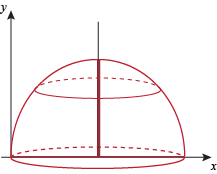
Solids of revolution are not fruits thrown at tyrannical rulers in protest. A solids of revolution is a volume built by rotating an area around a predetermined center line called the axis of rotation.
We mentioned before that way to think of this is like bundt cake. If we aren't happy with a thin slice, we can choose a thicker piece by making an initial slice and rotating the knife around the center to cut out a better sized portion. If we were to rotate all the way around once without cutting, we would form the entire cake, which is a full revolution of the solid cake.
Understanding how to make solids of revolution can be difficult to picture, so drawing them is often very useful. Just Like football players practice plays before a big game, we are going to get plenty of practice drawing solids of revolution before we build integrals with them.
Sample Problem
Draw the solid obtained by rotating the region bounded by y = x, y = 1, and the y-axis around the y-axis.
Answer.
As always, we will start by drawing the area we are going to make the volume with:

We can label the axis of rotation and draw a mirror copy of the region on the other side of the axis of rotation. Drawing the mirror copy helps us picture the axis of rotation more clearly. We know the y-axis is the axis of rotation because the problem said to rotate around the y-axis.

Next, we draw curved lines, solid in front and dotted in back, to make it look like the region went all the way around the y-axis:

This will usually be good enough to give you an idea of what the solid looks like.
Practice:
Draw the solid obtained by rotating the region bounded by y = x and y = x2 around the line y = 2. | |
This is a funny-looking that looks like 
We label the axis of rotation and draw a mirror copy of the region on the other side of the axis of rotation. We want to make sure the distance from the mirror copy to the axis is the same as the distance from the original region to the axis. Finally, we draw the curved lines that make things look 3-D. Since there's a hole in the middle, we need to draw curved lines for the outside and the inside of the solid. 
| |
Let R be the region bounded by the graphs of
, x = 1, and the x-axis. Draw the solid obtained by rotating R around
the x-axis
Answer
The region R looks like this:

For each problem we need to label the axis of rotation, draw a mirror image of R on the other side of the axis of rotation, then make curvy lines so things appear 3-D. Curvy lines are the technically correct term. If you don't like curvy, you can also use words like winding, snaky or even serpentine. Our goal is to eventually use these images to help us build our integrals.
For each of these, we will draw R, the axis of rotation, and then the mirror image of R across the axis of rotation. Then we will make curvy lines to make volumes out of the two areas. We will see that same region R can be used to make very different solids of rotation just by changing the axis of rotation.
Let R be the region bounded by the graphs of
, x = 1, and the x-axis. Draw the solid obtained by rotating R around
the y-axis
Answer
The region R looks like this:

For each problem we need to label the axis of rotation, draw a mirror image of R on the other side of the axis of rotation, then make curvy lines so things appear 3-D. Curvy lines are the technically correct term. If you don't like curvy, you can also use words like winding, snaky or even serpentine. Our goal is to eventually use these images to help us build our integrals.

Let R be the region bounded by the graphs of
, x = 1, and the x-axis. Draw the solid obtained by rotating R around
the line x = 1
Answer
The region R looks like this:

For each problem we need to label the axis of rotation, draw a mirror image of R on the other side of the axis of rotation, then make curvy lines so things appear 3-D. Curvy lines are the technically correct term. If you don't like curvy, you can also use words like winding, snaky or even serpentine. Our goal is to eventually use these images to help us build our integrals.

This solid has a vortex-shaped hole taken out of the middle, since the region doesn't touch the axis of rotation except at the origin.
Let R be the region bounded by the graphs of
, x = 1, and the x-axis. Draw the solid obtained by rotating R around
the line x = 2
Answer
The region R looks like this:

For each problem we need to label the axis of rotation, draw a mirror image of R on the other side of the axis of rotation, then make curvy lines so things appear 3-D. Curvy lines are the technically correct term. If you don't like curvy, you can also use words like winding, snaky or even serpentine. Our goal is to eventually use these images to help us build our integrals.

Let R be the region bounded by the graphs of
, x = 1, and the x-axis. Draw the solid obtained by rotating R around
the line x = -1
Answer
The region R looks like this:

For each problem we need to label the axis of rotation, draw a mirror image of R on the other side of the axis of rotation, then make curvy lines so things appear 3-D. Curvy lines are the technically correct term. If you don't like curvy, you can also use words like winding, snaky or even serpentine. Our goal is to eventually use these images to help us build our integrals.

This solid is missing a cylinder from its middle.
Let R be the region bounded by the graphs of
, x = 1, and the x-axis. Draw the solid obtained by rotating R around
the line y = 1
Answer
The region R looks like this:

For each problem we need to label the axis of rotation, draw a mirror image of R on the other side of the axis of rotation, then make curvy lines so things appear 3-D. Curvy lines are the technically correct term. If you don't like curvy, you can also use words like winding, snaky or even serpentine. Our goal is to eventually use these images to help us build our integrals.

Let R be the region bounded by the graphs of
, x = 1, and the x-axis. Draw the solid obtained by rotating R around
the line y = 4
Answer
The region R looks like this:

For each problem we need to label the axis of rotation, draw a mirror image of R on the other side of the axis of rotation, then make curvy lines so things appear 3-D. Curvy lines are the technically correct term. If you don't like curvy, you can also use words like winding, snaky or even serpentine. Our goal is to eventually use these images to help us build our integrals.

This solid also has a vortex-shaped hole in it.
Let R be the region bounded by the graphs of
, x = 1, and the x-axis. Draw the solid obtained by rotating R around
the line y = -1
Answer
The region R looks like this:

For each problem we need to label the axis of rotation, draw a mirror image of R on the other side of the axis of rotation, then make curvy lines so things appear 3-D. Curvy lines are the technically correct term. If you don't like curvy, you can also use words like winding, snaky or even serpentine. Our goal is to eventually use these images to help us build our integrals.

The real solid looks like this, with a cylinder missing from the middle.
Now that we've got a feeling for what some of these solids look like, let's start finding their volumes.