Symbolism, Imagery, Allegory
(Click the symbolism infographic to download.)
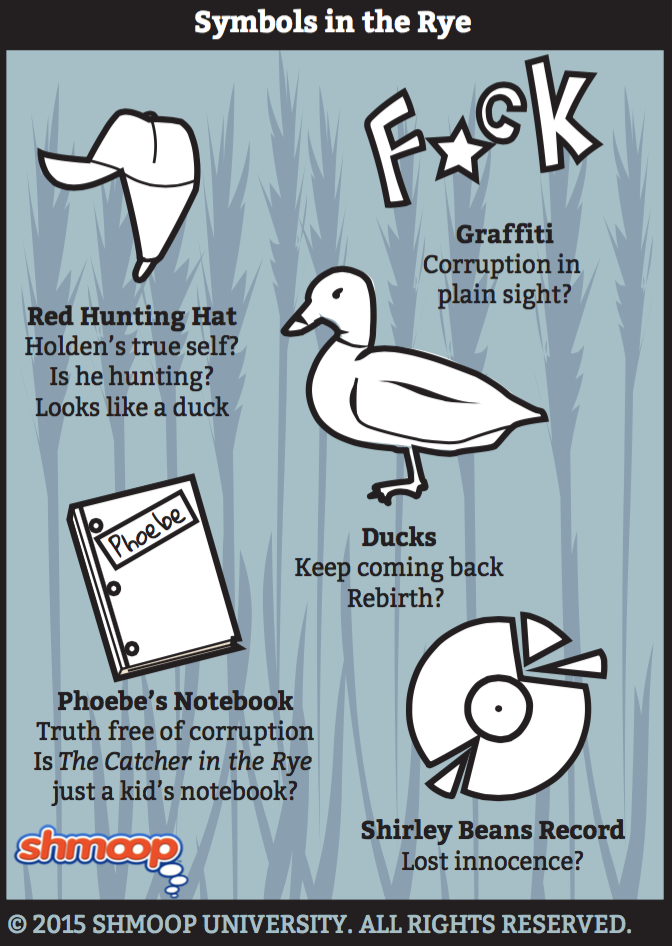
Before Holden wakes Phoebe up, he sits down and reads through her school notebook (check this out—it's not too far from the start of Chapter Twenty-One). Holden, much like we do, finds it endearing, states that "kid’s notebooks kill [him]," and adds that he could "read that kind of stuff […] all day and all night long" (22.18). But what does he like so much about it? Take a look:
Why has south eastern Alaska so many caning factories?
Because there's so much salmon
Why has it valuable forests?
because it has the right climate.
What has our government done to make
life easier for the Alaskan Eskimos?
look it up for tomorrow!!!
Phoebe Weatherfield Caulfield
Phoebe Weatherfield Caulfield
Phoebe Weatherfield Caulfield
Phoebe W. Caulfield
Phoebe Weatherfield Caulfield, Esq.
Please pass to Shirley!!!!
Shirley you said you were sagitarius
but your only Taurus bring your skates
when you come over to my house
Phoebe's notebook is the least phony expression of thought we've seen so far in the novel. There’s no hiding, no narrative, no analysis: Phoebe simply wrote exactly what she was thinking, new names, triple exclamation marks and all.
The question is this: is Catcher in the Rye also one of these “kid’s notebooks”? Is it just what some kid happens to be thinking? On the one hand, obviously no: it’s a carefully crafted novel by a fully adult author. But are we supposed to think that Holden is really just as naïve as Phoebe, saying things like “I’m the most terrific liar you ever say in your life” (3.1), or “I have a lousy vocabulary” (2.22)? Or is he actually guiding and manipulating the story in some way?
It’s definitely up to interpretation, but—call us naïve; we still think, in some way, that Catcher is just some kid’s notebook.