Now another function is going to join the party. Assume both f and g are integrable functions.
- The integral of a sum is the sum of the integrals. In symbols,

Also, the integral of a difference is the difference of the integrals:

We've taken whatever weighted area was between g and the x-axis, and stuck that on top of f. If g is negative, in some places we may actually be subtracting area from f. The integral of (f + g) is the integral of f plus the integral of g.
- If f (x) is smaller than g(x), the integral of f is smaller than the integral of g. In symbols, if
f (x) < g(x) for all x in [a, b]
then

- If both f and g are positive, it's clear that there's more area between g and the x-axis than between f and the x-axis:
- If both f and g are negative, the weighted area between g and the x-axis is closer to 0 than the weighted area between f and the x-axis, so we still have

- If f is negative and g is positive, then
 is negative and
  is positive.
 - If f and g are sometimes negative and sometimes positive, we can split the interval [a, b] into sub-intervals on which one of the previous conditions holds, and go from there.
- Let m and M be constants. If m ≤ f(x) ≤ M on [a, b], then

This is using the last property. We're comparing f to the constant functions m and M. If m ≤ f (x)on [a, b], then we know from the previous property that

Since  , we have half the inequality explained.
Similarly, if f (x) ≤ M on [a,b] then we know from the previous property that

and we know that .
Sample Problem
If f (x) < 2x, then

We can find  by looking at the graph and getting the area of the triangle:
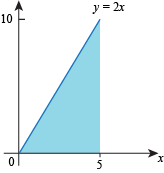
We conclude that

Sample Problem
If  and
and  , then

Be Careful: The integral of a product is not necessarily the product of the integrals.


 on [1, 2], so

Exercise 1
Let f (x) and g (x) be the functions graphed below.

- Find
 .
.

Exercise 2
- Find


Exercise 3
- Find


Exercise 4
- Does
 ?
?


Exercise 5
Assume f and g are integrable functions.
If  and
and  then
then


 and
and  to get
Exercise 6
- If
 , f ( x ) is an even function, and g ( x ) is an odd function, then

Assume f and g are integrable functions.


Exercise 7
If f is odd then


Exercise 8
If  then
then


 to get

