Sample Problem
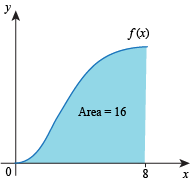
Let f (x) be the function graphed below.

We can see that 

Find a constant m such that

In other words, find a constant m so that we have this:
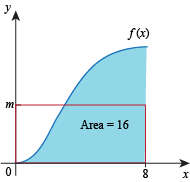
Answer.

. In order to have this equal 16, m must be 2.
We call this constant m the average value of f on [a,b]. When we take the integral of f on [a,b], you get some number. This number is like the sum of all the test scores: it's the accumulation of all the stuff.
To average that accumulation we give every x the same function value as every other x. Therefore we end up with a constant function whose integral on [a,b] is the same as the integral of f on[a,b].
The average value of f on [a,b] is a y-value. It's the particular y-value for which the weighted area between that y-value and the x-axis is equal to the integral of f on [a,b]. The average value of f on [a,b] is the (weighted) height of the rectangle whose (weighted) area is equal to the integral of f on [a,b].
Let f be non-negative for the sake of the pictures and let m be the average value of f on [a,b]. The area under m is a rectangle. Whatever area is in that rectangle but not under f must make up for the area that is under f but not part of the rectangle.
Practice:
Let f (x) = 4-x2. Is the average value of f on [-2,2] - strictly between 0 and 2?
- strictly between 2 and 4?
| |
The graph of f looks like this: 
We want a rectangle on [-2,2] whose area is the same as the area between f and the x-axis on [-2,2]. The height of that rectangle is the average value of f on [-2,2]. Since this is an example, we'll try out all the options offered in the problem and see which one works. - If the average value of f were strictly between 0 and 2, we would get a picture like this.

This rectangle doesn't cover as much area as it needs to, so the average value can't be between 0 and 2. - If the average value of f were equal to 2, the rectangle still doesn't cover quite enough area. The area in the rectangle but not under f doesn't quite make up for the area under f but not in the rectangle.
- Having the average value of f strictly between 2 and 4 could work.
- The average value of f can't be 4, because that's too big! The rectangle would cover all the area between f and the x-axis on [0,2], and then some!
This is like the story of Goldilocks and the 3 Bears. The area under m can't be too big or too small; it needs to be just right. The average value of f on [a,b] is the constant m for which the weighted area between m and the x-axis on [a,b] equals the weighted area between f and the x-axis on [a,b]. In symbols, it's the value of m for which .
We know what happens when we integrate a constant m from a to b: we get m(b-a). So the average value of f on [a,b] is the value of m for which 
If we divide both sides by ( b – a ) we get the formula .
This is the formula that shows up in most textbooks. We like the equation 
better because it helps us remember what the average value m is, but we admit the formula 
is quite handy when it comes to actually calculating average values. | |
Calculate the average value of on [0,3]. | |
Using the handy formula, the average value of f (x) on [0,3] is .
The graph of f (x) on [0,3] is a quarter of a circle of radius 3. This means the integral of f from 0 to 3 is 
So the average value of f on [0,3] is 
When finding average values, it's a good idea to do a sanity check. If the function mostly accumulates area above the x-axis on an interval, its average value on that interval should be positive. If the function mostly accumulates area below the x-axis on an interval, its average value on that interval should be negative. | |
Let f (x) = 3x. Find a constant m such that

Answer
First we need to know what
is. When we look at the graph, we see a trapezoid with heights 6 and 12 and width 2.
The area of this trapezoid is

In order for
to be 18 also, m must be 9.
Let f (x) = x. Find a constant m such that

Answer
Here's the graph of f (x) = x on [-2,4]:

From this graph we can see that

We want
m(4-(-2)) = 6.
Since (4-(-2)) = 6, We must have m = 1. The weighted area between f (x) = x and the x-axis on [-2,4] is the same as the weighted area between m = 1 and the x-axis on [-2,4].
Find the average value of the function on the specified interval. Check and make sure your answer has the sign you would expect.
Answer
The average value of f (x) = x on [-10,0] is

Since

the average value of f (x) = x on [-10,0] is

Since f (x) is below the x-axis on all of [-2,2], it's reassuring that we got a negative number for the average value.
Find the average value of the function on the specified interval. Check and make sure your answer has the sign you would expect.
on [-2,2]
Answer
The function
on [-2,2] describes half a circle.
The area of this half-circle is

so

The average of f on [-2,2] is

Since f (x) is below the x-axis on all of [-2,2], it's reassuring that we got a negative number for the average value.
Find the average value of the function on the specified interval. Check and make sure your answer has the sign you would expect.
- f (x) = sin x on [ = π,π]
Answer
The average value of f ( x ) = sin x on [-π,π] is

Since sin is an odd function, its integral on [-π,π] is 0. So the average value of f (x) = sin x on [-π, π] is

Find the average value of the function on the specified interval. Check and make sure your answer has the sign you would expect.
Answer
The graph of f (x) = 3x + 2 on [1,4] describes a trapezoid with width 3 and heights 5 and 14.
The area of this trapezoid is

so

The average of f on [1,4] is
.
Find the average value of the function on the specified interval. Check and make sure your answer has the sign you would expect.
Answer
The line -2x – 1 hits the x-axis when 
so the triangle above the x-axis has base 3.5 and the triangle below the x-axis has base 2.5:
Then

We conclude that the average of f on [-4,2] is