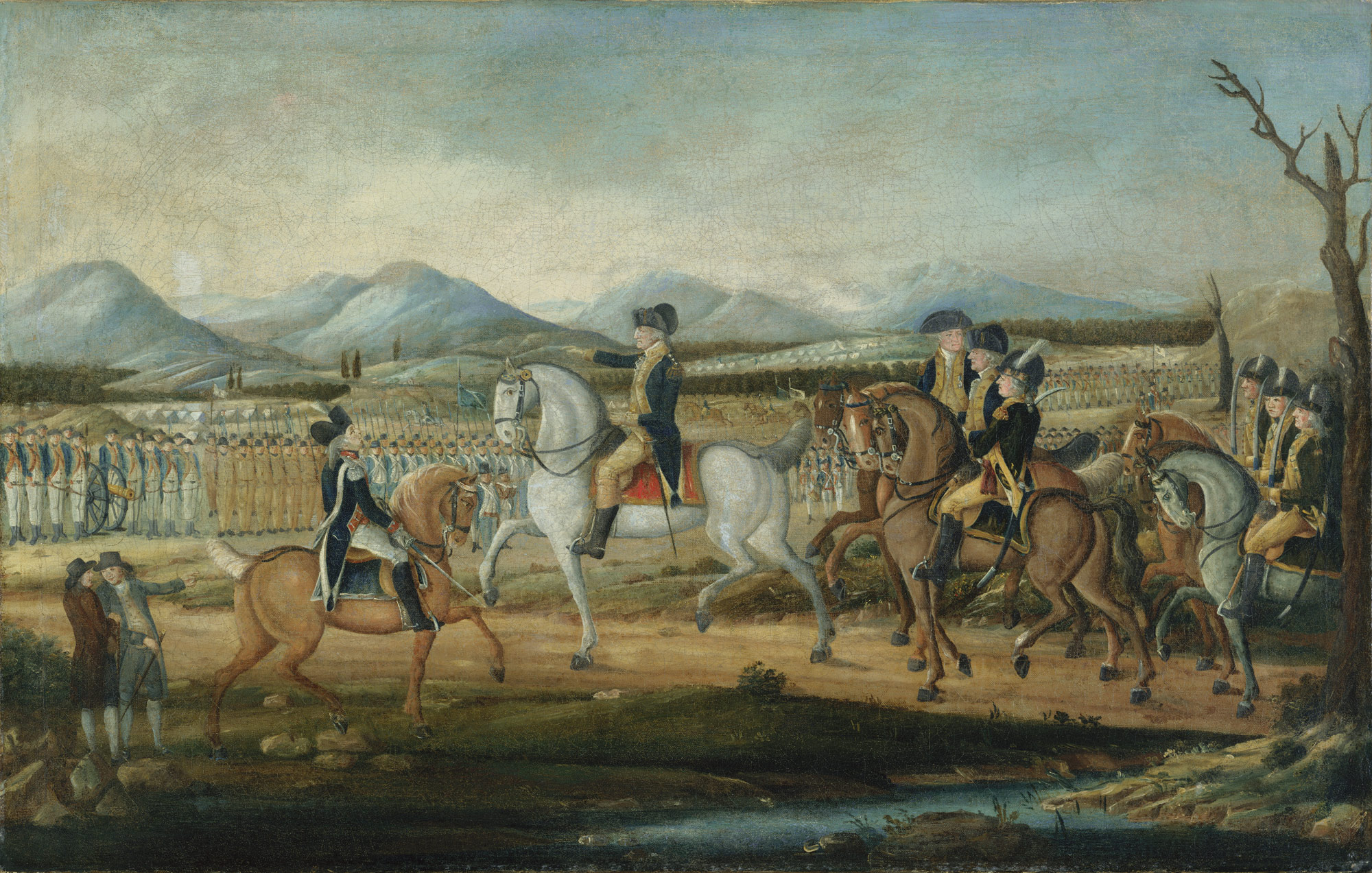
Washington reviewing the troops at Fort Cumberland before departing for western Pennsylvania to quell the Whiskey Rebellion. Attributed to Frederick Kemmelmeyer, 1795.
Roger Griswold beating Matthew Lyon with his cane. Lyon defends himself with fireplace tongs. The print was made in Philadelphia in 1798.
One of the many portraits of George Washington painted by Gilbert Stuart. Washington sat for Stuart twice toward the end of his presidency; giving Stuart the opportunity to paint the president from opposite angles. Deciding this was his good side, Stuart reproduced this angle in most of his portraits.
John Trumbull's portrait of John Adams is less famous than Gilbert Stuart's. But painted in 1793, while Adams was vice-president, Trumbull's better captures how Adams looked during his presidency.
John Trumbull painted more than one portrait of Alexander Hamilton. But this portrait, painted in 1806, two years after Hamilton's death, perhaps best captured Hamilton as he saw himself—intellectually superior, a leader of men, and something of a ladies' man.
This Federalist cartoon caricatures the riff-raff attracted to Thomas Jefferson (standing on the table). To Jefferson's right, holding the paper, is Edmund Genet.
This cartoon captures American outrage over the XYZ Affair. Here, the French agent, his five heads representing the French Directory, demands a bribe from the American delegation.
George Washington's extraordinary place in Americans' hearts is reflected in this engraving made shortly after his death—the Apotheosis of Washington, by David Edwin after Rembrandt Peale, ca.1800.
The deification of Washington persisted well into the nineteenth century as reflected in this painting by an unknown artist.
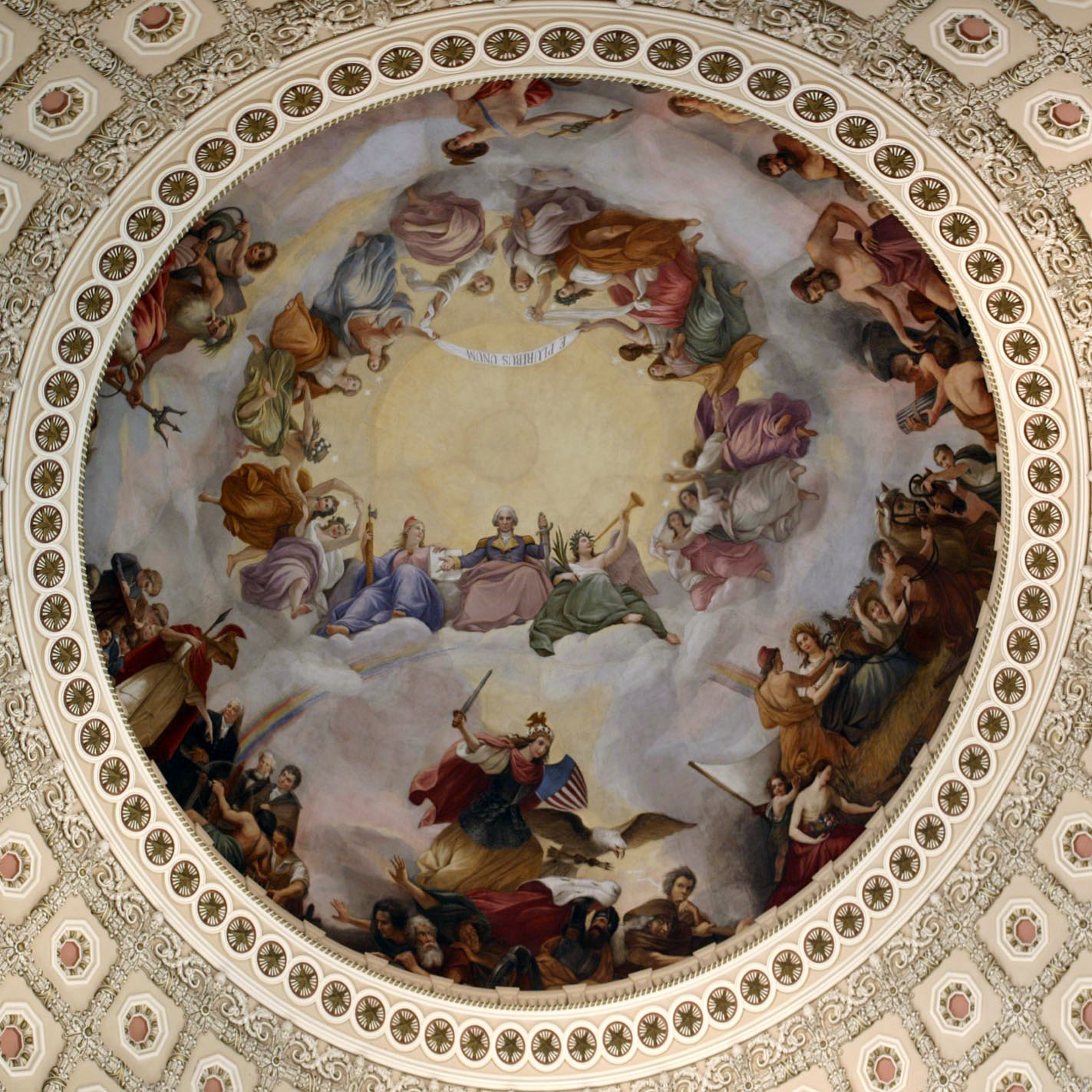
This fresco painted by Constantino Brumidi in 1865 in the Capitol dome, reflects the century's continuing deification of George Washington.