In our section on "Characterization," we mention that Tolkien frequently uses "type of being" to indicate essential aspects of a character's personality. So, the Elves are generally good, while Orcs are always bad. Gandalf is a Wizard, which also makes him wise. But this tool of characterization presents a strange ethical problem to us: is it possible for an Orc to become good? What role does choice play in determining the moral value of a character? If you are an Orc created by Sauron, can you be held ethically responsible for the evil that you do, since you are made that way? Can you even imagine an Orc in Tolkien’s Middle-earth intentionally, selflessly doing good? Race plays a central role in the moral nature of each of these characters, since there are good races (Elves), bad races (Orcs), and ambiguous races (humans). Tolkien’s use of race as a tool for characterization implies that the type of being that you are also determines your spiritual value. And that, it seems to us, gets into really dangerous territory. Where is the room for free will in Middle-earth? What examples do we have of characters who work against their own racial natures, either for good or evil?
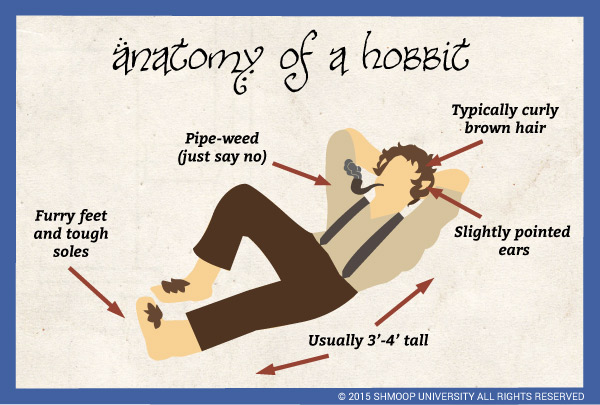
(Click the infographic to download.)
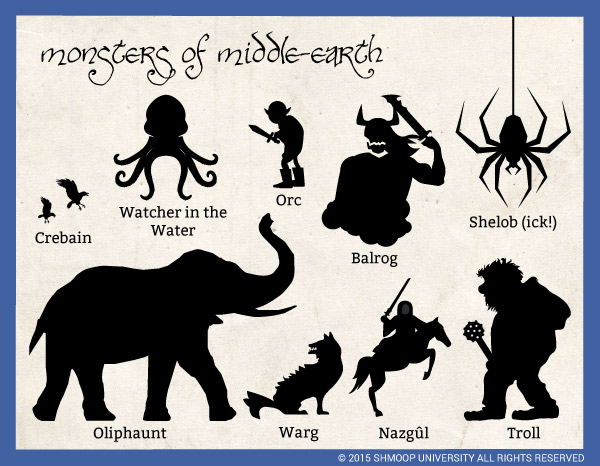
(Click the infographic to download.)
Questions About Race
- Do all of Tolkien's races share the possibility of becoming good or evil? What are some of the ethical problems of attaching moral value to race (even fictional races)?
- What examples do we get in The Fellowship of the Ring of multiple types of beings living and working together? How does Tolkien portray such places? Why are there not more examples? What keeps Elves, Dwarves, Hobbits, and men from cohabiting more often?
- How does Tolkien use language and song to express differences among the races of Middle-earth? Do Hobbit songs sound like Elven songs? What does Tolkien's different invented languages and literatures suggest about Elf, Dwarf, and Hobbit cultures respectively?
Chew on This
Even if it is fictional literature (about mostly non-existent races), Tolkien was wrong to make such sweeping generalizations.
Humans are the morally ambiguous characters in Fellowship of the Ring because Tolkien is human. He couldn't have fairly assigned himself to good or evil.