If
 ,
,
then
 .
.
This rule is often written
 .
.
We say that we're "pulling out'' the constant c from the limit.
Sample Problem
For example,

and
 .
.
Be Careful: This rule is only valid if

is actually defined and equals L for some real number L.
We wouldn't say

because what does it mean to multiply 3 by infinity? That's like saying 3 × undefined, which doesn't make sense.
If ,
is undefined (including if it equals ∞ or -∞), then the limit

is also undefined.
In pictures, if we multiply a function by a constant it means we're stretching or shrinking the function vertically. We can also stretch or shrink the limit.
For example, take the line f(x) = x and see what happens if we multiply it by 3:
As the function gets stretched, so does the limit. If we originally had

then as we stretch the function by a factor of 3, the limit will also be stretched by a factor of 3:

If we shrink the function by  , the limit will shrink by the same factor:
The limit will go from
to
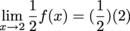
Sometimes we may be asked to find a limit given partial information about a function.
For example if we're given that limx → c f(x) = 4, then no matter what function f is,
limx → c 3·f(x) = 3·limx → c f(x) = 3 · 4 = 12.