Multiplication Property
As long as both  and
and  exist,

In words, the limit of a product is the product of the limits, as long as the limits involved exist.

Here's a few more examples of this:
- Assume

Then
- Assume

Then
- Assume
Then
Sample Problem
Find 
If we try to break this limit into pieces, we find
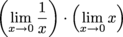
This is trouble, because

What do we find if we multiply ∞ by something (if we could do such a thing, which we can't because ∞ is not a number)? It would make reasonable sense to assume we'd get ∞ again.
What do we get if we multiply a number by 0? We get 0. What if we try to multiply ∞ by 0? That makes no sense at all.
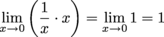
It turns out that in this case we can't find the limit of the product via the product of the limits.
However, we can still find the original limit we were asked about.
Since
Division Property
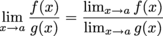
If the limits of f and g exist and
 ,
,
then
Suppose  and
and  Then,
Then,



If  , we can't use the rule we've been using to evaluate something like
 .
.
If we try we find that
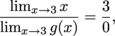
then we're out of luck.
Example 1
If
what is
|
 , and
, and  ,
, ?
?
Example 2
Assume that What is |
 exists,
  , and
, and  .
. ?
? .
. Example 3
Assume that What is |
 exists,
  , and
, and  .
. ?
? exists, so does
  . Then we can say
 .
.Example 4
Assume that What is |
 exists and
  .
. ?
?

 .
. .
.Exercise 1
Find the following limit, assuming that and
and  .
.


Exercise 2
Find the following limit, assuming that and
and  .
.

Exercise 3
Find the following limit, assuming that and
and  .
.

Exercise 4
Find the following limit, assuming that and
and  .
.

Exercise 5
Find the following limit, assuming that and
and  .
.

Exercise 6
Assuming that  and
and  ,find the following limit.


Exercise 7
Assuming that  and
and  , find the following limit.

Exercise 8
Assuming that  and
and  ,find the following limit.

 or 12.25
Exercise 9
Assuming that  and
and  ,find the following limit.

 or 4.6
Exercise 10
Assuming that  and
and  ,find the following limit.


Exercise 11
Find  (we may assume this limit exists), given that
 .
.
Exercise 12
Find  (we may assume this limit exists), given that
 .
.
Exercise 13
Find  (we may assume this limit exists), given that

Exercise 14
Find  (we may assume this limit exists), given that
 .
.
Exercise 15
Find  (we may assume this limit exists), given that
 .
.
