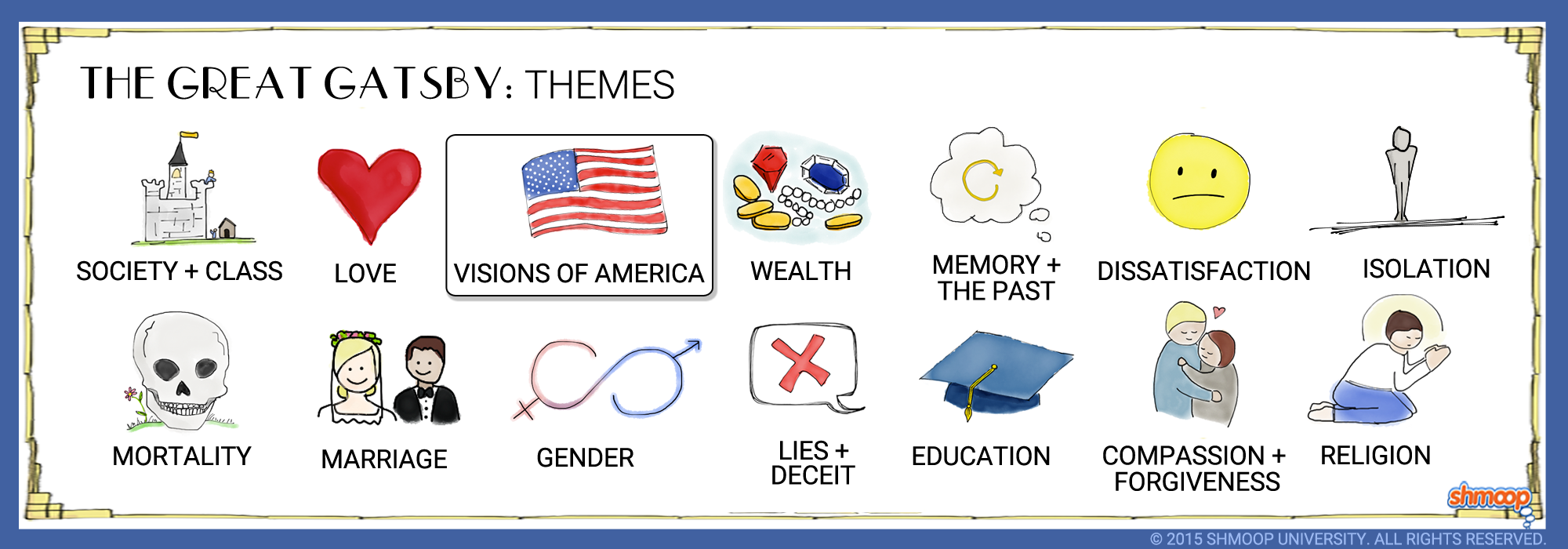
 (Click the themes infographic to download.)
Did the American Dream die in 2008, or did it die in 1918—or did it never really exist at all? In The Great Gatsby, the American Dream is supposed to stand for independence and the ability to make something of one's self with hard work, but it ends up being more about materialism and selfish pursuit of pleasure. No amount of hard work can change where Gatsby came from (the social class he was born in), and old money knows it. Merit and hard work aren't enough, and so the American Dream collapses—just like the ballooning dresses of Jordan and Daisy when Nick first sees them.
Questions About The American Dream
- Does Gatsby achieve the American Dream? If yes, when exactly can he say that he reaches it? If no, what prevents him from truly achieving it?
- Do you agree with Fitzgerald's criticisms of American culture during the Jazz Age? Would you rather be living then, or are you happy in present-day America?
- Would you rather live in East Egg or West Egg? The Northeast or the Midwest? Why?
- Nick leaves the East Coast, jaded by his experiences with Gatsby, the Buchanans, Jordan Baker, etc. Do you think he'll remain cynical even in the Midwest, or will he leave his disgust in New York?
Chew on This
Gatsby's experiences in New York prove that the "American Dream" is impossible to achieve.
By referring to figures like Ben Franklin and Buffalo Bill, Fitzgerald suggests that the entire concept of the American Dream is based on a lie.