- And now for the big money talk: The ghost (who says he is indeed the ghost of Hamlet's father) says he needs revenge, and sooner rather than later, because he's doomed to burn in eternal flames until he gets it.
- (The ghost appears to be suffering in Purgatory, a space where sins were "purged" before a spirit could reach heaven. Check out the "Act I, Scene iv" summary for more on how people viewed ghosts during the Elizabethan period.)
- Luckily, he knows his murderer: surprise! It's Claudius!
- But how? The ghost reveals the details: While he (King at the time) was sleeping in his orchard, Claudius snuck over and poured poison in his ear.
- Hamlet promises to avenge his father's death.
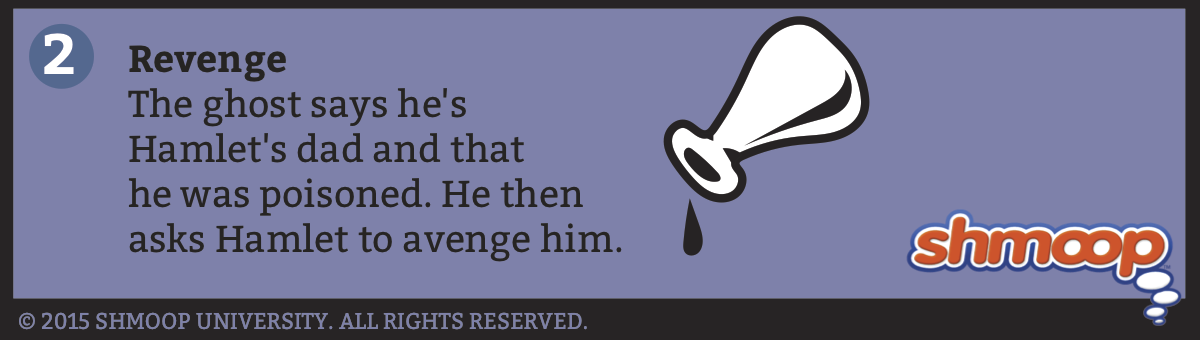 (Click the summary infographic to download.)
- Let's all take a moment to underline this or highlight it or whatever you do. Hamlet promises to avenge his father. He does, no fingers crossed behind his back or anything. Got it? Good.
- The ghost is as happy as a ghost can be, but he warns Hamlet not to do anything to Gertrude, his mother.
- Hamlet comes back and swears his friends to secrecy. He also warns them that he might start behaving strangely, but it's cool: he's just acting on instructions given to him by the ghost of his dead father. Specifically, he says he's going to put on an "antic disposition," which means he's going to pretend to be crazy, like an "antic" (which is the role of a theater clown or a grotesque).
- Also, everyone pinky swears to not tell anyone anything.
- The ghost's disembodied voice adds that they had really better be swearing.
- Yep, he's as creepy in person as he is on paper.