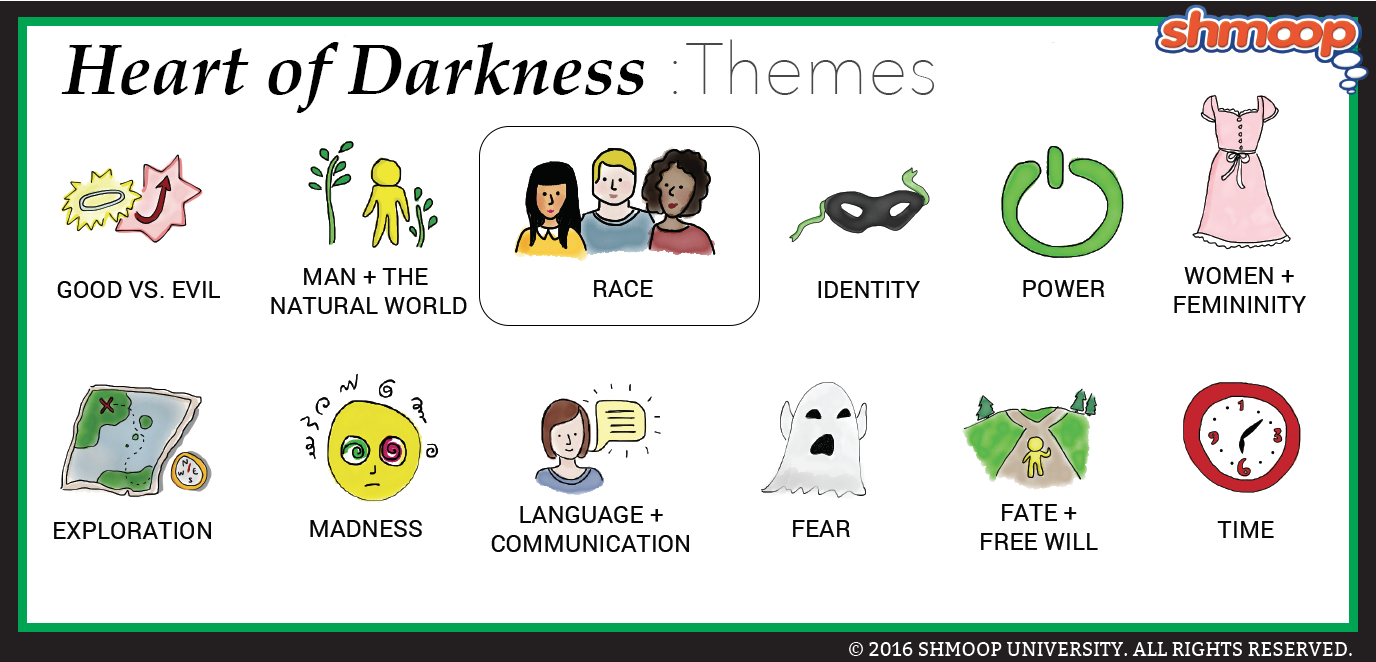
 (Click the themes infographic to download.)
Conrad doesn't exactly want to buy the world a Coke, but he does seem to have some unconventional ideas about race—at least, unconventional for the late nineteenth century. In Heart of Darkness, he seems to be suggesting that there really isn't so much difference between black and white—except that this vision of racial harmony becomes more complicated when you consider that he seems to be suggesting that black people are just less evolved versions of white people. Maybe. We're like 50% sure on that one. As with most issues in Heart of Darkness, the differences between black and white are so confusing as to be almost meaningless. And, in fact, maybe that's just Conrad's point.
Questions About Race
- How are the differences between white and black people depicted in Heart of Darkness? What kinds of activities does each group participate in?
- What does imagery of light and dark seem to have to do with race in Heart of Darkness? What does this say morally about each group of people?
- What kinds of white European expectations does Marlow bring into his journey up the Congo? How are they dispelled? Look specifically at the examples of the accountant, manager, brickmaker, and Kurtz. What is Marlow's attitude towards the native Africans?
- How is Kurtz's attitude towards the black Africans ambiguous? How might he be viewed as the ultimate symbol of imperialism and black subjugation? Alternatively, how might he be read as a symbol of liberation and freedom?
Chew on This
Despite white Europe’s good intentions towards the Africans and their desire to "civilize" the black man, imperialism proves to be a brutal and callous victimization of the native Africans for the sole purpose of maximizing profits.
Despite Kurtz’s brutality, he treats the Africans more civilly and more as equals than the majority of the other white European characters (like the accountant, the manager, and even Marlow). This is why Marlow sees him as the lesser of two evils.