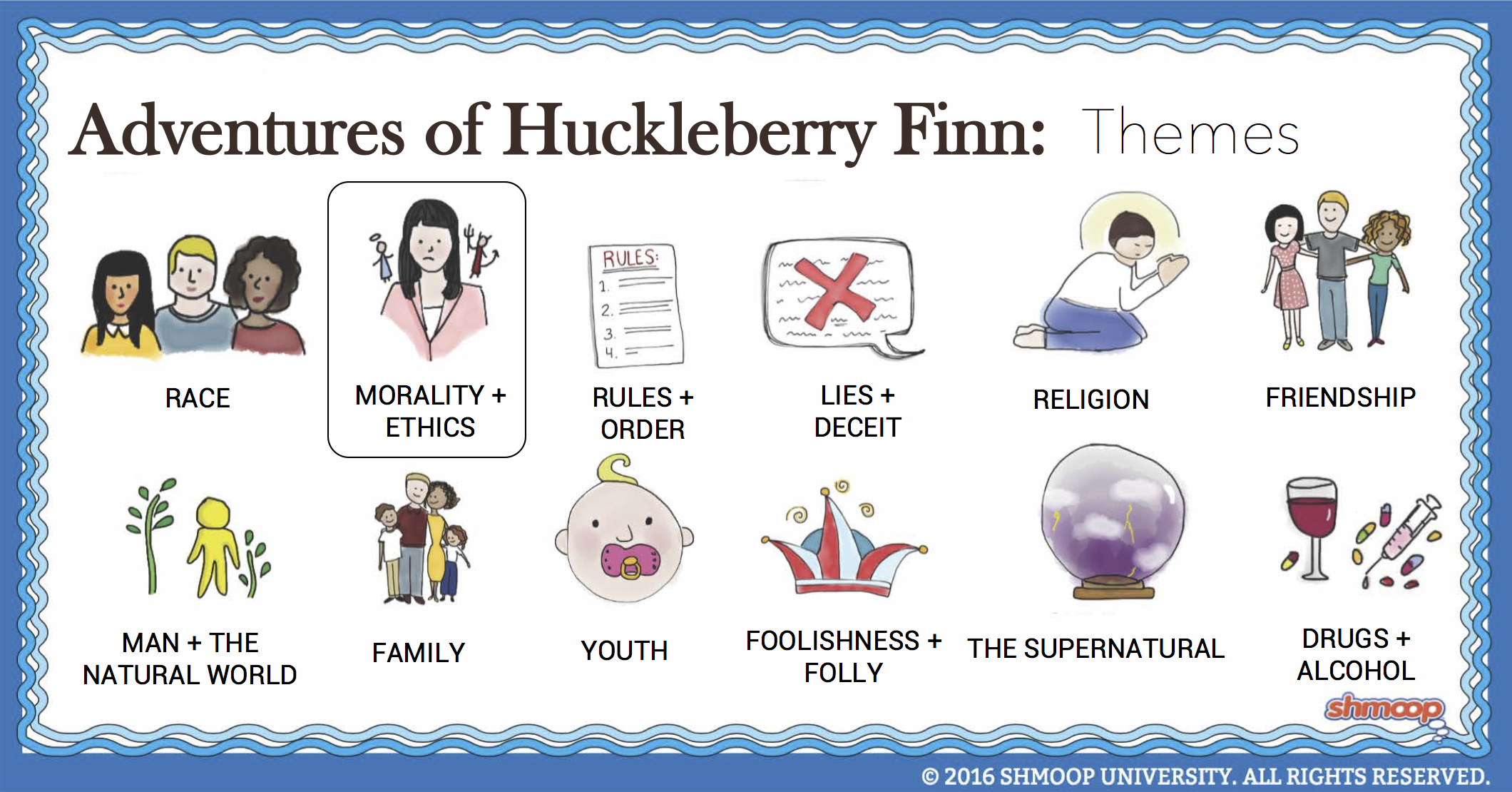
 (Click the themes infographic to download.)
If you're like Shmoop, you run into moral issues everyday. Should I copy my friend's trigonometry homework? Do I need to leave a note for the person whose car bumper I just dinged? Whose $5 bill is this on the ground, and can I keep it? Huck has moral quandaries, too—only his are more along the lines of, "Is it right to steal another person's property, if that property is a person?" Oooh, tricky. (Not.) But Huck figures out the answer. He also figures out that sometimes, society has it all wrong: in Huckleberry Finn, sometimes you just have to follow your heart. (Just don't try telling that to the police officer who pulls you over for speeding.)
Huck Finn Video
Questions About Morality and Ethics
- Huck isn't the only one who has moral crises every now and then. Do these other characters change as a result of their moral crises? Does Huck? How so?
- Does guilt help our hero (that would be Huck) or hinder him?
- What's up with Tom "having principle?" Is "principle" just the same thing as "morality," only with a few more consonants in the word? Or is it something different?
Chew on This
In his struggle to come to terms with society's rules and laws, Huck ends up defining his own (correct) set of moral beliefs.
While plenty of characters struggle through moral dilemmas, Jim is the only truly moral character in the story.