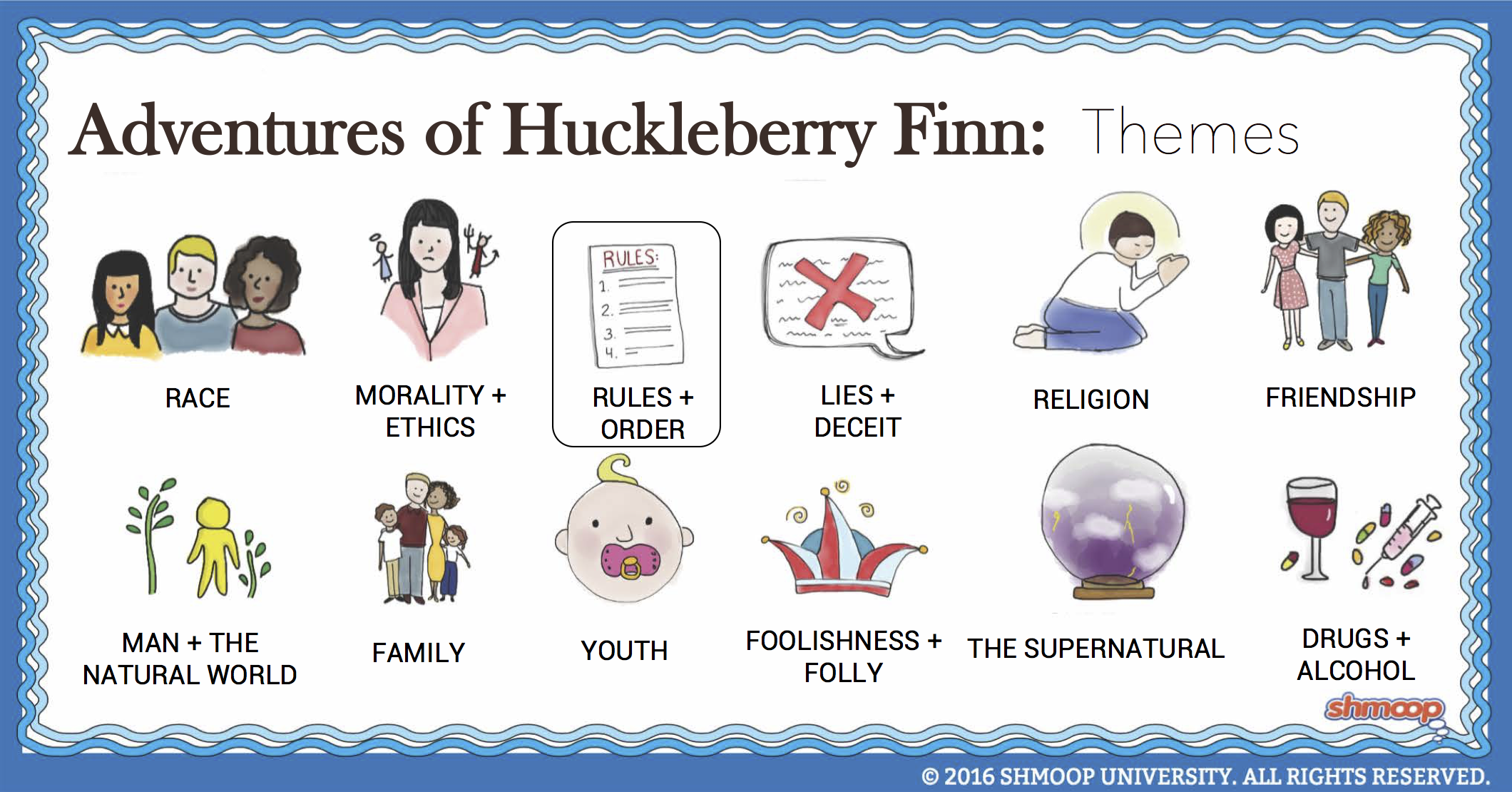
 (Click the themes infographic to download.)
Don't touch that. Don't slouch. Don't put your feet up. Go to church. Go to Sunday School. Just… go to school, period. Huck is surrounded by rules, and they're not all as easy to follow as "sit up straight." From the rules of honor and principle that govern the ridiculous Shepherdson-Grangerford feud to the nonsensical rules of "adventure" that Tom Sawyer picks up from his storybooks, Huckleberry Finn brings multiple conflicting systems of order into conflict to suggest that, just maybe, we shouldn't all blindly follow the rules. It's like that poster hanging in your middle school classroom says: "What's popular is not always right, and what's right is not always popular." We're pretty sure that Huck would agree.
Questions About Rules and Order
- All kinds of people try to convince Huck that their system of rules and order is the right one. What are these systems, exactly, and how are they different?
- Every so often, we run into some good old mobs and lynching. Do these mobs replace the real laws of state? Which norms end up being more powerful? (Check out Sherburn's speech in Chapter 22. He's got a few things to say about mobs.)
- What system of rules is Jim operating under, if any? Is there any logic or order to his superstitions?
Chew on This
Tom's ridiculous rules of adventure seem childish, but they're no more absurd than southern morality in general.
Despite his misgivings, Huck is ultimately unable to define a new system of behavior separate from that of the South.