Improper integrals with badly behaved limits are integrals where one or both of the limits is infinite.
These integrals look like

If only one limit of integration is infinite then the other limit of integration, c, would be a finite constant.
Remember that writing ± ∞ for the limits of integration is a shortcut. These improper integral creatures are really limits.
The integral

really means

Similarly,

To evaluate this type of improper integral, we have to work out the integral inside the limit and then evaluate the limit.
One Badly-Behaved Limit at a Time
When only one of the limits of integration is infinite we can work things out directly. When both limits of integration are infinite we have to split the integral into two pieces first.
Convergence and Divergence
There's some weird stuff going on here. If we take a value of p > 1, the integral

converges. But if we take a value of p < 1, that same integral diverges. And the graphs don't even look that different!
Take, for example, p = 2 and  :
:

One way to explain this is that the graph of  is able to bound a finite area above the x-axis on [1,∞) because it gets close to zero more quickly than the graph of
  .
.
There's another thing going on here we need to point out. Let

Then the function f (x) converges to 0 as x approaches ∞. In symbols,

However, the integral

diverges. It's possible for the function to converge to 0 at ∞, but for an improper integral of the function, with an upper limit of ∞, to diverge.
However, if the function f (x) diverges at ∞, then there's no hope for the integral

to converge. No matter what c is, if f zooms off to ± ∞ or can't make up its mind what to equal as x approaches ∞, then

is going to diverge.
In fact, if

equals anything other than 0, even if the limit converges, then

will diverge. If  then the function and the x-axis will enclose an infinite area on the interval [c, ∞).
With the other type of improper integral, it's possible for a function to diverge while the improper integral converges.
Be Careful: When you talk about the convergence or divergence of something, make sure you say what is doing the converging or diverging. Saying that a function converges and saying that an integral converges are not the same thing.
These ideas of convergence and divergence will come up again when we're talking about sequences and series.
Two Badly-Behaved Limits
So far we've looked at integrals with only one infinite limit. If both limits are infinite, we need to break up the integral somewhere in the middle.

In symbols,

where c is any real number you like (we usually pick something easy like 0 or 1, depending on the function). Since each of the integrals on the right-hand side is really a limit in disguise, this equation says

A sum of limits only exists if both limits involved exist. This is both good news and bad news.
The good news is that if you go to work out

and you find that either

diverges or

diverges, then you're done. The integral

diverges also.
The bad news is that if

does exist, you have to work out both of the limits

and
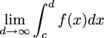
and then add them up. This comes with its own good news, though. You'll already have found the antiderivative for f (x) after the first limit, so the second limit won't be as much work.
Example 1
Determine whether
converges or diverges, and find its value if it converges. |


 approaches 0. So


Example 2
Determine if
converges or diverges. Find its value if it converges. |


 approaches 0, so we have
 is even, so this answer makes sense. We're saying the area between
  and the x-axis on (-∞,-1) is the same as the area between
  and the x-axis on (1,∞).
Example 3
Determine if
converges or diverges. If the integral converges, find its value. |


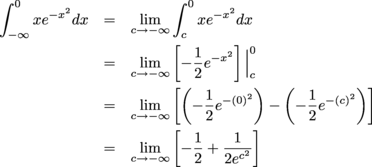
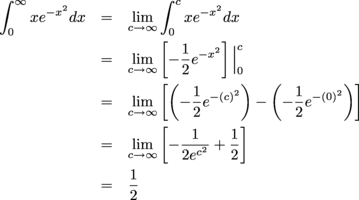
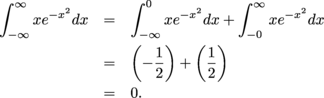
Example 4
Determine if
converges or diverges. Find its value if it converges. |




Exercise 1
Determine whether the integral converges or diverges. If the integral converges, find its value.


Exercise 2
Determine whether the integral converges or diverges. If the integral converges, find its value.


 .
. Exercise 3
Determine whether the integral converges or diverges. If the integral converges, find its value.


Exercise 4
Determine whether the integral converges or diverges. If the integral converges, find its value.
 for p > 1


Exercise 5
Determine whether the integral converges or diverges. If the integral converges, find its value.
 for p < 1


Exercise 6
Determine if the statement is true or false. Explain your answer.
If  converges to some finite number L, then

must converge.
Exercise 7
Determine if the statement is true or false. Explain your answer.
If diverges, then

must diverge also.
Exercise 8
Determine if the statement is true or false. Explain your answer.
If  then
then

must converge.
 Then
Then  , but
, but 
Exercise 9
Determine if the statement is true or false. Explain your answer.
If  then
then

must diverge.
Exercise 10
Determine whether the integral converges or diverges. If the integral converges, find its value.


Exercise 11
Determine whether the integral converges or diverges. Indicate on a graph the region whose weighted area is given by the integral. If the integral converges, find its value.


 :
:


 and the x-axis all lies on top of the x-axis.