You can think of integration by parts as a way to undo the product rule. While integration by substitution lets us find antiderivatives of functions that came from the chain rule, integration by parts lets us find antiderivatives of functions that came from the product rule.
Integration by parts requires learning and applying the integration-by-parts formula. Here's the formula, written in both Leibniz and Lagrange notation:


Why the Formula is True
It's time to be skeptical. Why should

be true? Just because we wrote down an equation doesn't mean it's valid.
Sample Problem
- What should be the derivative of
with respect to x?
- What should be the derivative of
with respect to x?
- What's the derivative of uv?
Answer.
is the family of all functions whose derivative is uv'. If we take the derivative of any function in that family, we get uv'. So it makes sense for the derivative of
to also be uv'. In symbols,

is the collection of all functions whose derivative is vu'. If we take the derivative of any one of those functions, we get vu', so the derivative of
should also be vu'. In symbols,

- This is a straightforward application of the product rule. The derivative of uv is
uv' + u'v.
Let's return to the question of why the equation

should be valid. Each side of this equation describes a family of functions. If each side of the equation describes the same family of functions, then the equation is valid.

describes the family of functions with derivative uv'.
The expression

describes the family of functions with derivative


Since uv' and vu' are the same, when we simplify we get
u'v + uv' – vu' = u'v.
This means the expression

also describes the family of functions with derivative u'v.
Since the expressions

and

describe the same family of functions, the equation

is valid.
How to Use the Formula
Hopefully, you're now convinced that

To use this formula we have to
- pick u and v',
- figure out what u ' and v are, and
- stick everything in the formula and simplify.
If we're using the notation

then we pick u and dv, figure out du and v, then apply the formula.
Practice:
Use integration by parts to find . | |
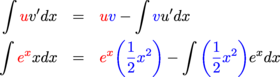
We'll do this example twice, once with each sort of notation. Using prime notation, take u = x v' = ex Then u' = 1 and v = ex. We plug all this stuff into the formula: 
Since the integral of ex is ex + C, we have 
We write + C instead of – C since either way we're describing the same family of functions. Using fraction notation, take u = x dv = exdx Then du = dx and v = ex. We plug all this stuff into the formula: 
Since the integral of ex is ex + C, we have 
Much to everyone's dismay, there's no set of absolute rules for determining which function should be u. There are some guidelines, though. The whole point of integration by parts is that if you don't know how to integrate ,
you can apply the integration-by-parts formula to get the expression 
and hopefully this second integral will be easier to integrate than the original integral. If you pick u and v' incorrectly the first time, you'll probably realize it soon. Sample ProblemIf we try to integrate 
by parts, and we choose u = ex v' = x then 
Putting everything into the formula, we get 
The new integral is 
which is worse than the original. This means we didn't pick u correctly! Thankfully, if we chose poorly the first time, all it means is we have to start over. When picking u and v', keep these guidelines in mind: - u ' should be simpler than u (or at least not worse!)
- v should be simpler than v' (or at least not worse!)
- You need to be able to find v from v'
- The new integral should be easier to integrate than the original integral.
| |
Use integration by parts to find

Answer
Answer. We want to choose u so that u' is simpler than u. This is probably a good choice:
u = x
v' = sin x
Now u' = 1 is simpler than u and v = (-cos x) isn't any worse than v'.
We apply the formula:

Simplifying the right-hand side and evaluating the new integral gives us

We could also write this as

It's possible that after applying the formula for integration by parts, you'll need to use integration by parts again in order to figure out the new integral. If that happens, be very careful with signs and coefficients. We recommend you work out the new integral by itself, then wrap up your expression for the new integral in parentheses before putting it back into the formula.
Use integration by parts (twice) to find

Answer
Take

so that u' is simpler than u and v isn't any worse than v':
u' = x
v = sin x
Sticking everything in the formula, we get

Using integration by parts again, we find that

Wrap this up in parentheses, and put it back in the integration by parts formula where we left off:

We don't care about including the + C in the parentheses, since it doesn't matter if we end up with + C or – C.

If we hadn't done that, it would have been very easy to write

which is not the correct answer (the term x cos x has the wrong sign). This is the step we're talking about when we say "be careful with your signs and coefficients" and "wrap the expression for the new integral in parentheses before putting it back in the formula."
Use integration by parts to find

Hint
You will need to use integration by parts twice!
Answer
We want u' to be simpler than u, so choose
u = x2
v' = sin x
Then
u' = 2x
v = -cos x
We use the formula for integration by parts:

Now we need to go figure out

This requires integration by parts again.
Take
u = x
v' = cos x
Then
u' = 1
v = sin x
Applying the integration by parts formula,

Now that we know

we can go pick up where we left off. We don't bother including the + C in the parentheses, since having + C instead of + 2C doesn't change the final answer.