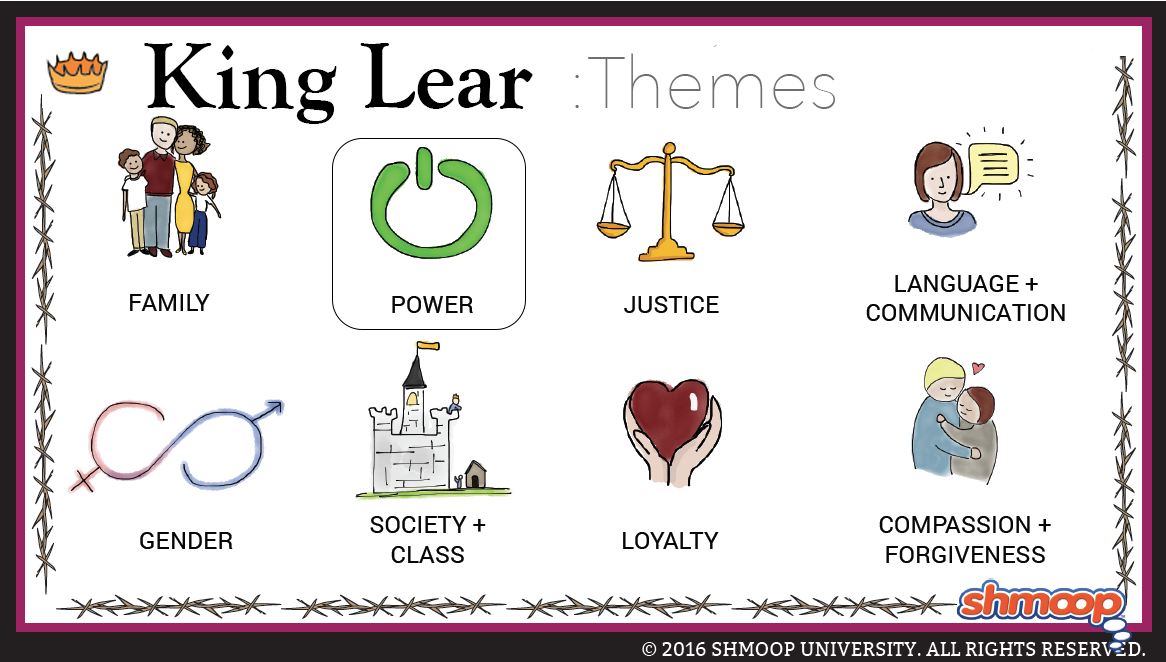
 (Click the themes infographic to download.)
Um, more like loss of power. Poor Lear really loses it all: his family, his mind... and his power.
After retiring and divvying up his kingdom among his ungrateful daughters, Lear discovers what it's like to lose the power and authority that come with the responsibilities of active rule. In addition to being a monarch, King Lear is also a family patriarch and Shakespeare asks us to consider the similarities between a father's relationship with his children and a king's relationship with his subjects.
Questions About Power
- Why does Lear want to divvy up his kingdom among his children? What happens as a result?
- Does King Lear have any power or authority left when he gives up his crown?
- Discuss why King Lear keeps a retinue of a hundred rowdy knights? Why do you think Goneril and Regan object to this?
- Who is left to govern the kingdom at the end of the play? Does anybody want the job? Why or why not?
Chew on This
Although King Lear sets out to avoid family and political conflict, his decision to retire and divide his kingdom results in a major family conflict as well as a full-blown national crisis.
Without the title of "king," Lear's authority means ultimately nothing—Shakespeare's play, then, suggests that a monarch's power is completely arbitrary.