Lord of the Flies
Lord of the Flies
by William Golding

Lord of the Flies Setting

Where It All Goes Down

An Uninhabited Island in the Pacific Ocean

Lord of the Flies takes place on an uninhabited island in the Pacific Ocean, at an unknown year during a fictional atomic war. Other than the war, there’s nothing “futuristic” about the story. Basically, we can assume the year is roughly around the time Golding is writing, in some sort of parallel universe where everything is the same except for this big war.

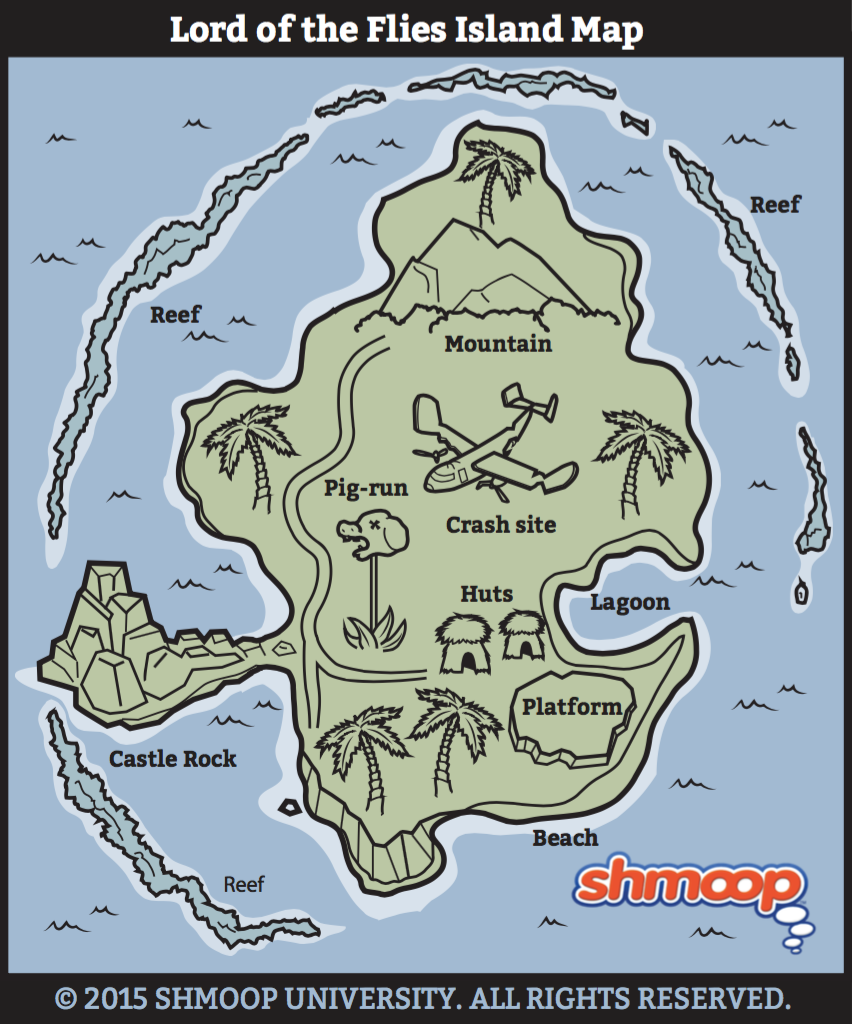
This is one of those books where the setting is absolutely vital to the story. The whole point is that the boys are stranded on an island, alone, with no civilization and no adults and so forth. Since this is rather obvious, it’s more interesting to look at the specific parts of the setting. Golding went to huge lengths to include an enormous amount of detail about the island. He makes sure we know where every action is taking place, and he points out little parts of the scenery early on that will later be hugely important. Almost as important as the actual geography of the island is the manner in which the boys (and the reader) discover it. We don’t find out much about the scenery until the boys do, and as such, we experience the same thrill of exploration and the same satisfaction of discovery. Let’s take a look.

All we know when we start is that the boys have crash-landed into “the jungle” and Ralph is heading toward “the lagoon.” The shore of the lagoon is lined with palm trees, which sounds all pool cabana and pink-umbrella drinks. Don’t be fooled by this false sense of security – there’s a lot more to the island than relaxing waterside views. Ralph looks out over the lagoon towards a “coral reef” and beyond that, the “dark blue” of the “open sea.” Behind him is the “darkness of the forest proper.” So far, then, we have a dark scary forest (DANGER), a bright “shimmering” lagoon (EXCITEMENT), and a wide open sea (ISOLATION). The setting is already channeling the emotion the boys and we feel.

Ralph goes on to examine the “pool” of the lagoon, which is far deeper than Ralph expected from “beach pool[s]” he has seen before. In other words, no fooling around, here; this is the real deal, as is their entire situation on the island. Speaking of islands, Ralph doesn’t know it’s an island. He says he climbs a rock and thinks it is an island, but again we get the sense that he’s unsure, wary, and, if he remains true to twelve-year-old boy form, will be eager to explore.

Which brings us to the exploration. When Ralph, Jack, and Simon get around to looking about, they head to the closest end of the island, only to find they can’t see around the corner because there isn’t one; rather, it’s a gradual curve. They endeavor to climb the mountain, using a series of “pink rocks” that wind through “the looped fantasy of the forest creepers” and thinking that animals, not people, made this quasi-path. They come to an opening, and now that they are high above the rest of the island, excitedly push a rock that falls through the air and “smash[es] a deep hole in the canopy of the forest.”

Finally, after all that, the boys get to the top and look at the whole island. It’s boat-shaped, they see, and on the far side is “another island; a rock, almost detached, standing like a fort, facing them.” This is the Castle Rock we’ll see later, so take note and hold your horses. The boys see that a reef encloses one side of the island, about a mile away from and parallel to “their beach.” Notice how they have started taking possession of the island? We also see that the boys are protected – sort of. There’s a reef on one side, sure, but the other side is open to the sea, which is no big deal for the time being, but, as Ralph will later inform us, is actually scary as hell. Meanwhile, the boys down below look like “insects” as they stand on the “platform” that juts into the lagoon.

Basically, what we’re seeing here is that the boys have taken advantage of the naturally occurring structures on the island (reefs, mountains, platforms) and imposed their own system on it. The mountain gets used for fire, the platform for meeting, the lagoon for swimming, and the beaches for building huts. On the other side of the mountain is “a platform of forest,” which Ralph uses to build the fire – the fire that eventually spreads destructively. So the boys have moved from working in harmony with the island to accidentally kind of BURNING IT UP.

Speaking of things that get destroyed, let’s talk about Simon and his pre-death mediation spot. He finds his little enclave in Chapter Three as he follows the same path that Ralph and Jack earlier did. We’d like to take this moment to point out, entirely in an aside, that during his discovery, Simon is likened to other boys. He looks over his shoulder “as Jack had done” and he appears “furtive,” the same word used to describe Roger in Chapter One. Through his exploration, we realize Simon is like the other boys; his death isn’t just the death of a meditating guru (which is sad), but also the death of a very young boy (which is very sad). Asides aside, Simon’s little spot is a huge part of the setting in Lord of the Flies. With its “honey-colored sunlight” and “green candle-light buds,” this spot is holy and pure, a place entirely distinct from the rest of the island.

Another interesting spot in the little “circular hollow in the side of the mountain” filled with “butterflies” and “blue flowers.” This is where the dead parachuting man lands, before he is slowly dragged up the side of the mountain by the wind. Creepy, isn’t it? This is an intensely visual scene, where we see the natural and exotic beauty of blue flowers contrasted with the unnatural figure of a dead man wrapped in parachuting strings, dead because of an unnatural act like war. This is how the setting of a novel, through little intricacies and details, can comment on larger themes.

The last part of the setting to mention is Castle Rock, the detached pile of rocks that lies just off one end of the island. The boys assume the beast must be here, ironic considering this is where Piggy meets his death. If the beast is the darkness of man, and this dark act is committed by man at Castle Rock, then, yes, in some ways, this is where the Beast ends up residing. As Ralph and Jack approach, the narration points out “an impenetrable tangle of creepers and trees,” which is where Ralph later hides as he hunted and eventually smoked out. Most importantly, Castle Rock is a “pink bastion,” 100 feet high and a prime location for pushing rocks onto portly fellows. Even here, Golding cleverly says that the rocks up there “seem to totter.”

Jack uses setting to make a point, too, as he moves his new tribe to a space “near the end of the island” on the beach and claim that they “shan’t dream so much down here.” While Ralph and his “civilized” bunch is hanging on the protected, coral reef side of the island, Jack has chosen the beach on the side of the open water, a place of, according to Ralph, “brute obtuseness,” “hard, clipped blue” and “the ceaseless, bulging passage of the deep sea waves.” Fittingly, this more savage, brutal area is where Simon is killed, his “blood staining the sand.”

So there you have it. Setting is hugely important. Whatever you’re writing about, you can probably use the setting as a whole (the fact that they’re stuck on an island), or some piece of the setting (a specific place like Castle Rock or the Mountain) in order to make your point. We sure did.

Next Page: Narrator Point of View
Previous Page: Symbolism, Imagery, Allegory