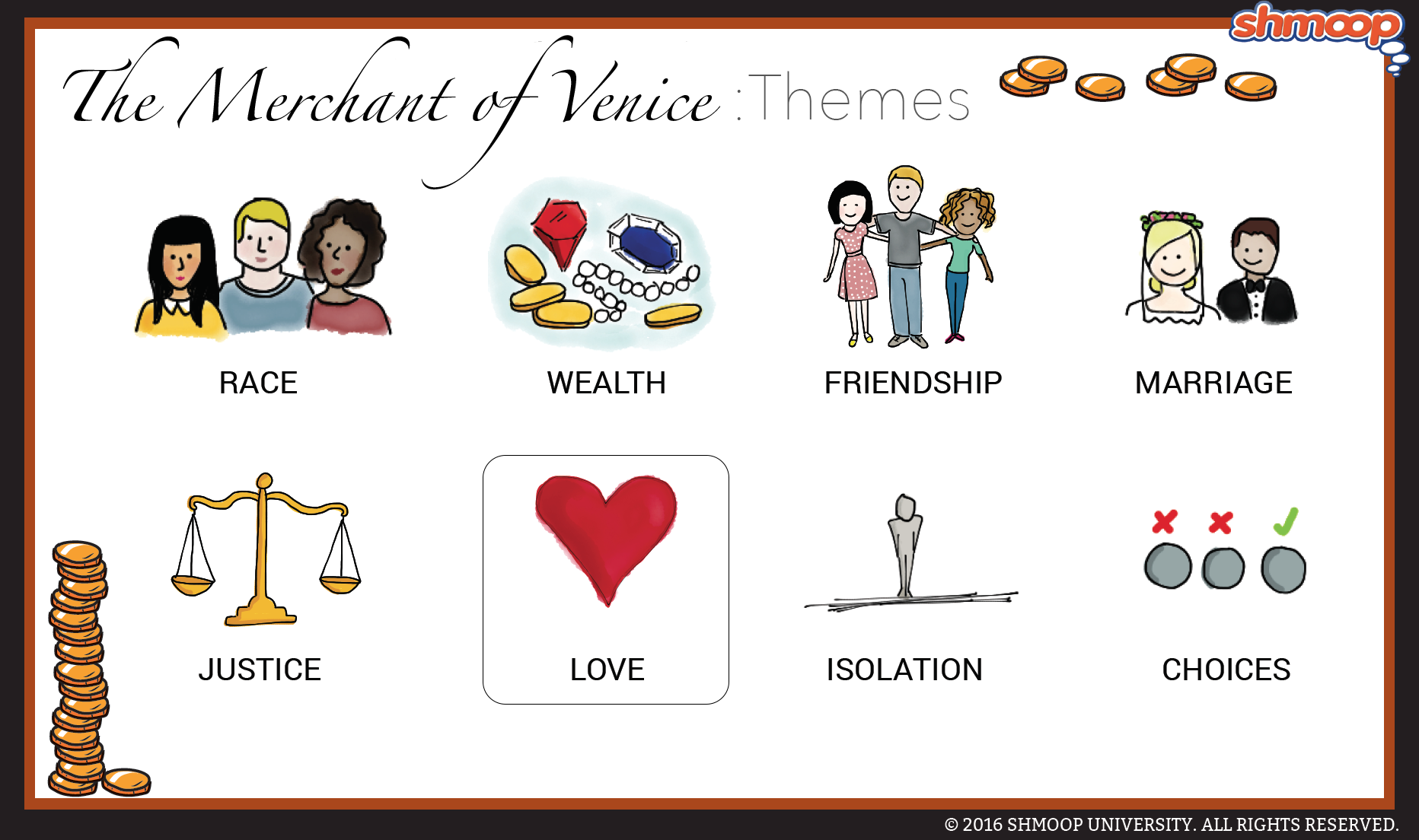
 (Click the themes infographic to download.)
Love in The Merchant of Venice is not quite all you need. Sure, there's love between family members, between friends, and, of course, between lovers. But love is more notable for its absence than its presence in the play. The Beatles would be less than pleased.
Love often goes hand in hand with betrayal. Bassanio says he "loves" Portia... but he courts her for her money. At times, the same seems true of Lorenzo's interest in Jessica. Women seem happy to give love, but they do so with a bit of cynicism. Antonio clearly loves Bassanio (whether romantically or not), but he ultimately must subordinate this love to Portia's more formal marriage with him. Love is regulated, sacrificed, betrayed, and generally built on rocky foundations in the play.
Questions About Love
- What kinds of love are there in the play? Is any love held up as more valuable or enduring than another? Are all types of love presented as equally realistic?
- What exactly is the nature of the love between Bassanio and Antonio? Is it shared, equal, or completely misunderstood? Do both men feel the same way about each other?
- Does Antonio really see his love in competition with Portia's love for Bassanio? In the end, when he wagers his soul as a guarantee of Bassanio's faithfulness to Portia, is he giving anything up?
Chew on This
Portia does not love Bassanio. We know, based on her of citing the Hercules myth, that Portia knows he is using her to get to her money. Because she's a practical woman, she's convinced herself to care for him anyway. She's making the best of a bad situation, which is why she's willing and interested in asserting her power over him at the end of the play.
Even though he is too gruff to express it, Shylock truly loves his daughter Jessica. When she deserts him, leaving him entirely alone in the world, he is transformed from a mildly grumpy man into an actively malicious one.