Where It All Goes Down
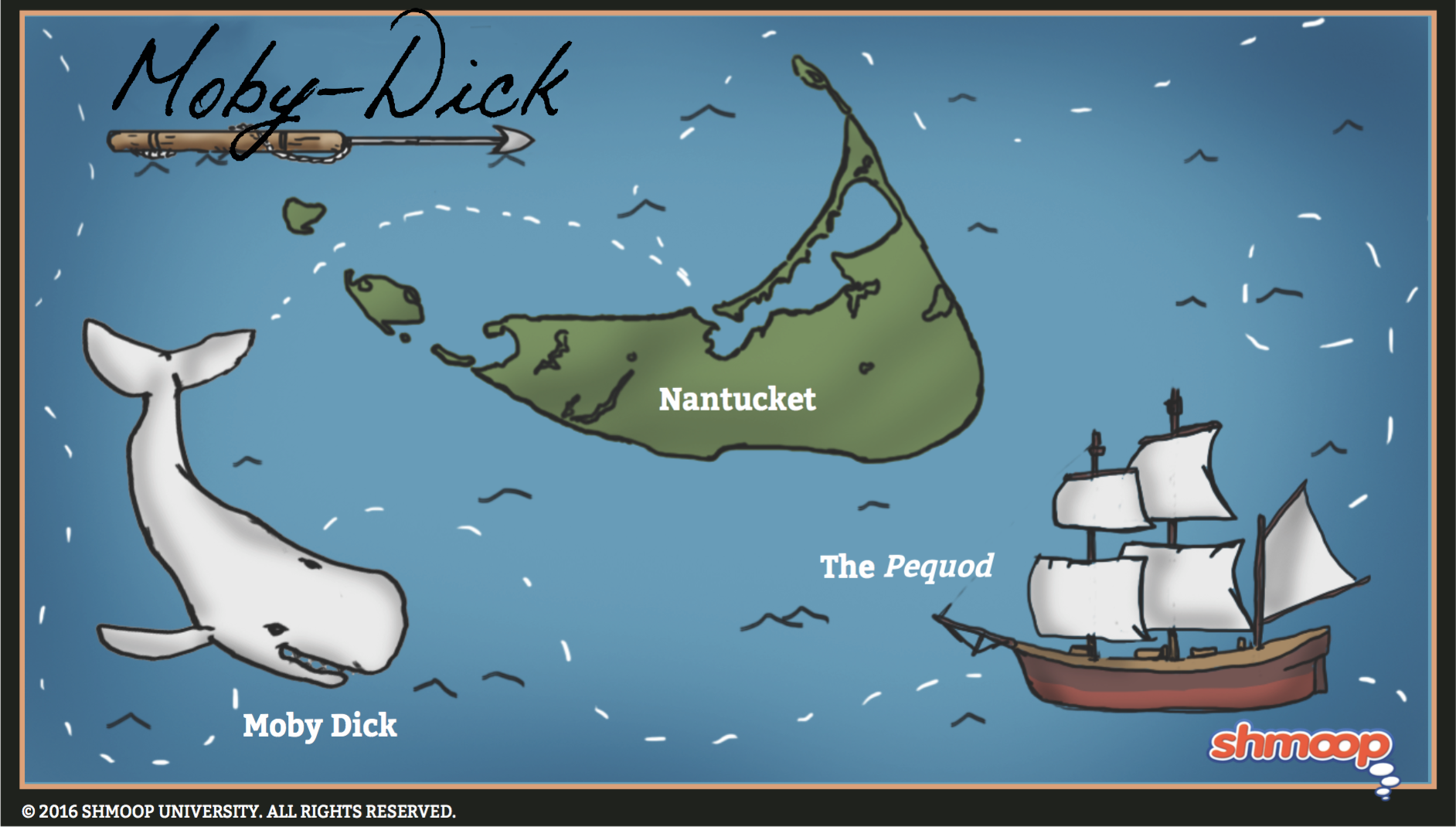 (Click the map infographic to download.)
Nineteenth-Century America: Nantucket And The New England Coast; The Open Sea And The Pequod
This novel exists on an epic scale. How epic? Oh, epic enough that it takes you literally around the globe.
When Ishmael decides to take a whaling voyage, one of his reasons is that he wants to see the world. You might be under the impression that, as a reader, you’ll get to see the world with him, experiencing a lavish array of sights, sounds, and settings. After all, the Pequod sails most of the way around the world, through three different oceans, and meets ships from all sorts of other countries.
Well, we’re sorry to disappoint you, but, like Captain Peleg, we have to ask what you see when you look over the bow of the Pequod. Here’s what Ishmael saw: "nothing but water; considerable horizon though, and there’s a squall coming up" (16.37).
That’s the only world you’re going to see in this novel, a world of water that you could pretty much see standing in one place on the dock in Nantucket. But this unchanging expanse of ocean gives the novel a convenient everything-and-nothing feel: like the ship, the novel ranges across a wide variety of settings, and yet it seems like it’s always pretty much in the same place.
Our comments on the setting of Moby-Dick wouldn’t be complete without a few words on nineteenth-century American culture. The Pequod may seem pretty separate from any real land or country, but over the course of the novel we gradually learn just how strongly it holds to its American-ness, both in its whaling customs and its attitude toward other ships.
Plus, the complex social makeup of the Pequod makes it feel more like a metaphorical, miniaturized version of a nation than a simple whaling ship. So it’s reasonable to assume that Melville is suggesting the ship can represent all of the United States. If so, we need to consider the ways in which contemporary political and social issues are being subtly represented in the novel—especially issues of race and slavery, since the nation is on the brink of the Civil War.