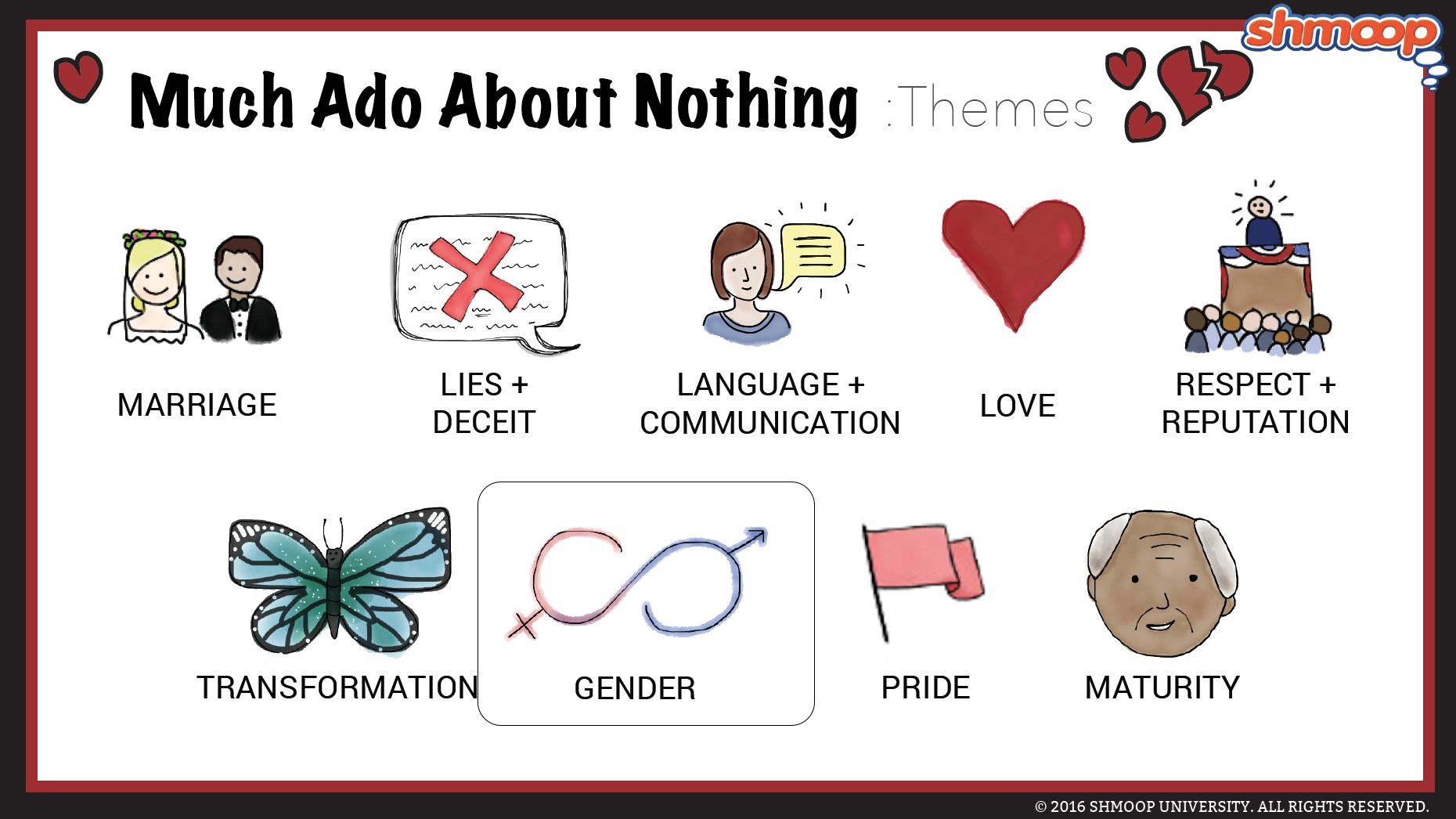
 (Click the themes infographic to download.)
Gender (always a loaded theme) is super-loaded in Much Ado About Nothing.A bunch of characters are subject to limitations and expectations because of their gender: Hero willingly submits to her father as his daughter, but she’s equally willing to submit to her husband as his wife.
Still, more than in many of Shakespeare’s other plays, gender is often used as a cover or excuse. Benedick and Beatrice claim to be looking for impossible idealized forms of the other sex; but in reality, they’re likely just afraid of admitting they’re in love. In addition, both genders have the same expectations about each other in love—the men joke about being cuckolded (as if they expect women to be unfaithful) and the women are told they must put up with men’s deception too.
In a play where a woman (Beatrice) is arguably the most interesting and strong character, gender limitations aren’t as central as the expectations each gender has of the other.
Questions About Gender
- Are either Hero or Beatrice held up as the ideal form of a women in the play? Do we have any sense of what an ideal woman is like in the world of this play? (Perhaps from Benedick’s speech or Claudio’s reactions to Hero?) Are the female characters in the play idealized, or realistic?
- Let’s play Freud for a little while. Does Beatrice have penis-envy (meaning, wish she were a man)? Is that potentially the root of all of her male-bashing? Is there any evidence that she’s cued in to the inequality that exists between men and women, and resents it?
- When Beatrice talks about how "manhood as melted into curtsies" (4.1.315), is she guilty of idealizing men? Does her wish for men to be both gentlemanly and full of brute force seem unfair? If she does have ideal notions of what a man should be, why does she refuse live up to men’s ideal notions of what a woman should be? (Or does she?)
- Is there a double standard for the two sexes in the play? Are the ailments of the play (suspicion, pride, etc.) gendered, or are they equally distributed among all the characters, regardless of gender? Do any characters seem to be a certain way because of their gender, or is it more their natural temperament that defines who they are?
Chew on This
Beatrice knows the restrictions that should limit her as a woman, but she initially escapes them by not being a wife. She hesitates to marry Benedick at the end because she knows she will have to fall into the subservient role of a wife.
In this play, men and women alike are subject to foibles, not because of their gender, but because they are human. Men and women are not treated differently in the play at all—they’re all equally ordinary (and subject to ordinary human failings).