- Odysseus' crew lands next on the island of Aiolia, ruled by Aiolos, the god of the winds.
- Aiolos welcomes the Ithakans and listens to their tale of the Trojan War. They stay at his home for a month.
- When they leave, the gracious Aiolos gives Odysseus a bag of storm winds. (Neat!) The idea is that only the west wind is left free to blow the Ithakans straight back home.
- Odysseus doesn't tell his men what's in the bag, and just takes care of steering the ship by himself for nine days.
- Then, predictably, he falls asleep, exhausted. His men see Ithaka on the horizon, but before waking their master decide to check out what's in the sack; they think it may be treasure of some sort.
- This is a phenomenally bad idea.
- The moment they open the sack all the storm winds rage out and blow the ship backwards, undoing all their nine days of sailing.
- Odysseus despairs, even though he really only has himself to blame. He even thinks to kill himself, which would be extremely suspenseful if he weren't the one telling this story.
- So instead of suicide, Odysseus rows all the way back to Aiolia and begs for more help.
- Aiolos now realizes that the gods have cursed Odysseus, because there's no other way he could've messed that one up.
- The god refuses to help him.
- So the Ithakans row for six more days and again see land—Lamos, this time, the land of the Laistrygones, who are something between ogres and giants.
- When the men land, the king, Antiphates, greets them by falling on the first man and drinking his blood. And that, understandably, is the end of their stay on Lamos.
- They sail again until they reach the island of Aiaia, home of the goddess Circe.
- Odysseus scouts around and sees a plume of smoke rising inland. Made cautious by his last few adventures, he decides not to explore it alone.
- Instead, after killing a big stag for dinner, he sends 22 men—including his friend Eurylochos—to explore the hall.
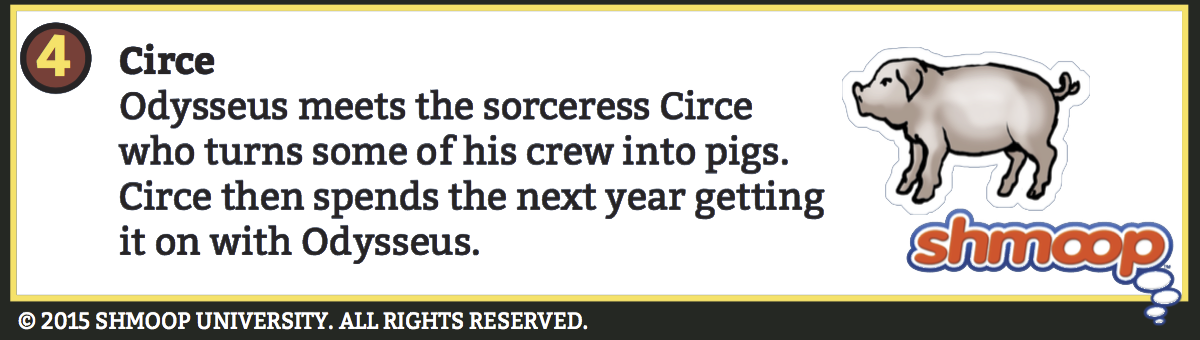
- The witch Circe greets them and invites them in. She's so hot that everyone goes immediately, except for cautious Eurylochos.
- He watches in secret as the men eat—and turn into pigs, which Circe drives into a pigsty.
- Well, that's what you get for leering at a goddess, right ladies?
- Eurylochos runs back to the ship to warn Odysseus, who arms up to rescue his men. Eurylochos begs him not to go back, and in fact stays behind himself once the men set out with their master.
- On the way, Odysseus is visited by the god Hermes who gives him advice and a magical herb called moly.
- Odysseus is supposed to eat it to keep from turning into an animal at Circe's table and then draw his sword when the witch tries to drive him into a cage. When she breaks down, he has to agree to have sex with her if she vows not to use magic against him.
- Gee, sounds like a fair trade to us.
- Odysseus follows all the instructions.
 (Click the summary infographic to download.)
- All of them.
- Afterwards, Circe restores Odysseus' companions to him by turning them back to human form.
- Then the witch, who is apparently a nice person now, invites the whole crew to stay with her and rest, which they do. For a year. (!)
- Finally, one of Odysseus' men asks if perchance they could consider the possibility of potentially, perhaps, maybe going home.
- So Odysseus approaches Circe to help them get to Ithaka.
- She prophecies that he cannot go home until he visits the land of the dead to see the prophet Teiresias, who has further instructions for him. She gives him directions to get to the Underworld (which you could reach by ship back then, apparently).
- Meanwhile, Elpenor—one of Odysseus' crew members—wanders to the rooftop to get some fresh air and spends the night up there.
- In the morning, Elpenor wakes up and falls off the roof to his death.
- Sadly, nobody notices because they're all despairing over the news of going to the Underworld and also they're busy preparing the ship.
- They find that Circe has disappeared for good, leaving behind only a black ewe and ram as sacrifice required to enter the Underworld.
- It's like a highway toll, but bloodier and less portable.