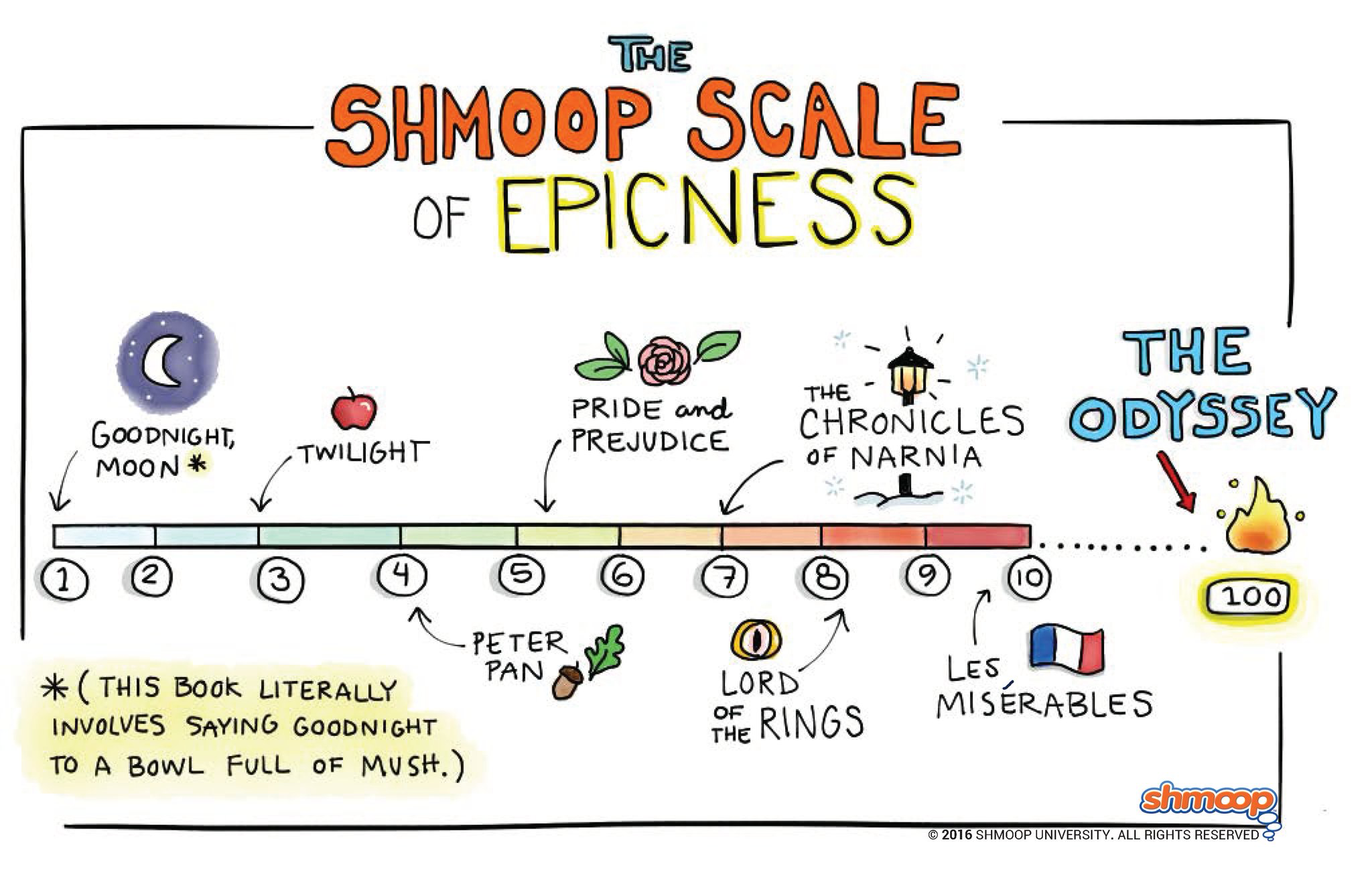
 (Click the infographic to download.)
Epic Poetry; Folklore, Legend, and Mythology; Quest
Along with Homer's Iliad, The Odyssey is one of ancient Greece's two great epics. (Actually, they sort of defined what an epic was in the first place.) Both poems feature a larger than life hero, deeds of great valor, and the gods' interference in human affairs. And both poems use epic literary devices: opening with an invocation to the muse; beginning the story in medias res ("in the middle of things"); providing long lists of people, genealogies, and places significant to mythological history; and using epithets, or repeated nicknames, for various characters, major and minor.
But The Odyssey isn't just The Iliad 2: The Voyage Home. It plays around with epic conventions by using a more complicated plot; by including characters from lower social orders (such as Eumaios the swineherd); and by centering a lot of the action around women in the home. Come parts of the story (especially the parts recounted by Odysseus) even resemble cultural folklore, involving unrealistic, mythological creatures and occurrences.
And, of course, it's not much of an epic without a quest. Odysseus has a goal and a heck of time reaching it—check out our analysis in "Booker's Seven Basic Plots" for all the questy goodness.