Websites

Jefferson County Schools has created a terrific "Jeopardy" style trivia game for students to study the Odyssey. Categories include "Gods and Goddesses." "Mere Mortals," "Monsters," "Travel and Tourism," and "Misc." (Linked file is in PowerPoint.)
GoogleLit Trips is a website devoted to helping teachers and students explore literature by using Google Earth. Check out this Google Earth map of Homer's travels
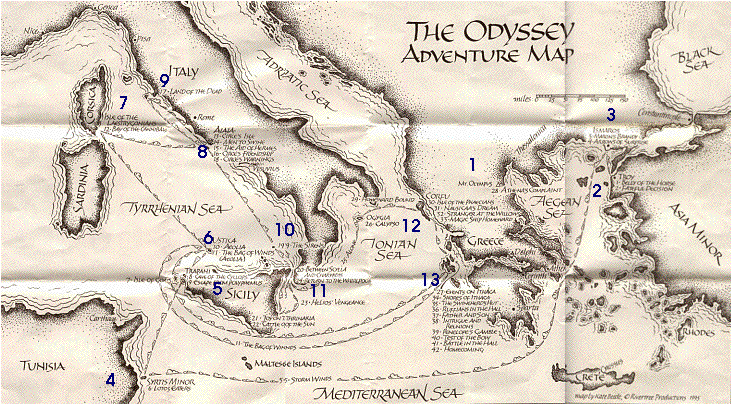
Homer probably took some poetic license with his geography. Still, here's a rough idea of where some of Odysseus' episodes may have taken place.
If we linked to our learning guides every time we mentioned one of these guys, we'd get carpal tunnel. Here's a link to Shmoop's Greek and Roman mythology guide—you might notice some familiar names.
Movie or TV Productions
This is actually a 1967 adaptation of James Joyce's Ulysses. Neat!
Well, Odysseus is a little cartoonish. This 1987 show is in full 2D
This Odyssey (1992-1994) puts its hero in a coma and makes him work his way home from a magical land called "Downworld."
This 1997 version of the Odyssey was produced by Coppola, stars Isabella Rossellini and Bernadette Peters, and is pitched by IMDB as full of "bronzed muscles gleaming." Say no more.
In 2000, the Coen brothers gave us O Brother, Where Art Thou: the Odyssey set in the deep south. With George Clooney. And convicts.
Historical Documents
This is an absolutely amazing piece of parchment from the third century BCE containing lines from Book 20.
Here are some more really, really old fragments of the Odyssey—and some other ancient Greek works.
Here's another wee piece of Book 17. Aren't you glad you can pull a whole copy off the shelf?
Video
Here's Odysseus killing some scantily clad suitors in the 1954 adaptation with Kirk Douglass.
Here's Odysseus messing with his servants in Troy, the 2004 "adaptation" of the Iliad.
Here are some scholars talking about an ancient Greek vase painted with an image of Odysseus escaping Polyphemos' cave. Neat!
Audio
In this genius-grant-winning project, a therapist counsels returning war veterans by talking about the Odyssey.
Here's Cream singing "Tales of Brave Ulysses."
Images
… when I stuff wax in your ears. Here's a vase with Odysseus tied to the mast.
Sorry, we warned you. Here's Odysseus consulting with Teiresias.
We did this minimalist vase of Odysseus hiding out under a ram.
Here's Odysseus slaying the suitors.
Penelope and Telemachos having a little mother/ son moment.