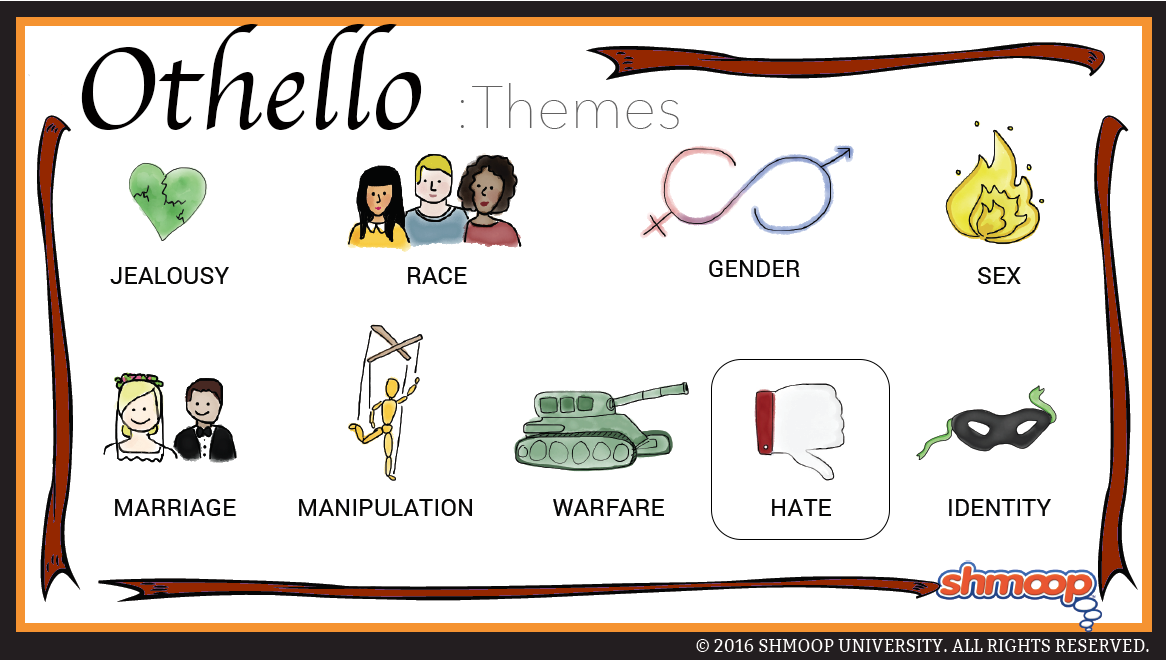
 (Click the themes infographic to download.)
Hatred is supposed to have a cause, some concrete event or insult that inspires a lasting rage. But in Othello, the play's villain is motivated by a hatred that seems to elude any reasonable definition. Iago's hatred and his determination to destroy his boss, Othello, seems out of proportion with the reasons he gives for it: anger that Othello did not promote him or jealousy that Othello might have slept with Iago's wife. Iago's loathing has been famously called a "motiveless malignity" that redefines our understanding of hatred, making it seem a self-propelling passion rather than the consequence of any particular action.
Questions About Hate
- When in Othello is the word "hate" used explicitly? What other words are sometimes substituted for "hate"?
- How does Iago describe his hatred? How often does Iago use the word "love" in comparison with other characters? What kind of relationship might this depict between love and hate? Are they polar opposites, or two shades of the same color?
- We argued elsewhere in this module that Cyprus, being the "island of Venus," inflames passion in the characters. Does it inflame hatred the same way it does love?
Chew on This
In Othello, love and hate are shown to be two sides of the same emotion.
Iago is a force that converts everything into its opposite – above all, love becomes hate.
Just as Iago transforms Othello's love into hatred, the play subtly suggests that Iago's hatred for Othello is actually suppressed love.