The best way to graph polar functions is by using a graphing calculator or a computer program. We can wave our hands and pull a rabbit out of a hat. That's because there aren't as many rules about graphing polar functions. Those few rules that we do have can be much more complex.
With a rectangular function
y = f (x)
there are certain rules about how the function stretches or translates if we look at variations such as:
cf (x)
c + f (x)
f (cx)
f (c + x)
where c is a constant.
We have rules like this when dealing with polar functions too, but not as many.
- The graph of r = cf (θ) will be the same shape as the graph of r = f(θ), but stretched away from or squished toward the origin by a factor of c.
- The graph of r = f (θ - c) is the same as the graph of r = f(θ), but rotated by an angle of c.
As far as nice rules for graphing go, that's all we get.
- There's no nice rule that tells us how the function r = f(cθ) looks.
- There's no nice rule that tells us how the function r = c + f (θ) looks.
We can verify that the function r = f (cθ) is weird by trying different values in the graphing calculator.
The function
r = c + f(θ)
is also weird. Adding a constant can change whether your r values are positive or negative, which can totally change the shape of the graph.
It may also change the bounds we need for θ if we want to find the whole graph.
Practice:
Without a calculator, graph the polar function
r = 1 + cos θ
for
0≤ θ ≤ 2π.
| |
First, notice that since cos θ is always between -1 and +1, the quantity r = 1 + cos θ is always between 0 and 2. In particular, r will never be negative. We should find points in every quadrant. Find the value of r at some nice angles. %%%%%%DATA ENTRY This data is in a table. {c|c} θ&$r = 1 + cosθ$ \hline 0&2 $\frac{π}{2}$&1 π&0 $\frac{3π}{2}$&1 This gives us some points to start from. PICTURE polar funcs 24 Now we need to figure out what's going on in between these points. Remember that r is never negative. From θ = 0 to θ = \frac{π}{2}, the value of r will move from 2 to 1. PICTURE polar funcs 25 From $θ = \frac{π}{2}$ to $θ = π$, the value of r will move from 1 to 0. PICTURE polar funcs 26 From $θ = π$ to $θ = \frac{3π}{2}$, the value of r will move from 0 to 1. PICTURE polar funcs 27 From $θ = \frac{3π}{2}$ to $θ = 2π$, the value of r will move from 1 to 2. PICTURE polar funcs 28 We end up with a heart shape that looks nothing like the graph r = cosθ. The moral of the story is that we typically use calculators when making anything but the simplest of graphs in polar coordinates.. | |
Use a calculator to graph each polar function. Notice that we're changing the bounds on θ each time.
Answer
These don't look like they have anything to do with each other!
- PICTURE: graph r = cos θ for 0 ≤ θ≤ π
Use a calculator to graph each polar function. Notice that we're changing the bounds on θ each time.
- r = cos(2θ) for 0≤ θ ≤ 2π
Answer
- PICTURE: graph r = cos(2θ) for 0 ≤ θ ≤ 2π
Use a calculator to graph each polar function. Notice that we're changing the bounds on θ each time.
- r = cos(\frac{1}{2}θ) for 0≤ θ ≤ 4π.
Answer
- PICTURE: graph r = cos(\frac{1}{2}θ) for 0 ≤ θ ≤ 4π.
Without a calculator, graph the polar function
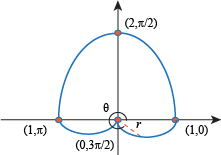
r = 1 + sin θ
for
0≤ θ ≤ 2π.
Answer
Again, r is never negative becauser = 1 + sin θis always between 0 and 2.
Find the value of r at some nice angles.
%%%%%%DATA ENTRY This data is in a table.
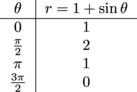
{c|c}θ& r = 1 + sinθ\hline0&1$\frac{π}{2}$&2π&1$\frac{3π}{2}$&0
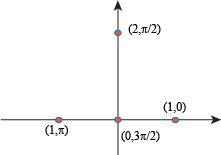
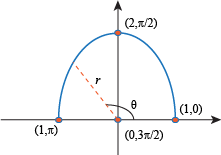
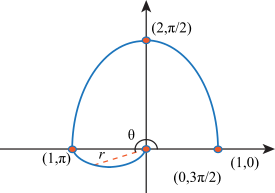
This gives us some points to start from.PICTURE graph points, label in polar coordinatesNow we need to figure out what's going on in between these points. Remember that r is never negative. From θ = 0 to θ = \frac{π}{2}, the value of r will move from 1 to 2.PICTURE similar to polar funcs 25 From θ = \frac{π}{2} to θ = π, the value of r will move from 2 to 1.PICTURE similar to polar funcs 26From θ = π to θ = \frac{3π}{2}, the value of r will move from 1 to 0.PICTURE similar to polar funcs 27From θ = \frac{3π}{2} to θ = 2π, the value of r will move from 0 to 1.PICTURE similar to polar funcs 28Again, we end with a heart shape that looks nothing like the graph r = sinθ.
%The moral is that adding constants does weird things to a polar graph.
% to graph straight line in polar: $θ = ...$