We've been through apples, oranges and mythological creatures unlike anyone has ever seen. But we still don't have a quick way to compare the magnitude of a vector before and after we scale it.
To do this, we have to resort back to one of the oldest tricks in the great book of mathematics: the number 1.
What's the vector equivalent of the number 1? It's a unit vector, which is a vector that has magnitude equal to 1.
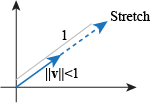
Turns out that we can scale any vector to get a unit vector pointing in the same direction. If the vector
has magnitude less than 1, we stretch it.
If the vector has magnitude greater than 1, we shrink it.
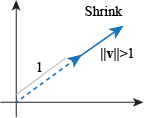
The process of scaling a vector to get a unit vector pointing in the same direction is called normalization.
Practice:
Normalize the vector <3,4>. | |
First we have to find out how long the vector is. 
Since the vector has magnitude 5 and we want it to have magnitude 1, the vector is 5 times too long. 
We need to ``divide" the vector <3,4 > by 5, which is the same as multiplying by . Let 
We claim v is a unit vector. Check by finding its magnitude: 
Yes, v is a unit vector. Hmm. The normalization of <3,4 > is 
This happens to be the same thing as  Coincidence? | |
Normalize the vector
| |
Find out how long the vector is. 
This vector is too short. We want it to have length 1, but it only has length . P If we multiply the vector by 2, we'll get a new vector with magnitude 1. Let
 The magnitude of v is 
Therefore v is a unit vector, which is what we wanted. Remember your fraction division: multiplying by 2 is the same thing as dividing by . 
We found the normalization of . Since multiplying by 2 is the same thing as dividing by , we could also write the vector as 
which happens to be the same thing as 
If we're given a vector v and asked to normalize it, find the vector 
This is guaranteed to be a unit vector pointing in the same direction as v (unless v is 0, but that's not a vector). What direction does <0,0> point?. It doesn't. | |
Exercises. Normalize each vector.
Answer
We need to divide each vector by its magnitude, we need to find the magnitude for each vector.
- The magnitude of the vector is

The unit vector is

Exercises. Normalize each vector.
Answer
- The magnitude of the vector is

The unit vector is

Exercises. Normalize each vector.
Answer
- The magnitude of the vector is

This vector is already a unit vector. Since it's already normalized, there's no more work to do here.
Exercises. Normalize each vector.
Answer
- The magnitude of the vector is

The unit vector is
