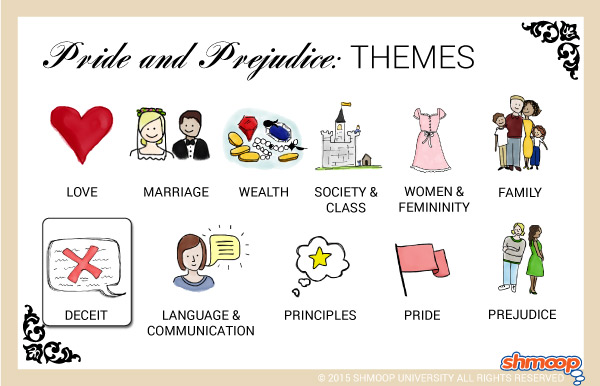
 (Click the themes infographic to download.)
Sure, Wickham fools everyone. But Pride and Prejudice is really interested in self-deceit: the lies we all tell ourselves. You know, like, "I'm totally going to start dieting tomorrow"; or, "From now on, I'm only going to date nice guys," or "This school year, I'm going to neatly organize all of my homework." Motivated by pride and vanity (not to mention prejudice), these kinds of lies are the hardest to let go. It's worth it, though: the reward is a happy marriage.
Questions About Deceit
- Why is Elizabeth so shocked to learn about Charlotte's practicality, Darcy's honor, Wickham's deceit, etc.? Does this mean she's been deceiving herself a little about how she's such a good judge of character?
- There isn't much (or any) outright aggression in the novel, but there sure is a lot of passive-aggression (think Miss Bingley's letter to Jane, or Mrs. Bennet's side-swipes at Darcy). What would happen if these characters would just put their anger cards on the table? What prevents them from doing so?
- Is "good manners" just a nice name for deceit?
Chew on This
The novel's characters are so conditioned to accept good manners at face value that they make natural victims for conmen like Wickham.
Charlotte Lucas is the only character in the entire novel who isn't deceiving herself and isn't deceived by others.