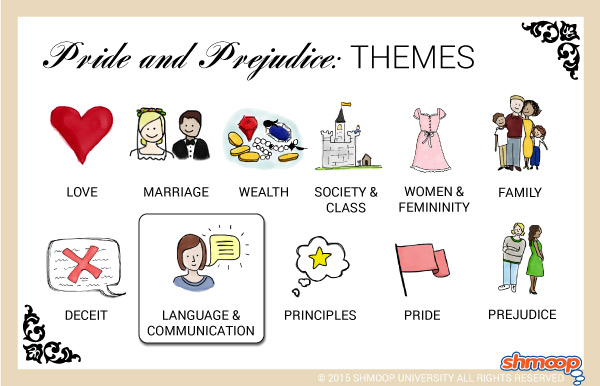
 (Click the themes infographic to download.)
In a society where you aren't really supposed to say what you're thinking—witness all the trouble Lydia gets into—it's no easy task to express feelings, correct mistakes, and give context for your decisions and actions. It's basically the early nineteenth-century equivalent of being required to communicate via vague Facebook statuses. In Pride and Prejudice, good manners and the rules of acceptable behavior tend to be obstacles that get in the way of meaningful discussion. But breaking these rules carries its own dangers. Only the characters who manage to walk the line between frankness and bluntness are the ones who get the narrator's grudging approval.
Questions About Language and Communication
- Who always says what he/she means? Who never says what he/she means? Which is more effective at getting others to do what the character wants?
- Compare the speaking voices to the writing voices of the characters who send letters. Does Mr. Collins sound like his letter? Does Jane? Darcy? Why or why not?
- Why are we shown some proposal scenes (Mr. Collins to Elizabeth, Darcy's first try to Elizabeth) and not shown others (Mr. Collins to Charlotte, Bingley to Jane, Darcy's second go)? Because rejection is funnier than acceptance?
Chew on This
A lot of the novel's humor comes from the way characters are totally unable to understand each other or to make themselves understood.
The most powerful characters are able to shut others up when necessary.