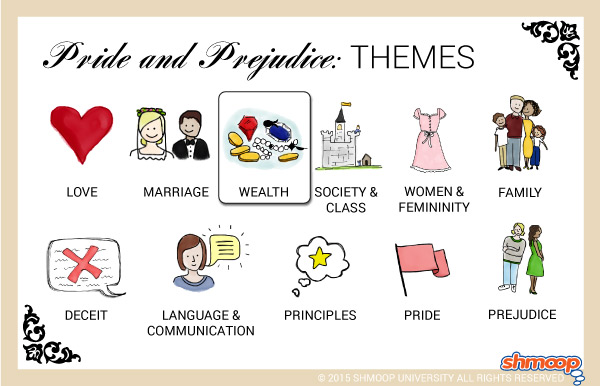
 (Click the themes infographic to download.)
Money makes the world go 'round, especially if you're a young woman trying to get married in Regency England. The five Bennet daughters have almost no money, which means no way to entice men to marry them and no way to support themselves after their father dies and their house in handed over to Mr. Collins. So, was everyone in the early nineteenth century just out for money? Well, kind of. But can you blame them? For men, there were very, very few paths to financial independence without either (1) inheriting or (2) marrying money. Some got rich in the army or through business, but that was super rare. For women, the options were even more limited: inherit or marry. In Pride and Prejudice, the Bennet girls aren't trying to marry for money because they want to buy a Lexus and vacation in St. Barts; they're trying to marry for money because they don't want to live on the early nineteenth-century equivalent of the streets.
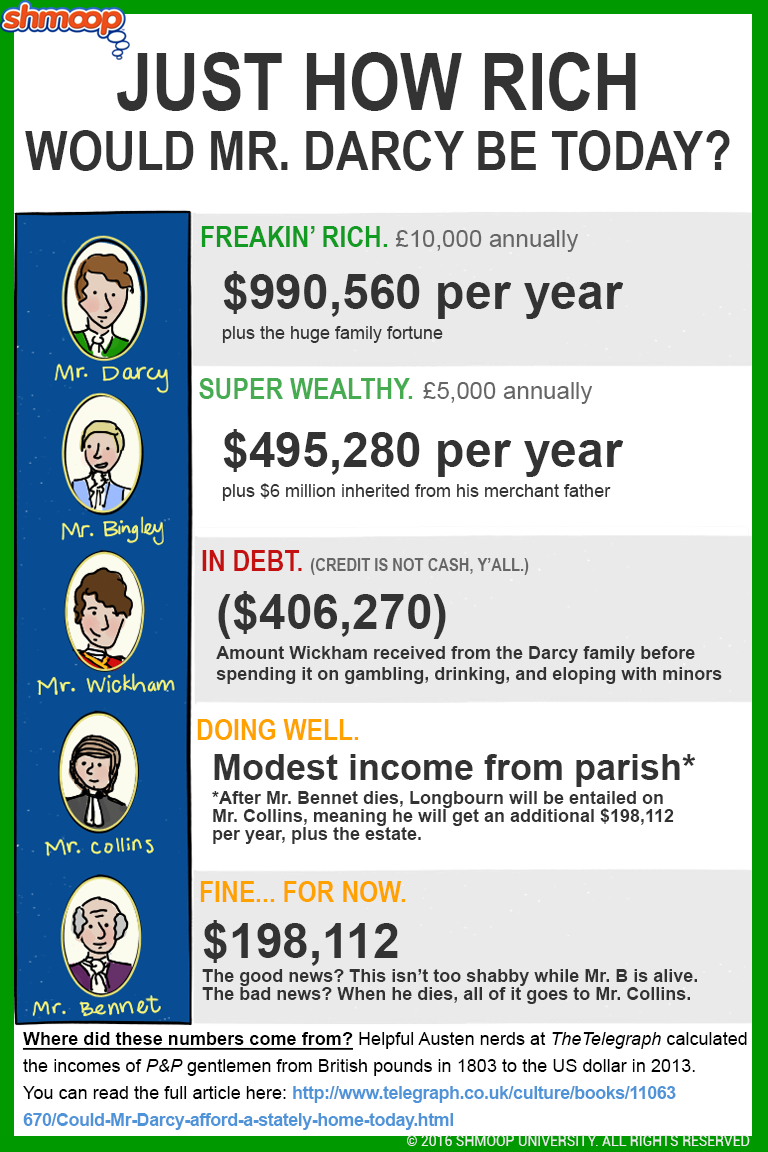
(Click the infographic to download.)
Questions About Wealth
- Can you think of a single plot element in the novel that doesn't have to do with some kind of monetary transaction? Why or why not?
- Why hasn't Mr. Bennet made any kind of provisions for his wife and daughters after his death? Do other characters blame him for this? What do you make of that?
- Which characters think the most about money when it comes to marriage? Which think about it the least? Does it make a difference if the characters are male or female?
- How much does Mr. Darcy's fat estate impact Elizabeth's interest in him, really?
Chew on This
Pride and Prejudice's detailed treatment of money adds to the novel's realism—like when Lydia wants to treat her sisters but has to borrow money from them instead.
Austen criticizes the idea that women belong purely to a domestic sphere by showing that they have to continually appraise their suitors on economic, business-like grounds.