Symbolism, Imagery, Allegory
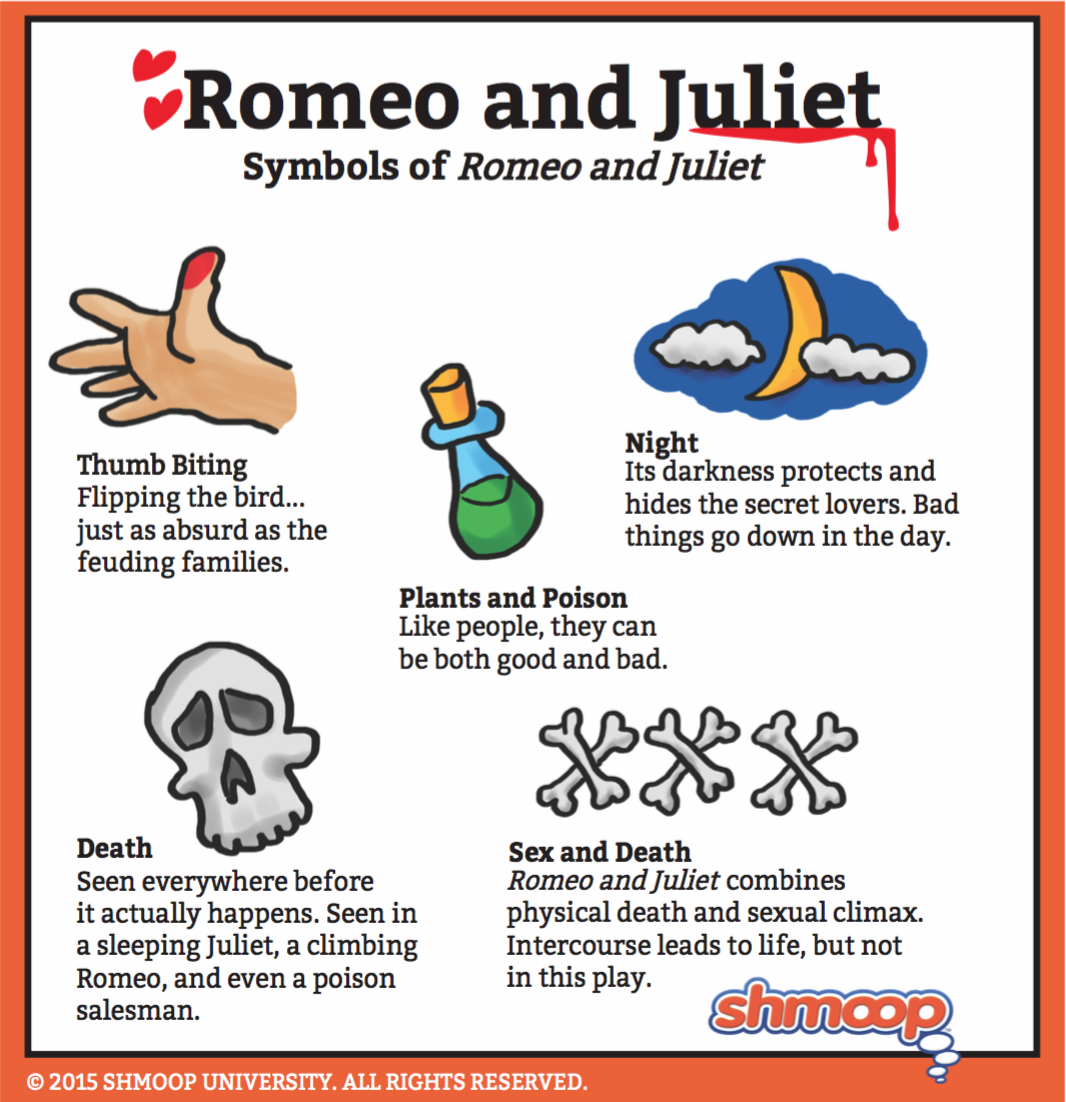
(Click the symbolism infographic to download.)
If you like jumbo shrimp or boneless ribs, then you and Shakespeare have something in common: you both like oxymora.
An oxymoron is a Greek expression that refers to the combination of two terms that are ordinarily opposite—like "oxy," meaning "sharp," and "moron," meaning "dull." Jumbo shrimp? Boneless ribs? Both oxymora.
Shakespeare loved these things, particularly in Romeo and Juliet. For example, at the end of the famous balcony scene, when Romeo is leaving, Juliet says "parting is such sweet / sorrow" (2.2.199-200). "Sweet sorrow?" Totally oxymora.
Think that's impressive? Get a load of Juliet's use of 6 oxymora when she finds out that lover boy (that would be Romeo) has killed her cousin, Tybalt:
O serpent heart, hid with a flow'ring face!
Did ever dragon keep so fair a cave?
Beautiful tyrant, fiend angelical!
Dove-feathered raven, wolvish-ravening lamb!
Despised substance of divinest show!
Just opposite to what thou justly seem'st,
A damnèd saint, an honorable villain!
O nature, what hadst thou to do in hell
When thou didst bower the spirit of a fiend
In moral paradise of such sweet flesh?
Was ever book containing such vile matter
So fairly bound? O, that deceit should dwell
In such a gorgeous palace! (3.2.79-91)
Clearly, Juliet is experiencing some mixed emotions—she wonders how the love of her life, the guy she thought was so wonderful, could be a killer. Juliet's use of oxymoron here gives expression to her turmoil.
This passage is also full of paradoxes, longer statements that contradict themselves and nonetheless seem true—like when Juliet asks, "Was ever a book containing such vile matter so fairly bound?"
The point is that these oxymora and paradoxes work with the major paradox at the center of the play, expressed in Juliet's cry, "My only love sprung from my only hate" (1.5.152). By using oxymora and paradox through the play, Shakespeare manages to make the form (how it's being said) match up with the content (what's being said). Pretty nifty.