Symbolism, Imagery, Allegory
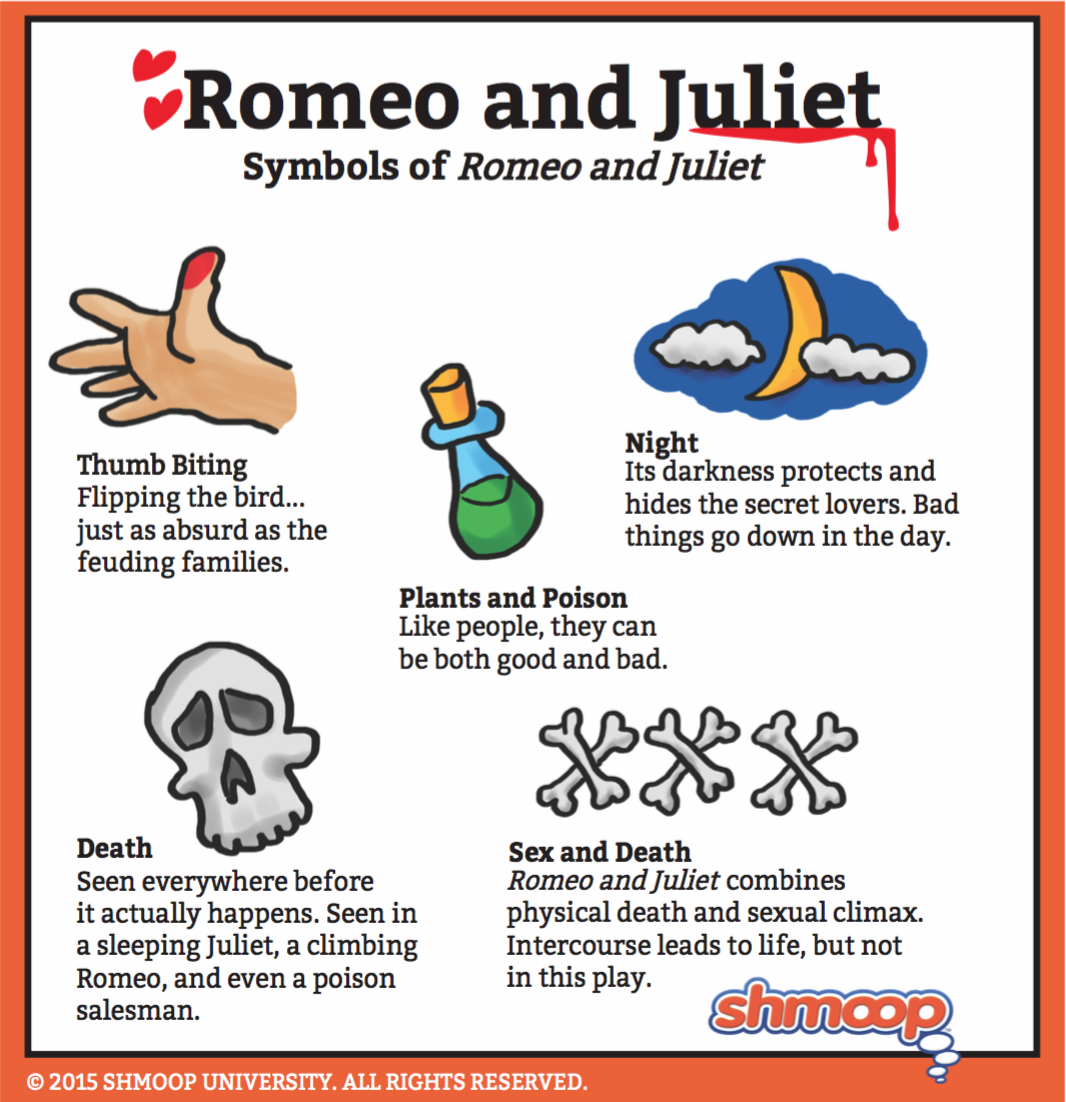
(Click the symbolism infographic to download.)
Sex and death: pretty much the opposite of each other, right? Not in Romeo and Juliet. In fact, Romeo and Juliet sees to think sex and death go together like, uh, Oreos and milk.
In the very first scene, Sampson crudely puns on the term "maidenhead" (virginity) when he equates sword fighting against men with raping women: "When I have fought with the men I will be civil with the maids—I will cut off their heads […] the heads of maids or their maidenheads" (1.1.23-24; 26). Yikes. Remind us to keep away from Sampson, K?
But crude sex/ death jokes aren't just for belligerent servants. Even Juliet links sex and death by punning on the word "die" when, day-dreaming about her impending wedding night with Romeo, she imagines Romeo being transformed into a bunch of "little stars" lighting up the night sky: "Give me my Romeo, and when I shall die / Take him and cut him out in little stars, / And he will make the face of heaven so fine" (3.2.23-25). Fun fact: Juliet's playing with the fact that "die" was slang for "orgasm." So, "when I shall die" … yeah. You can connect the dots, right?
Even Capulet gets in on the game, when Capulet sees his daughter's lifeless body and says that "death" has "lain with" (slept with) Juliet: "See, there she lies, / Flower as she was, deflowered by him. Death is my son-in-law, death is my heir" (4.5.42-44). (By the way, Capulet has no idea at this point that Juliet is married to Romeo—he still thinks she was all set to marry Paris and is still a virgin.) So, "death" (think orgasm) is linked to "deflowering" (think death). Pretty twisted.
If your mind isn't blown enough yet, we have one more for you: Romeo drinks his poison from a goblet, a traditional symbol of female sexuality. (Sound familiar? This same symbolism is used in the Da Vinci Code, where the Grail, a big V-shaped goblet, symbolizes, well, a woman's genitalia.) Juliet, in contrast, stabs herself with Romeo's dagger—i.e., a penis (source Marjorie Garber). Oh, and guess what the word "vagina" literally means in Latin? "Sheath." So, when she thrusts the dagger into her chest, as though she's putting it into a sheath … We're pretty sure you can connect the dots on that one, too.
But what does it all mean? Symbolically, Romeo and Juliet combine physical death and sexual climax. It's all pretty ironic, really. Typically, sex acts between men and women are supposed to result in the creation of life (making babies, that is). Yet, in the play, that's just not the case.