Symbolism, Imagery, Allegory
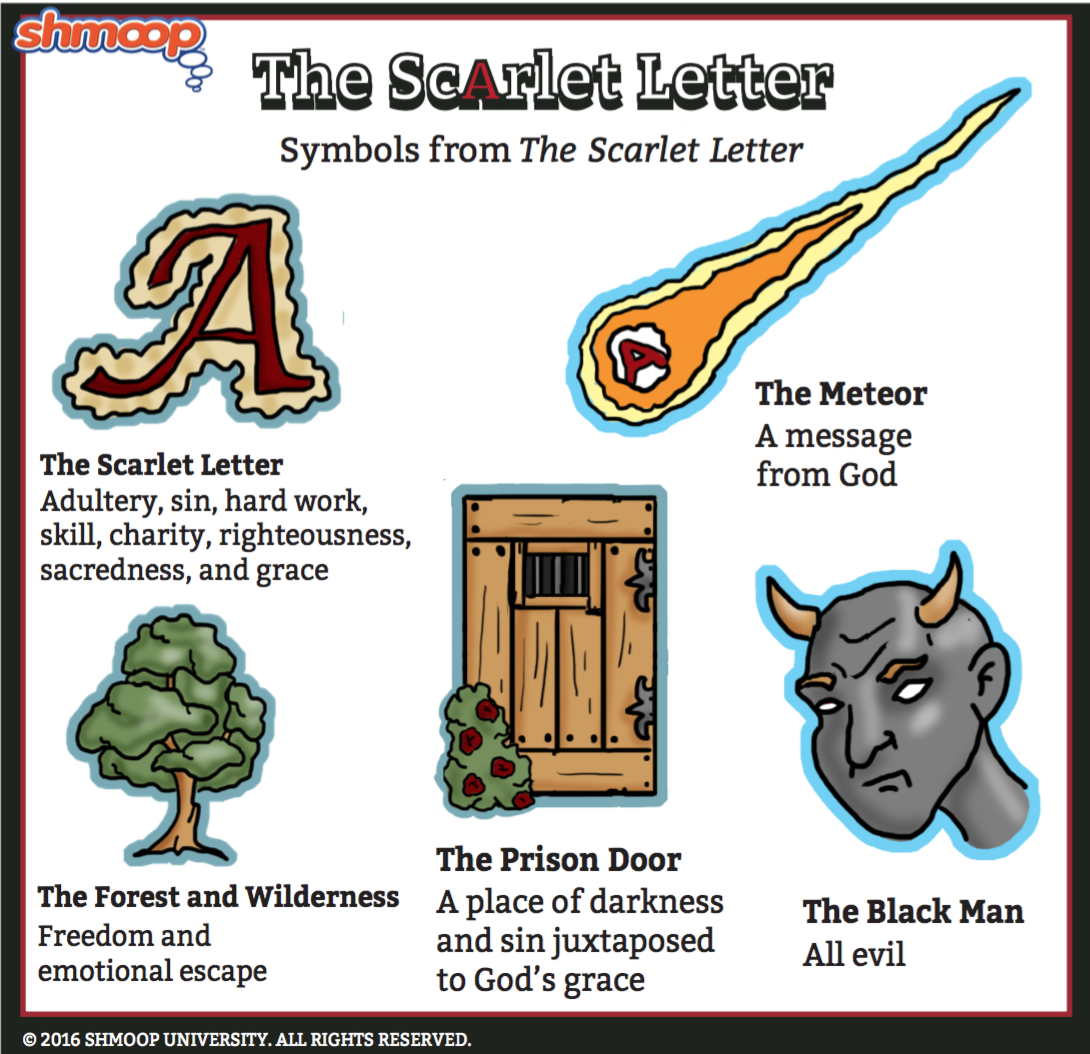
(Click the symbolism infographic to download.)
Hester's scarlet letter is a hardworking symbol. At various times, it symbolizes adultery, sin, hard work, skill, charity, righteousness, sacredness, and, of course, grace. Whew! We're exhausted just thinking about it.
At first, there's no question: it symbolizes the sin of adultery, and Hester wears it as punishment. But from the very beginning, she's not willing to let it dictate the terms of her punishment. She has to make the letter, since this is mid-17th-century Colonial America—you want something, you make it. You can't just run out to the Adultery Superstore. And, like an early Martha Stewart, she makes it beautiful:
On the breast of her gown, in fine red cloth surrounded with an elaborate embroidery and fantastic flourishes of gold thread, appeared the letter 'A.' It was so artistically done, and with so much fertility and gorgeous luxuriance of fancy, that it had all the effect of a last and fitting decoration to the apparel which she wore; and which was of a splendor in accordance with the taste of the age, but greatly beyond what was allowed by the sumptuary regulations of the colony. (2.10)
Now that's a good thing.
By embroidering the "A" so finely and ornately, Hester takes control of her own punishment. She basically owns it. The letter showcases her talent and artistry, skills that allow her to make a living as a single parent in Puritan Boston. These qualities of strength and independence set her apart—as does her love of beauty, since we meet the Puritans as a crowd of "bearded men, in sad-coloured garments and grey steeple-crowned hats. Hester's scarlet letter is the like the woman in the red dress from The Matrix: an indication that there's another way.
As Hester Prynne builds a new life, her hard work and charity end up altering the letter's meaning. Some people even "refused to interpret the scarlet A by its original signification" (8.3), meaning that they forget, or choose to forget, that it's a symbol of her sin. Instead, they say that the "A" stands for "Able"—as in, Hester is such an able woman.
Eventually, the letter even achieves a kind of holiness. It has "the effect of the cross on a nun's bosom. It imparted to the wearer a kind of sacredness, which enabled her to walk securely amid all peril. Had she fallen among thieves, it would have kept her safe" (13.5). Many years later, when Hester returns and voluntarily takes up the scarlet letter again, it has become, for her and others, a symbol of grace: "a type of something to be sorrowed over, and looked up with awe, yet with reverence too" (24.11).
Symbology
One last thing. (This might get a little complicated, so take it slow.) In general, symbols aren't like icons on a map: you can't decode a text by saying that one thing—say, a prison door—always symbolizes another thing. Sure, sometimes an author will get really explicit. In The Scarlet Letter, the prison door really does work as an "A means B" kind of symbol.
But mostly, that's just not how literature works. Instead, certain items, colors, and references gather associations. So we can't just say that the scarlet letters means X, because it means a lot of things. And that's what makes it interesting; that's what makes it worth writing almost 600 words about. If we could just say "the scarlet letter represents adultery," then, well, we'd be out of job.
But it doesn't, and Hawthorne knows that. He's a smart guy. He knows about literature and literary symbols. So, we think one thing that's going on here is that Hawthorne is warning us not to be too literal. The scarlet letter symbolizes all those things that we already said, but it also symbolizes the danger of thinking symbolically. If we say that something—like Pearl, or the letter—is a symbol that represents one thing and nothing more, then we lose life's complexity. We become like the Puritans, only able to interpret things in one way.
But we're Shmoopers, and—now that we've read The Scarlet Letter —we know that life and literature are a lot more complex than "A means B."
