We say x = c is a critical point of the function f if f (c) exists and f'(c) = 0 or is undefined. It's generally a peak or valley in the curve. It's where the slopes becomes interesting. When climbing Mount Everest, we might say that we've reached the critical point when we've reached the summit. It's where we can enjoy the view while feasting on granola.
Be Careful:A critical point of a function f is a value in the domain of f at which the derivative f ' is 0 or undefined.
It's also possible for a function to have no critical points at all.
To find the critical points of a function f we
- take the derivative of f
- find any places where f ' is undefined but f is defined, and finally
- find the roots of the derivative.
We can often check our answers by graphing the function and making sure it looks like it has critical points in the right places. We know what a graph looks like at a spot where the derivative doesn't exist:

and we know what a graph looks like when it has a derivative of 0 (horizontal tangent line):

Practice:
Find the critical points of the function f (x) = 5x2 + 4x - 2.
| |
First we take the derivative: f '(x) = 10x + 4. Since f '(x) is defined everywhere, we can move right on to finding the roots of f '(x). We need to solve the equation f '(x) = 0. Here we go: 
This means -2/5 is a critical point - in fact, our only critical point. If we look at the graph, this makes sense, so long as we zoom in enough to see what the graph looks like around x = -2/5: 
| |
Find the critical points of the function f (x) = 3x2/3 + 3x5/3 | |

First we take the derivative. 
By some mildly tricky rewriting, we can factor this formula. 
Now that the derivative is nicely factored, we'll do the rest of the job. f ' is undefined when x = 0, since 
is undefined. Since f (0) is defined at 0, x = 0 is a critical point. Finally we want to find the roots of the derivative. We have f '(x) = x-1/3(2 + 5x). The factor x-1/3 is never 0. The factor (2 + 5x) is 0 when x = -5/2, so we've found another critical point. The final answer: there are critical points at x = 0 and at x = -5/2. If we zoom in enough on the graph, this makes sense. The derivative doesn't exist at 0, and there appears to be a horizontal tangent line at : 
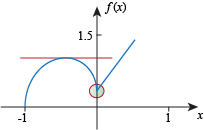
| |
Find the critical points of the function f (x) = ex.
| |
First we take the derivative: f '(x) = ex. Since the derivative f '(x) is never undefined and has no roots, the function f (x) has no critical points. If we graph the function, we see no corners and no places with a horizontal tangent line: 
| |
Find the critical points of the function f (x) = 1/x. | |
First we take the derivative. Since f (x) = x-1, f '(x) = -x-2 = 1/x2 Although f '(0) is undefined, x = 0 isn't a critical point because f (0) is also undefined. A critical point must be a valid point on the function, which means the original function must be defined there. Since f ' has no roots, we conclude that f (x) has no critical points. On the graph, we see no places where f is defined and simultaneously the derivative is undefined or zero: 
| |
For the function, find all critical points or determine that no such points exist.

Answer
First we find the derivative, using the quotient rule:

We're leaving the derivative in this form, with the numerator and denominator factored, because it will make the next pieces of the task easier.
Next we need to find the x-values at which the derivative is undefined but f is defined. Since f'(x) is a rational function, it's undefined wherever the denominator is 0.
To have
(x + 2)2 = 0
we need to have
x + 2 = 0
or
x = -2,
so f' is undefined at x = -2. However, f is also undefined at x = -2, so x = -2 is not a critical point. Finally, we need to find the roots of f'. Since f'(x) is a rational function, it will be 0 when the numerator is 0 and the denominator isn't 0.In order to have
x(x + 4) = 0
we must have either x = 0 or x = -4. Since neither of these values make the denominator of f' equal zero, x = 0 and x = -4 are critical points. If we look at the graph of f, this makes sense:

For the function, find all critical points or determine that no such points exist.
f (x) = cos x
Answer
f (x) = cos x
The derivative is
f'(x) = -sin x.
This is never undefined, and is 0 at all multiples of π. So the critical points of f (x) are x = nπ, where n is any integer. If we look at a graph of f, this matches our intuition:

For the function, find all critical points or determine that no such points exist.

Answer

We find the derivative using the quotient rule.

The derivative f'(x) is undefined when x ≤ 0, but since we're only looking at the function f for x > 0, we don't find any critical points because f'(x) is undefined. To find where f'(x) = 0, we find where the numerator is equal to 0.
If
ln x - 1 = 0
then
ln x = 1,
therefore
x = e.
This is our only critical point. This makes sense on the graph, if we zoom in a lot:

For the function, find all critical points or determine that no such points exist.

Answer

Again, we need to use the quotient rule to find the derivative. Be careful when factoring out the negative signs.

Now we can investigate where f '(x) is undefined or zero. f '(x) is undefined when x = 0. However, this doesn't count as a critical point since x = 0 wasn't in the domain of f to begin with. f '(x) is zero when
-28(x + 1) = 0,
which is when
x = -1.
This is our only critical point.
If we look at a graph, we can see this critical point, but we need to zoom in a lot:

We need to be careful with the calculator. Make sure it's telling the correct answer.
For the function, find all critical points or determine that no such points exist.
f (x) = xex
Answer
f (x) = xex
We use the product rule to find the derivative:

This function is never undefined. Since ex is never zero, x = -1 is the only root of f'(x) and therefore the only critical point.
Again, this makes sense on the graph:

For the function, find all critical points or determine that no such points exist.
f (x) = 4x3 + 3x2 – 2x + 1
Answer
f (x) = 4x3 + 3x2 – 2x + 1
We find the derivative:
f '(x) = 12x2 + 6x – 2.
Since this is a polynomial, it's defined everywhere. In order to find the roots of the derivative, first factor out the unnecessary 2:
f '(x) = 2(6x2 + 3x – 1).
Then we need to use the quadratic formula:

These are the critical points, and our exact answers. However, to check our work on the graph it's useful to know approximate values:

If we graph the function f using marks every 0.25 on the x-axis, we do appear to have horizontal tangents around 0.25 and -0.75. This is enough evidence to support our answer.
For the function, find all critical points or determine that no such points exist.
f (x) = sin x cos x
Answer
f (x) = sin x cos x
We find the derivative using the product rule.

This is never undefined. f '(x) is zero when
cos2 x = sin2 x,
or when
cos x = ± sin x.
Think about the unit circle. sin and cos are equal at π/4, 3π/4, 5π/4, 7π/4, and anything you find by adding or subtracting 2π to any of these numbers. Look at a graph and see if this is believable:

Yup, it's believable. We have horizontal tangent lines everywhere we expected to. So our critical points occur at

where k is any integer.
or the function, find all critical points or determine that no such points exist.
f (x) = sin2 x
Answer
f (x) = sin2 x
We can rewrite the function as
f (x) = (sin x)2,
which means we need the chain rule to take the derivative of this function.
f '(x) = 2(sin x)(cos x)
The derivative f'(x) is never undefined, but is 0 whenever either sin or cos is 0 - that is, at every multiple of π/2. So these are our critical points. The graph looks like this:

For the function, find all critical points or determine that no such points exist.
f (x) = ex + e-x
Answer
f (x) = ex + e-x
We take the derivative (using the chain rule for the second term).
f'(x) = ex - e-x.
This is never undefined, and is zero when
ex = e-x.
But this is only possible when x = -x, which means
x = 0
is our only critical point.

For the function, find all critical points or determine that no such points exist.
f (x) = 3x – 2x
Answer
f (x) = 3x – 2x
We find the derivative:
f'(x) = 3 – 2xln 2.
This is never undefined. Find its root(s):
That horrible expression is the exact value of the critical point. For the sake of checking the graph, this value is approximately 2.1.