The goal of this section is to be able to go from a formula of a function to an accurate graph of that function. We use the first and second derivatives to help find exact points on the graph and to determine the overall shape(s) of the graph.
There are three steps to drawing a graph.
- Find dots (intercepts, critical points, inflection points).
- Find shapes.
- Play connect-the-dots with the shapes.
Make sure you're happy with each step by itself. The following examples put all the steps together.
Sample Problem
Let f (x) = xex. Sketch a graph of f (x). Label all intercepts, critical points, and inflection points.
Answer.
We'll go through the three steps.
• Find dots (intercepts, critical points, inflection points).
To find the y-intercept we plug in 0 for x and see what we find:
f (0) = 0e0 = 0.
The y-intercept is (0, 0). This is also the only x-intercept since the only time xex can be zero is if x is zero.
Now we find the critical points. From this example we know that there's a critical point at x = -1. In order to graph this point we need the full coordinates:
f (-1) = -1e-1 ≅ -0.37.
There's a critical point at approximately (-1,-0.37).
Now for inflection points. We know from this exercise that there's an inflection point at x = -2. Since
f (-2) = -2e-2 ≅ -0.27
we have an inflection point at approximately (-2,-0.27).
Step 1 is done. We have points:

• Find shapes.

Set up a numberline, marking all the important points we found:

Now figure out the signs of f, f ' and f " in the intervals between the important points. We know f is negative when x is negative, and positive when x is positive:

We know f ' is negative when x < -1 and positive when x > -1:

Finally, we know f " is negative when x < -2 and positive when x > -2:

Using this information, we can figure out the shape of f over each interval:

• Play connect-the-dots with the shapes.
Since f is negative for all negative values of x, we know the concave down, decreasing shape to the left of x = -2 must stay below the x-axis.
We play connect-the-dots, and find this:

Practice:
Draw a graph of 
| |
• Find dots. f is zero only when x = 0. We find an interesting new twist here, because f has asymptotes: there's a vertical asymptote at x = 4 and a horizontal asymptote at y = 12. The derivative of f is 
This is only zero or undefined when x = 4. Since f is undefined when x = 4, we don't find a critical point here, so f has no critical points. The second derivative of f is 
Again, the only place f " is zero or undefined is at x = 4, where f is undefined. Therefore f has no inflection points either. When we go to graph the dots, we also put on the asymptotes: 
• Find shapes. Make the numberlines: 
The function is negative when 0 < x < 4 (since then 12x is negative and ( x - 4 ) is positive), and positive everywhere else: 
The derivative f '(x) = -48( x - 4 )2 is always negative, since ( x – 4 )2 is always positive. 
The second derivative is negative when ( x – 4 ) is negative and positive when ( x – 4 ) is positive: 
By looking at f ' and f " we can figure out the shapes of f : 
• Play connect-the-dots. We connect the dots to find the final graph, remembering to use the asymptotes: 
| |
Graph the function. Label all intercepts, critical points, and inflection points.

Answer

• Find dots.
The function f is undefined and has a vertical asymptote when x = 0. This function has no roots.
The derivative is

This is zero when x = 1. Since
, we have a critical point at (1,e).
The second derivative is

Use the quadratic formula to see if x2-2x + 2 has any roots.

f" is undefined at 0, so f has no inflection points.

• Find shapes.
We start with the numberline.

The function
is positive when x is positive and negative when x is negative.

The derivative
is negative when x < 1 and positive when x > 1.

Now for the sign of the second derivative.
Since the polynomial x2 - 2x + 2 opens upwards and never hits the x-axis, it must always be positive. Since ex and x4 are also positive, the only factor of f" that isn't always positive is x:

This means f" is negative when x is negative, and positive when x is positive.

Now we can find the shapes:

• Play connect-the-dots.
The final graph looks like this:

Graph the function. Label all intercepts, critical points, and inflection points.
f (x) = x3 - 5x
Answer
f (x) = x3 - 5x
• Find dots.
To find the roots, we factor the function:
f (x) = x(x2 - 5)
The roots are x = 0 and
. The root x = 0 is also the y-intercept.
The derivative of f is
f'(x) = 3x2 - 5.
This is zero when

so these are our critical points. For the sake of graphing,
The corresponding y values are

The second derivative is
f"(x) = 6x.
This is 0 when x = 0, so that's our inflection point.
We graph the dots, labeling their type. So long as it's written down somewhere what the coordinates of the critical points are, don't worry too much about trying to fit that label on the graph.

• Find shapes.
Here are the numberlines:

f (x) = x(x2 - 5) is negative when x is negative and x2-5 is positive, which occurs when
. f is also negative when x is positive and (x2 - 5) is negative, which occurs when
. f is positive everywhere else.

f'(x) = 3x2 - 5 is negative when
and positive everywhere else.

f"(x) = 6x is negative when x is negative and positive when x is positive.

Now we can find the shapes:

• Play connect-the-dots.
Here's the graph:

Graph the function. Label all intercepts, critical points, and inflection points.
f (x) = x2ex
Answer
f (x) = x2ex
• Find dots.
The function f (x) is only zero when x = 0.
The derivative is

which is zero when x = 0 and when x = -2, so these are our critical points. When x = 0, we have y = 0 also.
f(-2) = 4e-2
so the complete coordinates of the critical points are
(0,0) and (-2,4e-2).
For the sake of graphing,
4e-2 ≅ 0.54.
The second derivative (using the first definition of f', not the factored version) is

This is zero when (x2 + 4x + 2) is zero. We need the quadratic equation to solve this one:

We need to find the corresponding y-values.

• Find shapes.
Set up the numberline:

The function f is never negative.

The function f '(x) = xex(2 + x) is negative when exactly one of the quantities x and (2 + x) is negative, and positive otherwise. Therefore f ' is only negative when -2 < x < 0.

The function f "(x) = ex(x2 + 4x + 2) is negative when x is between the roots of the polynomial (x2 + 4x + 2). That is, when


These are the shapes of f :

• Play connect-the-dots.
We play connect-the-dots, keeping in mind that f can't go below the x-axis:

Graph the function. Label all intercepts, critical points, and inflection points.

Answer

• Find dots.
The function f is undefined when x = 1, and has a vertical asymptote there.
Before finding derivatives, rewrite the original function:
f (x) = 4(ln x)-1
The derivative is

This is never undefined or 0 at a place where f is defined, so the function f has no critical points.
The second derivative is

This is undefined at the same places as f and f'. This is zero when

The corresponding y value of the inflection point is

For the sake of graphing,
e-2 ≅ 0.135.
Here are the points:

• Find shapes.
We'll start with the numberlines.

The function f is negative when x < 1 and positive when x > 1.

The derivative
f'(x) = -4x-1(ln x)-2
is always negative, so f is always decreasing.

The second derivative is

The factors 4x-2 and (ln x)-2 are always positive, so the sign of f" is determined by the sign of the factor [1 + 2(ln x)-1].
When x > 1, the quantity ln x is positive and so is [1 + 2(ln x)-1].
When x < 1, we know there's a possible inflection point at e-2 ≅ 0.135. We need to know what's going on with the sign of f" on the intervals
0 < x < e-2
and
e-2 < x < 1.
In order to not find too much of a headache, plug in some numbers and find the sign of [1 + 2(ln x)-1]. Since e-2 ≅ .135, we'll use x = 0.1 for the first interval and x = 0.5 for the second. When x = 0.1, we find
[1 + 2(ln .1)-1] ≅ 0.131 > 0
so f" is greater than zero on the interval 0e{-2}. When x = .5 we find[1 + 2(ln .5)-1] ≅ -1.885 < 0
so f" is less than zero on the interval e{-2}

This means f is concave up at the beginning of the graph, then concave down until the asymptote, then concave up again. Here are the shapes:

• Play connect-the-dots.
Here's the final graph:

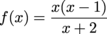
Graph the function. Label all intercepts, critical points, and inflection points.

Answer

• Find dots.
The first thing to do is factor the numerator of f:

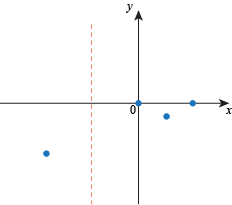
Now we can see that f is undefined with a vertical asymptote at x = -2, and has roots at x = 0 and x = 1.
The derivative of f is

This is zero when the numerator is zero, which occurs at (using the quadratic formula)

We have critical points at

The second derivative of f is

This is never 0, and is undefined at the same place f is undefined, so the function f has no inflection points.
Here are the dots:

• Find shapes.
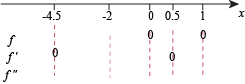
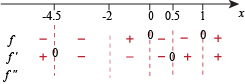
Here's the numberline:

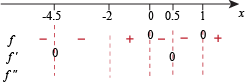
First, find the sign of the function
.
When x < -2 all quantities x, ( x - 1 ), and (x + 2) are negative, so f is negative.
When -2 < x < 0 the quantities in the numerator are both negative and the denominator is positive, so f is positive.
When 0 < x < 1 the quantity x - 1 is negative, while x and x + 2 are positive, so f is negative.
When 1 < x all quantities x, ( x - 1 ), and (x + 2) are positive, so f is positive.

Next, the sign of
.
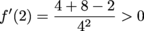
The denominator is always positive, so we don't need to worry about that. Since f'(0) is negative, the derivative f' is negative in between the two critical points. Plugging in some other numbers, we can see what the derivative is doing outside the critical points.

and

The derivative f' is positive outside the critical points.

Finally, the sign of
. This one is negative when x < -2 and positive when x > -2.
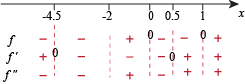
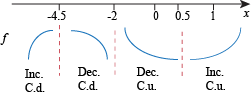
Using this, we find the shapes of f:

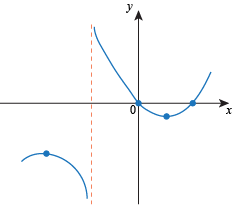
• Play connect-the-dots.
Here's the final picture.