Sample Problem
- Below is a graph of a function f with a minimum at x = x0. Determine the sign of the derivative f ' at each labelled x-value.

- Below is a graph of a function f with a maximum at x = x0. Determine the sign of the derivative f ' at each labelled x-value.

A minimum, assuming it's not at the endpoint of an interval, usually looks like this:

The derivative is zero (or undefined) at the place the minimum occurs:

Since the function must decrease down to the minimum and then increase away from the minimum, the derivative is negative to the left and positive to the right of the place where the minimum occurs:

We can use a numberline to keep track of the sign of f ' like this:

A maximum, assuming it's not at the endpoint of an interval, usually looks like this:

The derivative is zero (or undefined) at the place the maximum occurs:

Since the function must increase up to the maximum and then decrease away from the maximum, the derivative is positive to the left and negative to the right of the place where the maximum occurs:

We can use a numberline to keep track of the sign of f ' like this:

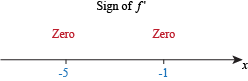
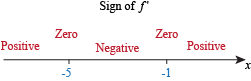
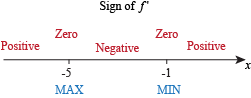
If we don't have a graph of the function, we can go the other way around: we make a numberline first, and use that to determine if a critical point of f is a maximum or a minimum or neither. We find the sign of f ' a little to the left of the critical point, and a little to the right of the critical point.
But if we encounter something like this, the critical point is neither a min nor a max:

This process is called the First Derivative Test because we are using the first derivative to test whether a critical point is a min or a max or neither.
Example 1
Let f (x) = xex. Use the First Derivative Test to determine if each critical point is a minimum, a maximum, or neither. |

Example 2
Let f (x) = x3. Use the First Derivative Test to determine if each critical point is a minimum, a maximum, or neither. |

Example 3
Let f (x) = sin x on the interval 0 ≤ x ≤ 2π. Use the First Derivative Test to determine if each critical point is a minimum, a maximum, or neither |
 and when
  (remember, we're only looking at the interval [0,2π] right now). So far, we have a numberline that looks like this:


 , the function f has a maximum at
  . Since f ' is negative to the left and positive to the right of
  , the function f has a minimum at
  .
.
Exercise 1
For the function, use the First Derivative Test to determine if each critical point is a minimum, a maximum, or neither.
 for 0 < x


Exercise 2
For the function, use the First Derivative Test to determine if each critical point is a minimum, a maximum, or neither.
f (x) = -x3 + 3x2 – 3x


Exercise 3
For the function, use the First Derivative Test to determine if each critical point is a minimum, a maximum, or neither.


Exercise 4
For the function, use the First Derivative Test to determine if each critical point is a minimum, a maximum, or neither.


 and positive to the right of x =
  , f has a minimum at x =
  . Since f ' is positive to left of x =
  and negative to the right, f has a maximum at x =
  .
.
Exercise 5
For the function, use the First Derivative Test to determine if each critical point is a minimum, a maximum, or neither.
f (x) = ex