Sample Problems
- Assume f is defined and twice differentiable on the whole real line. Around a minimum of the function f, is f concave up or concave down?
- Assume f is defined and twice differentiable on the whole real line. Around a maximum of the function f, is f concave up or concave down?
A minimum of f will usually occur at the bottom of a right-side up bowl:

Having a right-side up bowl means f is concave up here.
A maximum of f will usually occur at the top of an upside-down bowl:

Having an upside-down bowl means f is concave down here.
The Second Derivative Test says
- If f is concave up around a critical point, that critical point is a minimum.
- If f is concave down around a critical point, that critical point is a maximum.
This is true because if f is concave up around a critical point, f looks like this:

Such a critical point must be a minimum. On the other hand, if f is concave down around a critical point, then f looks like this:

Such a critical point must be a maximum.
Be Careful: If f " is zero at a critical point, we can't use the Second Derivative Test, because we don't know the concavity of f around the critical point.
Be Careful: There's sometimes confusion about this test because people think a concave up function should correspond to a maximum. This is why pictures are useful. If we remember what a concave up function looks like, we'll be fine.
There's a good question that most people have right about now: if you're not told which to use, how do you know whether to use the first derivative test or the second derivative test?
The good news is that it often doesn't matter. When it's possible to use both the first derivative test and the second derivative test, they will give the same answer.
The other good news is that you can usually do whichever test is easier. Sometimes finding the second derivative is not fun, like with the function

The first derivative is

and while we could find the second derivative, it's not pretty and we don't want to bother. In this case, it probably makes more sense to plug in a couple of numbers and see what the sign of the first derivative is doing. Sometimes the second derivative test doesn't work at all (if f " is 0 at the critical point), in which case we need to use the first derivative test.
On the other hand, sometimes you can see that the second derivative is really nice. Take the function
f (x) = x2 + 4x + 1.
The first derivative is
f '(x) = 2x + 4
and the second derivative is
f "(x) = 2,
which is always positive. Therefore f is always concave up, so any critical point needs to be a minimum. The second derivative test for this one is a piece of cake. Mmm, cake.
The bad news is that, as with the rest of math, we do need to practice. The more functions we stare at, the better we'll become at deciding whether to use the first derivative test or the second derivative test to classify a function's extreme points. Don't worry; there are plenty of practice problems.
Example 1
Let f (x) = xex. If possible, use the second derivative test to determine if each critical point is a maximum, a minimum, or neither. |


Example 2
Let f (x) = -x3 + 3x2 – 3x. If possible, use the second derivative test to determine if each critical point is a minimum, maximum, or neither. |

Example 3
Let f (x) = 5 – x2. If possible, use the second derivative test to determine if each critical point is a minimum, maximum, or neither. |

Exercise 1
For the function, use the second derivative test (if possible) to determine if each critical point is a minimum, maximum, or neither. If the second derivative test can't be used, say so.


Exercise 2
For the function, use the second derivative test (if possible) to determine if each critical point is a minimum, maximum, or neither. If the second derivative test can't be used, say so.
f (x) = exsin x for 0 < x < 2π
 and
and  , so these are our critical points. The second derivative is
 is negative, we know
 .
.  is positive, we know
 .
.
Exercise 3
For the function, use the second derivative test (if possible) to determine if each critical point is a minimum, maximum, or neither. If the second derivative test can't be used, say so.
f (x) = x3 – 2x2 + x

 and x = 1. Now we find the (sign of) the second derivative at each critical point.
Exercise 4
For the function, use the second derivative test (if possible) to determine if each critical point is a minimum, maximum, or neither. If the second derivative test can't be used, say so.


Exercise 5
For the function, use the second derivative test (if possible) to determine if each critical point is a minimum, maximum, or neither. If the second derivative test can't be used, say so.
f(x) = cos x on the interval

Exercise 6
Classify the extreme points of the function, using either the first or second derivative test. Explain why you chose to use the test you did.
f (x) = x4 – 32x
Exercise 7
Classify the extreme points of the function, using either the first or second derivative test. Explain why you chose to use the test you did.
f (x) = (x – 1)9
Exercise 8
Classify the extreme points of the function, using either the first or second derivative test. Explain why you chose the test that you did.

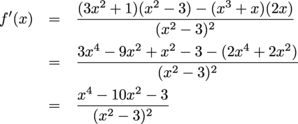
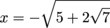
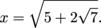
 , in which case f is also undefined, so we don't find any critical points that way. To find when f ' is zero we need to solve the equation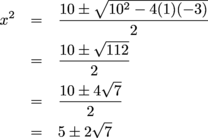
 is negative and x2 can't be negative, we know



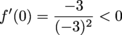

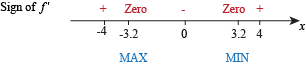
Exercise 9
Classify the extreme points of the function, using either the first or second derivative test. Explain why you chose to use the test you did.
f (x) = ex2 – 4x

Exercise 10
Classify the extreme points of the function, using either the first or second derivative test. Explain why you chose to use the test you did.


 . We can't use the second derivative test at x = 0 because f '(0) doesn't even exist. The first derivative test it is. Here's the numberline, and the values we need to plug into f':


