Evaluating terms of a sequence, given the formula, isn't so bad. Going the other way around is a little trickier. It can be a bit like juggling buzzing chainsaws while riding a unicycle and chewing gum.
Okay, it's not that hard. Given the terms, how do you figure out the formula?
Sample Problem
Write down the formula for the general term in the sequence
2,4,6,8,10,...
starting with n = 1.
Answer.
Let's make a table so we can see the relationship between n and an.

The second number in each row is obtained by doubling the first number.
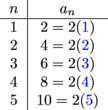
The formula for the general term is
an = 2n.
You should be very familiar with the following common sequences and the definitions of their general terms.
- The sequence of natural numbers an = n:
1, 2, 3, 4,...
- The sequence of squares an = n2:
1, 4, 9, 16, 25,...
- The sequence of cubes an = n3:
1, 8, 27, 64,...
- The sequence of even numbers an = 2n:
2, 4, 6, 8,...
- The sequence of odd numbers an = 2n – 1:
1, 3, 5, 7,...
We can also write this sequence as an = 2n + 1 if we start with n = 0 instead of n = 1.
- The sequence of powers of 2 where an = 2n:
2, 4, 8, 16, 32,...
Most people don't want to reinvent the wheel, and mathematicians are no exception. Many sequences are built by making slight adjustments to more familiar sequences. Adjustments might include adding, subtracting, or multiplying by a constant.
In most of the sequences we've looked at so far, n only shows up once. There's only one occurrence of n in the formula an = n2 or an = 2n.
The most complicated general term we've seen is an = n2 + n.
When terms get more complicated, finding a formula for the nth term can feel like trying to solve a Rubik's cube. Just like the Rubik's cube, we have to look at individual parts to figure out the general formula.
Here's a useful trick. When you get to Taylor series, you'll need to be comfortable with sequences whose terms have alternating signs.
Sample Problem
Find a formula for the general term of the sequence
-1, 1, -1, 1,...
starting at n = 1.
Answer.
If we raise (-1) to an odd power, we get -1. If we raise (-1) to an even power, we get + 1. We could think of the sequence
-1, 1, -1, 1,...
as
(-1)1, (-1)2, (-1)3, (-1)4, ...
Then the formula for the general term is
an = (-1)n.
Sample Problem
Find a formula for the general term of the sequence
1, -1, 1, -1,...
starting at n = 1.
Answer.
There are (at least) two answers. We can think of this sequence as
(-1)2,(-1)3,(-1)4,(-1)5,...
in which case the general term is
an = (-1)n + 1.
Or we can think of the sequence as
(-1)0,(-1)1,(-1)2,(-1)3,...
in which case the general term is
an = (-1)n – 1.
Either formula is right.
If the terms of a sequence have alternating signs, the formula for the general term will have a factor of (-1) raised to some power.
Using this trick is simple. To find the formula for such a sequence, first ignore the alternating signs and find the formula you would have if all terms were positive. Then multiply by (-1)n or (-1)n + 1 to account for the signs.
Next, we will teach you how to amaze your friends by levitating six inches off the floor.
Practice:
Write down the formula for the general term in the sequence 2, 5, 10, 17, 26,... starting with n = 1. | |
This sequence is very close to the sequence of squares. If we re-write each term we can see how n affects the value of the term 
The formula for the general term is an = n2 + 1. | |
Find a formula for the general term of the sequence 0, 2, 6, 12, 20,... starting with n = 1. | |
This looks like it's growing at roughly the same rate as the sequence of squares. Let's break the terms down into a square plus or minus something and see what we get. 
The formula for the general term is an = n2 – n. Before starting the exercises, be aware that there can be multiple definitions of the same sequence. For example, the sequence 2, 5, 8, 11,... can be defined by either an = 2 + 3(n – 1) or an = 3n – 1. If you get the correct terms when you evaluate your formula, your answer is correct, whether it agrees with ours or not. To check your answers when you're not sure if you found the correct formula, evaluate the first 3 or 4 terms using your formula, and see if you get the terms that were given. While doing the exercises, make sure you get an answer of your own before looking at ours. There's a big difference between recognizing that an answer is correct and being able to come up with your own answer. In order to do well on homework, tests, and life, you need to be able to come up with your own answers, not just recognize when someone else finds one. | |
Find a formula for the general term of the sequence 
starting with n = 1. | |
Let's do the easy part first. Look at the denominators of the terms:  The denominator of the nth term is n!. Now look at the numerators, which we can rewrite as powers of 2:  
The numerator of the nth term is 2n. The formula for the general term is 
Sometimes one part of the formula seems shifted, so we need an n in one part of the formula but (n + 1) in another part. Tricky. This can be affected by whether we start the sequence at n = 0 or n = 1. | |
Find a formula for the general term of the sequence 
starting with n = 1. | |
The numerators can be rewritten as powers of 2:   The numerator of the general term is 2n. The denominators are factorials, but starting at 2! instead of 1!. Let's make a table to help us see the relationship between n and the denominator. 
The denominator of the nth term is (n + 1)!. The formula for the general term is 
| |
Find a formula for the general term of the sequence 2, -4, 8, -16, 32,.... starting at n = 1. | |
First, ignore the signs. The sequence 2, 4, 8, 16, 32,... is the sequence of powers of 2, with the nth term given by 2n. In order to make the signs alternate we need to multiply 2n by either (-1)n or (-1)n + 1. If we multiply by (-1)n the first term will be a1 = (-1)121 = -2. This has the wrong sign, so we need to multiply by (-1)n + 1 instead. Then the first term is a1 = (-1)1 + 121 = 2, just like it should be. The formula for the general term is an = (-1)n + 12n. We could also use an = (-1)n – 12n. | |
Find a formula for the general term of the sequence 
starting at n = 1. | |
First ignore the signs and find the general term for the sequence 
The numerator of the nth term is n. The denominators are powers of 2, but starting at 22 instead of 21. The general term of this sequence, ignoring the signs, is 
To make the signs alternate and have the first term be positive, we need to multiply by (-1)n + 1. The general term of the original sequence, accounting for the sign changes, is 
| |
Find a formula for the general term of the sequence 
starting at n = 1. | |
Ignore the signs. The denominator of the nth term is n!. The numerator of the nth term is (2n – 1), since the numerators are odd numbers starting at 1. Now pay attention to the signs again. Since the signs alternate and the first term is negative, we also need a factor of (-1)n. The formula for the general term is 
| |
Write the formula for the general term of the sequence. Assume the first term of the sequence corresponds to n = 1.
3, 4, 5, 6,...
Answer
The first thing we'll do for the sequence is make a table to help us see the relationship between n and an.

The second number in each row is 2 greater than the first number. The formula for the general term is
an = n + 2.
Write the formula for the general term of the sequence. Assume the first term of the sequence corresponds to n = 1.
4, 8, 12, 16,...
Answer
The first thing we'll do for the sequence is make a table to help us see the relationship between n and an.

The nth term is an = 4n.
Write the formula for the general term of the sequence. Assume the first term of the sequence corresponds to n = 1.
5, 9, 13, 17,...
Answer
The first thing we'll do for the sequence is make a table to help us see the relationship between n and an.

This sequence is obtained by adding 1 to each term of the previous sequence:
an = 4n + 1.
Write the formula for the general term of the sequence. Assume the first term of the sequence corresponds to n = 1.
0, 3, 8, 15, 24,...
Answer
The first thing we'll do for the sequence is make a table to help us see the relationship between n and an.
These look almost like squares, just slightly out of place.

The formula for the general term is an = n2 – 1.
Write the formula for the general term of the sequence. Assume the first term of the sequence corresponds to n = 1.
3, 6, 9, 12, 15,...
Answer
The first thing we'll do for the sequence is make a table to help us see the relationship between n and an.

The general term is an = 3n.
Write the formula for the general term of the sequence. Assume the first term of the sequence corresponds to n = 1.
2, 5, 8, 11, 14,...
Answer
The first thing we'll do for the sequence is make a table to help us see the relationship between n and an.
These terms are very close to the terms in the previous sequence.

The general term is an = 3n – 1.
Write the formula for the general term of the sequence. Assume the first term of the sequence corresponds to n = 1.
-1, -2, -3, -4,...
Answer
The first thing we'll do for the sequence is make a table to help us see the relationship between n and an.
We don't need to make a table for this one. The nth term is -n. As a formula,
an = -n.
Write the formula for the general term of the sequence. Assume the first term of the sequence corresponds to n = 1.
9, 19, 29, 39,...
Answer
The first thing we'll do for the sequence is make a table to help us see the relationship between n and an.
Each term is 1 less than a multiple of 10. Which multiple of 10 depends on n.

The formula for the general term is an = 10n – 1.
Write the formula for the general term of the sequence. Assume the first term of the sequence corresponds to n = 1.
9, 18, 27, 36,...
Answer
The first thing we'll do for the sequence is make a table to help us see the relationship between n and an.
If you look at this as similar to the previous sequence, each term is some amount less than a multiple of 10. Which multiple of 10, and the amount less, both depend on n.

The general term is
an = 10n – n.
If you look at this sequence from scratch, you're more likely to see

Now the general term is an = 9n.
Write the formula for the general term of the sequence. Assume the first term of the sequence corresponds to n = 1.
2, 8, 18, 32, 50,...
Answer
The first thing we'll do for the sequence is make a table to help us see the relationship between n and an.
These numbers are all even, so we'll guess that they're 2 multiplied by something.

The general term is an = 2n2.
Find a formula for the general term of the sequence. The sequence starts with n = 1.

Answer
The numerators are odd numbers:


This means the numerator is (2n – 1). The denominators are powers of 2:


This means the denominator is 2n.
The formula for the general term is
.
Find a formula for the general term of the sequence. The sequence starts with n = 1.

Answer
The numerators are cubes:


The numerator is given by n3.
The denominators are multiples of 3:


The denominator is given by 3n.
The formula for the general term is

We could also simplify this to

Find a formula for the general term of the sequence. The sequence starts with n = 1.

Answer
The numerators are even numbers and the denominators are odd numbers. We can rewrite the sequence as


The formula for the general term is

Find a formula for the general term of the sequence. The sequence starts with n = 1.

Answer
The numerators are even numbers, given by 2n. Each denominator is 3 greater than its corresponding numerator:


The formula for the general term is

Find a formula for the general term of the sequence. The sequence starts with n = 1.

Answer
The numerators are even numbers again, given by 2n. The denominators are multiples of 3, but starting at 6 instead of 3. Let's make a table to see what's going on.

The denominator is given by 3(n + 1). The formula for the general term is

Find a formula for the general term of each sequence. Assume each sequence starts with n = 1.
2, -4, 6, -8, 10,...
Answer
If we ignore the signs we see the sequence of even numbers 2n. In order to have the signs alternate with the first term positive, we need to multiply by (-1)n + 1.
The general term is
an = (-1)n + 12n
Find a formula for the general term of each sequence. Assume each sequence starts with n = 1.
-3, 6, -9, 12, -15,...
Answer
If we ignore the signs we see the sequence is made of multiples of 3. In order to have the signs alternate with the first term negative, we need to multiply by (-1)n.
The general term is
an = (-1)n3n
Find a formula for the general term of each sequence. Assume each sequence starts with n = 1.
-1, 3, -5, 7,...
Answer
If we ignore the signs we see the odd numbers (2n – 1). To have alternating signs with the first term negative, we multiply by (-1)n.
The general terms is
an = (-1)n(2n – 1).
Make sure you have proper parentheses in this expression, because
(-1)n2n – 1
means something different!