We already know that series and integrals share some similar properties. We are going to show that, by replacing the series with an equivalent integral, we can determine if the series converges.
In terms of our Pandora's box, we are just replacing our grilled cheese with something else. Assume we've replaced them with gremlins. Maybe we should keep the box shut on these guys.
Before, we used graphs the convergence or divergence of some series and doing some reasoning similar to what we did when studying left-hand and right-hand sums for integrals.
Integral Test: Let f be a non-negative decreasing function on [c,∞) where c is an integer. If the integral

converges, then the series

converges.
If the integral diverges, then the series also diverges.
Like we mentioned before, the integral test replaces grilled cheese with gremlins. They are hard to tame, but if you can do so, you can open the box safely. If you can't tame the gremlins, then keep that box shut.
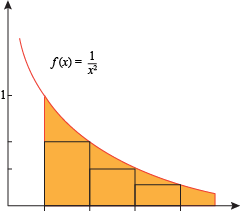
The integral test works because, depending on how we draw the series, we can choose whether the rectangles will cover more or less area than the integral.
In the example with the harmonic series we drew the series as an overestimate. Since the integral diverged, we knew the series had to diverge.
If we have an integral that converges, we draw the series as an underestimate (right-hand sum) instead. Since a convergent integral describes a finite area, the smaller area covered by the rectangles must also be finite.
Practice:
Does the constant series 
where a > 0, converge or diverge? | |
We already know the constant series diverges if a ≠ 0. However, looking at the graph can help the intuition. Here's a 2-D graph of the constant series: 
Putting all the little rectangles together creates an infinitely long rectangle of height a > 0. The area of such a rectangle must be infinite. Since the sum of the constant series is the area of that rectangle, 
is infinite - in other words, the series diverges. At long last, we can give a proof that the harmonic series diverges (even though its terms converge to 0). | |
Does the harmonic series 
converge or diverge? | |
Look at the visualization of the harmonic series where we use left-hand sums. 
Draw the curve 
through this picture. Since all the dots corresponding to terms of the series have coordinates of the form 
the curve passes through all the dots. 
A while ago we found that 
diverges, which means the area it represents is infinite. 
Since the rectangles cover even more area, the area covered by the rectangles must be infinite also. The sum of the harmonic series 
is the area covered by the rectangles, which is infinite, so the harmonic series diverges. Another way to look at this example is that the rectangles we get by visualizing the harmonic series give a left-hand sum approximating the integral 
Since the function is decreasing, a left-hand sum is an overestimate . An overestimate of an infinite value is infinite, so 
is infinite. The series diverges. | |
Does the series 
converge or diverge? | |
Since the function is non-negative and decreasing on [1,∞) we can use the integral test. The integral 
converges by the p-test . The integral test says that the series must also converge. In pictures, the area described by the integral is finite. Since the rectangles that correspond to the terms of the series cover a smaller area, this smaller area must also be finite. This means the series converges. There's something a tiny bit tricky going on in this example. The rectangles that give the underestimate of 
don't correspond exactly to the series 
They correspond to the series 
because of how we're drawing the rectangles: 
This is one of those times when limits of summation don't matter . The first term a1 of the series is a finite number, so if 
converges then so does the original series 
This is why we have the part about c in the integral test. Since limits of summation don't matter for the convergence/divergence of a series, if 
converges, then so does 
We can use any starting index we like, so long as all the terms are defined. This means the convergence/divergence of the infinite series a1 + ... + ac – 1 + ac + ... is determined by the converge/divergence of its tail ac + ac + 1 + .... If the tail converges, the whole series converges. If the tail diverges, the series diverges. This means if the starting index of the series isn't a good choice for c, we can pick a different value. We can pick any whole number value of c for which f is non-negative and decreasing on [c,∞). | |
If possible, use the integral test to determine whether the series 
converges or diverges. | |
The function 
doesn't behave exactly as we want: it isn't non-negative and decreasing from 1 onwards. However, if we zoom in on the graph it appears that f(x) is non-negative and decreasing from x = 6 onwards: 
If we wanted to be careful, we could show that f' is indeed non-negative for all x > 6. Since f(x) is non-negative and decreasing on [6,∞) we can use the integral test with the integral 
Using integration by parts we get 
It doesn't matter what this works out to exactly. The important thing is that the terms -ce-c and 4e-c approach 0 as c approaches ∞, so the limit works out to a finite value. This means the integral converges, so by the integral test 
converges. Since the starting index of summation doesn't matter, 
also converges. | |
If possible, use the integral test to determine whether the series Σ sin n converges or diverges. | |
We can't use the integral test here. There is no whole number value of c for which the function f(x) = sin x is non-negative and decreasing on [c,∞). However, since 
doesn't exist, we can use the divergence test to say that this series diverges. | |
If the terms of a series approach zero, must the series converge? Justify or provide a counterexample.
Answer
No, the series doesn't have to converge.
The harmonic series is the standard counterexample. The terms of the harmonic series approach zero, but the harmonic series itself diverges. The correct statement is that if a series converges, its terms must approach zero.
The example was sort of like comparing two improper integrals, but instead of two integrals we had one integral and one collection of rectangles trying to approximate the integral.
Does

converge or diverge?
Answer
Let
. This function is decreasing and non-negative on [1,∞), and the nth term of the series is f(n).
Since

diverges by the integral p-test (since
is less than 1), the series must also diverge.
By the magic of the integral test, we get a p-test for series like we had for improper integrals. The series

converges if p > 1 and diverges otherwise.
The big catch to the integral test is that there are integrals we can't evaluate. If we can't evaluate the integral, the integral test is worthless. Sometimes, the gremlins shake the box so hard that we can't decide whether to open it or not. We need another test to figure out if we should open it or not.
There are also situations where we aren't allowed to use the integral test because the function f doesn't satisfy the hypotheses. In order to use the integral test, the function that describes the terms has to be non-negative and decreasing on [c,∞).
For the series, determine if it's okay to use the integral test. If so, use the integral test to determine whether the series converges or diverges.

Answer
The function function f(x) = e-x is decreasing and non-negative on [0,∞) so we're allowed to use the integral test. We can integrate f(x).

Since the integral converges, the series converges also.
For the series, determine if it's okay to use the integral test. If so, use the integral test to determine whether the series converges or diverges.

Answer
The sign of sin does weird stuff, which means the function f(x) = x sin x is sometimes negative. There is no point c for which f(x) is non-negative on [c,∞).
This means we're not allowed to use the integral test.
For the series, determine if it's okay to use the integral test. If so, use the integral test to determine whether the series converges or diverges.

Answer
The function

is non-negative and decreasing on [1,∞). From ancient history we know that since 0.5 < 1 the integral

diverges. The integral test tells us that the series

must also diverge.
The shorter version is that we could use the p-test for series to say that since
p = 0.5 < 1
we know by the p-test that the series diverges.
For the series, determine if it's okay to use the integral test. If so, use the integral test to determine whether the series converges or diverges.

Answer
The function factors:

Sadly, from x = 9 onwards this function is negative.
That means we're not allowed to use the integral test.
For the series, determine if it's okay to use the integral test. If so, use the integral test to determine whether the series converges or diverges.

Answer
The function

is non-negative and decreasing. Integrating this requires a formula:

The arctan function approaches
as x goes to infinity:

This means the integral works out to

We don't know what this number is, but it's a finite number, and that's all that matters. The improper integral converges, and by the integral test the series does too.