We've already mentioned that series and integrals are much alike. The integral is the series' brother from another mother. Before we put on our x-ray glasses and take a closer look at convergence and divergence of series, we need to review and discuss two things: basic integral definitions, convergence, and divergence; and visualizing sequences and series.
Since we've already discussed everything we need to know about integrals, we've listed the important concepts here:
- weighted area, including left- and right-hand sums
- improper integrals with an infinite limit of integration
- what it means for such integrals to converge or diverge
- comparison of improper integrals
- the p-test for integral convergence
If you feel unsure about any of these, be sure to go review before we dive headfirst into the new stuff.
We already know we can visualize a sequence on a 2-D graph. We make the horizontal axis show which term we're on and the vertical axis show the value of that term.
Because they are sort of flat, we are going to use grilled cheese sandwiches to visualize series in 2-D.
First, we have a difficult question for you to answer; it is sure to confuse you for hours. What happens to the value of a number if you multiply it by 1?
The value of the number doesn't change. We sincerely hope you got that question right.
Sample Problem
What is the area of a grilled cheese sandwich with height an and width 1?
Answer.
The area of the sandwich looks like this:

Its area is
(height)(width) = an(1) = an.
Practice:
Visualize the harmonic series 
on a 2-D graph. | |
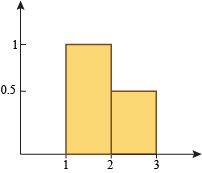
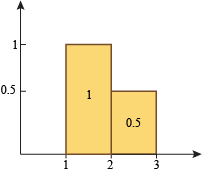
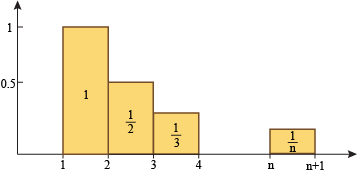
The first term, a1 = 1, is the area of a rectangle with height 1 and width 1. We are using rectangles now because we ate all of the grilled cheese sandwiches. Put this rectangle on the interval [1,2]: 
The next term, , is the area of a rectangle with height and width 1. Draw this rectangle on the interval [2,3]: 
Keep going. The area of the nth rectangle is 
Draw this rectangle on the interval [n, n + 1]: 
If we add up the areas of all the rectangles, we get the harmonic series: 
The sum of the series is the total area covered by the rectangles. We're not claiming the area is finite. In fact, in this case it isn't, as we'll show soon. However, it still makes sense to think of the area covered by the rectangles as the sum of the series. In the previous example we drew the rectangle for an on the interval [n, n + 1]. This image looks surprisingly familiar to the left-hand sum of an integral. This is because the value of the series at n (the left endpoint of the interval) determines the height of the rectangle. Alternately, we could draw the series by putting the rectangle for an on the interval [n – 1, n]. In this case we get a right-hand sum. The value of the series at n (the right endpoint of the interval) determines the height of the rectangle. | |
Find the area covered by the three grilled cheese sandwiches shown below.

Answer
Each sandwich has width 1. The areas are
a1(1) = a1
a2(1) = a2
a3(1) = a3

The total area covered by the three sandwiches is
a1 + a2 + a3.
If we add the areas of those three grilled cheese sandwiches, we get the value of the finite series
a1 + a2 + a3.
The graph of those sandwiches is a visualization of the series:

We can use the same idea to visualize any series. Think of each term an of the series as the area of a grilled cheese with width 1 and height an. Then the sum of all terms of the series is the sum of the areas of all the sandwiches.
So far we've been looking at series with positive terms because they're easy to draw and it makes sense to think about their area. If we think about weighted area instead, we can apply this idea to any series of numbers, positive and/or negative. In this case, we could consider grilled cheese sandwiches made using American cheese as positive and those made using Swiss cheese negative. When we add them together, we can get a positive or negative area, just like integrals.
Visualize the harmonic series

on a 2-D graph. Draw the rectangle for each term an on the interval [n – 1, n], so that we get a right-hand sum instead of a left-hand sum.
Answer
The rectangle for a1 will still have height 1 and width 1. Instead of putting it on [1,2] we'll put this rectangle on [0, 1]:

The next rectangle, for
, will fall on the interval [1, 2]:

and so on.
The area of the nth rectangle is still

We draw this rectangle on [n – 1, n].

If we add up the areas of all the rectangles, we still get

We shifted the rectangles, but still ending up adding the same values.
We've used left- and right-hand sums before to approximate the values of integrals. Now we're using them, along with grilled cheese sandwiches, to visualize series.
Whether we draw the rectangles to the left or the right, the area covered by the rectangles is the sum of the series. It doesn't matter which way we draw the rectangles until we start using the pictures to determine whether a series diverges or converges.
Draw 2-D graphs to visualize the series

using (a) a left-hand sum and (b) a right-hand sum.
Answer
(a) Draw the rectangle for the term an = n2 on the interval [n, n + 1]:

(b) Draw the rectangle for the term an = n2 on the interval [n – 1, n]: