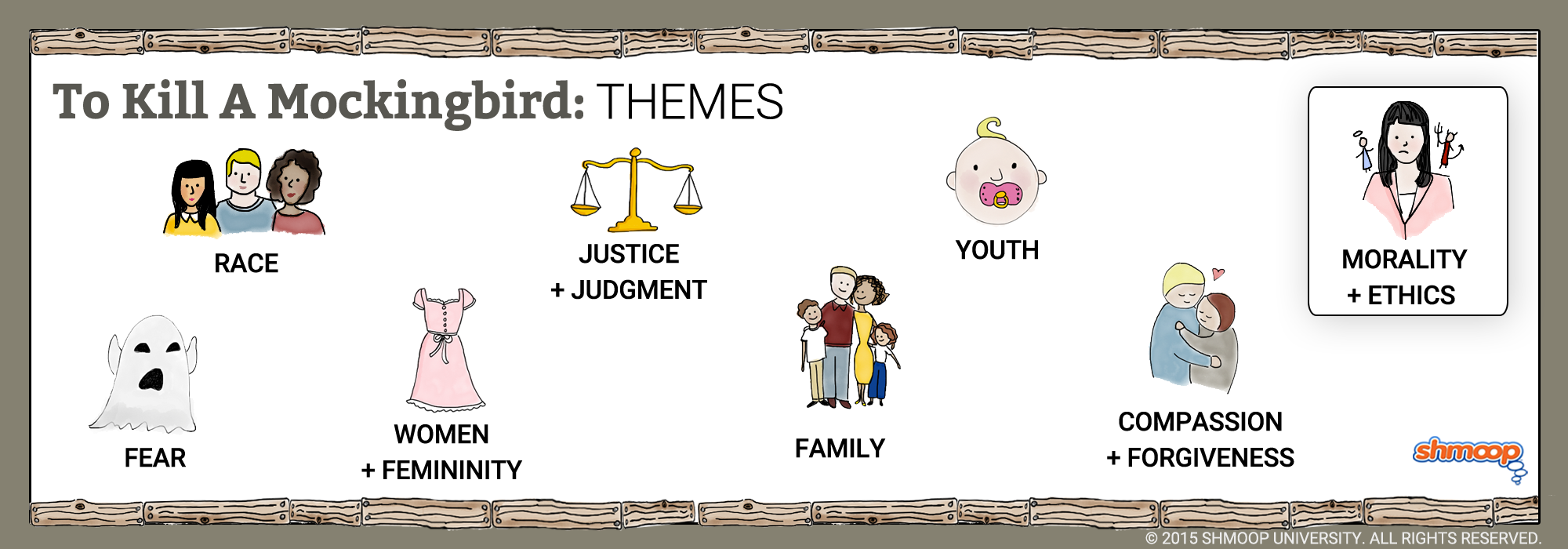
 (Click the themes infographic to download.)
Atticus thinks that everyone deserves a fair trial. Maycomb thinks that only white men do. Scout thinks that her father is right. Maycomb thinks that her father is wrong. So, who's more moral—the community standard, or the individual conscience? Where do the rights of the community end and the rights of the individual begin? To Kill a Mockingbird examines the conflict between the individual and the community. On the one hand, standing up for your beliefs can get you into a lot of trouble. But if your beliefs are moral, then you just might end up dragging the whole community in a more satisfactory direction. After all, a community's morals are the sum of what its individuals believe.

Questions About Morality and Ethics
- What do individual characters in the novel base their ideas of right and wrong on?
- How does the community work to enforce collective standards of morality? Where do those collective standards come from?
- What moral principles does the novel suggest are desirable? Does anything in the novel undermine these moral principles? Are there times when the novel appears to be hypocritical?
- Does Bob Ewell have bad morals or no morals? What's the difference?
Chew on This
Atticus presents himself as morally consistent—the same at home as on the streets—but really he has two moral systems: one for himself (based on a strict moral code); and one for others (based on sympathetic understanding).
While the novel in general presents honesty as a virtue, it also suggests that honesty is not always the best policy.