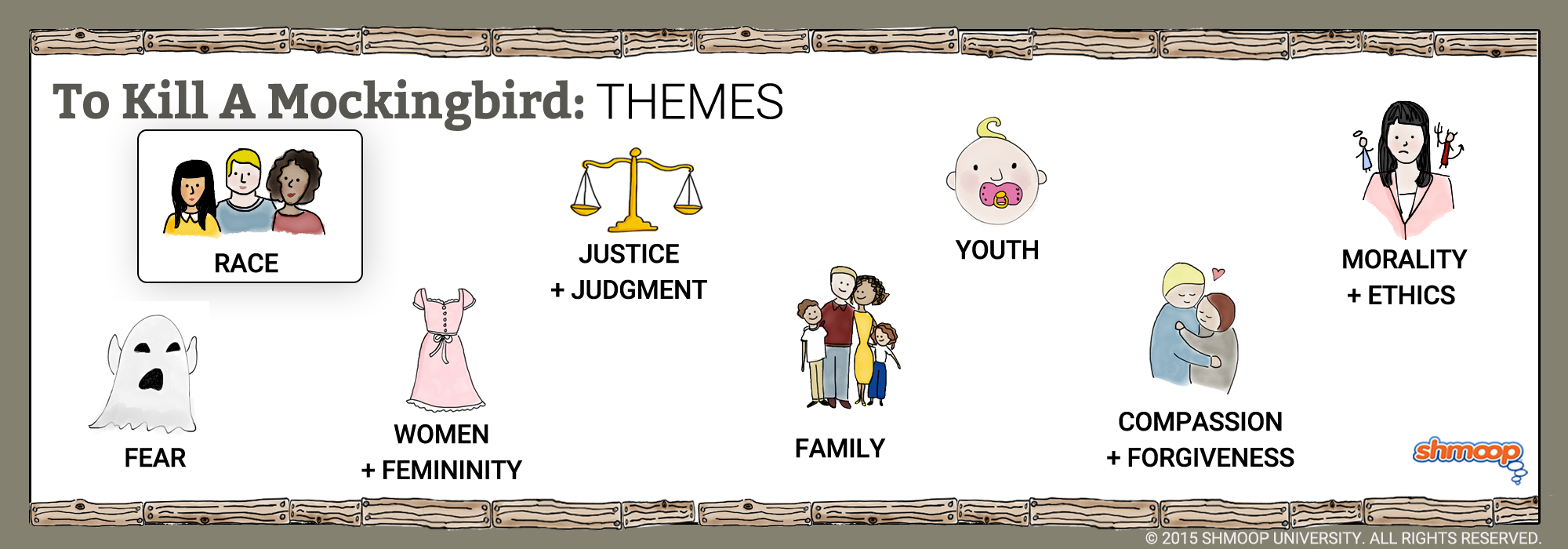
 (Click the themes infographic to download.)
Imagine a world where everyone with blue eyes got to give orders to everyone with brown eyes. If you're born with blue eyes, you get the good jobs, the good schools, the good houses, and all the fair trials you could want. If you have brown eyes—too bad. It's menial labor, rudimentary education, and a house by the dump.
Yeah. It doesn't make any sense. And if it happened overnight, there'd be massive protests. But what if it happened gradually, and what if generations after generations slowly came to accept it? Pretty soon, you'd have people arguing that brown-eyed people are just naturally inferior, and that's Just the Way It Is. And if you're living in a hidebound, one-horse town like Maycomb, there's even less reason to question the status quo. And that's where we are in To Kill a Mockingbird: a town even more traditional-bound than the rest of the South, where it's not just black people who Are the Way They Are, but the white families, too. So is there hope for this town?

Questions About Race
- How does the novel portray its African-American characters? Are there elements of racism in these portrayals?
- How is the African-American community similar to the white community in Maycomb? How is it different? How might these similarities and differences affect how the two communities see each other?
- How might Maycomb, and the events of the novel, be different if there were more than two races represented in the town?
- Does the novel seem to think that racism will eventually be overcome? Or will there always be an element of racism in Maycomb?
Chew on This
The black characters in To Kill a Mockingbird contribute to the development of the white characters rather than appearing as individuals in their own right.
To Kill a Mockingbird suggests that racism is learned, so it can be unlearned.