Character Analysis
Bob Ewell is the current head of a family that has been "the disgrace of Maycomb for three generations" (3.93). (Sounds like quite an honor.) Considered human trash by the Maycomb community, the Ewells live in a shotgun shack out by the dump. Ewell has no ambition to improve his life, or the lives of his eight motherless children; instead, he spends his welfare checks on whiskey and lets the local landowners turn a blind eye to his poaching activities out of pity for his hungry children.
Poor Widower
On the one hand, Bob is an object of pity. He was doomed from the moment he was born a Ewell. On the other hand, he's such an obnoxious and mean character that it's hard to feel sorry for him. The town's view that he's just a Ewell, and Ewells are trash, makes it easy for them to avoid responsibility for trying to help him or his children: no point in offering any aid to someone who's not going to change.
Scout first sees Mr. Ewell at Tom Robinson's trial. She thinks he looks like a freshly-scrubbed rooster, and he's about as articulate as a dirty-minded Foghorn Leghorn. On the witness stand, he plays the comedian even with the lawyer for his own side.
Mr. Ewell was Mr. Gilmer's witness, and he had no business being rude to him of all people.
"Are you the father of Mayella Ewell?" was the next question.
"Well, if I ain't I can't do nothing about it now, her ma's dead," was the answer. (17.70-72)
It seems that Mr. Ewell's default position is to be antagonistic to everyone, even people who are supposed to be on his own side. No wonder he has no friends. His response is not only a rude attempt to impress others by making a joke, it also hints at how Ewell sees women in general: lying cheating whores whose deaths are to be laughed about.
R-E-S-P-E-C-T… Not
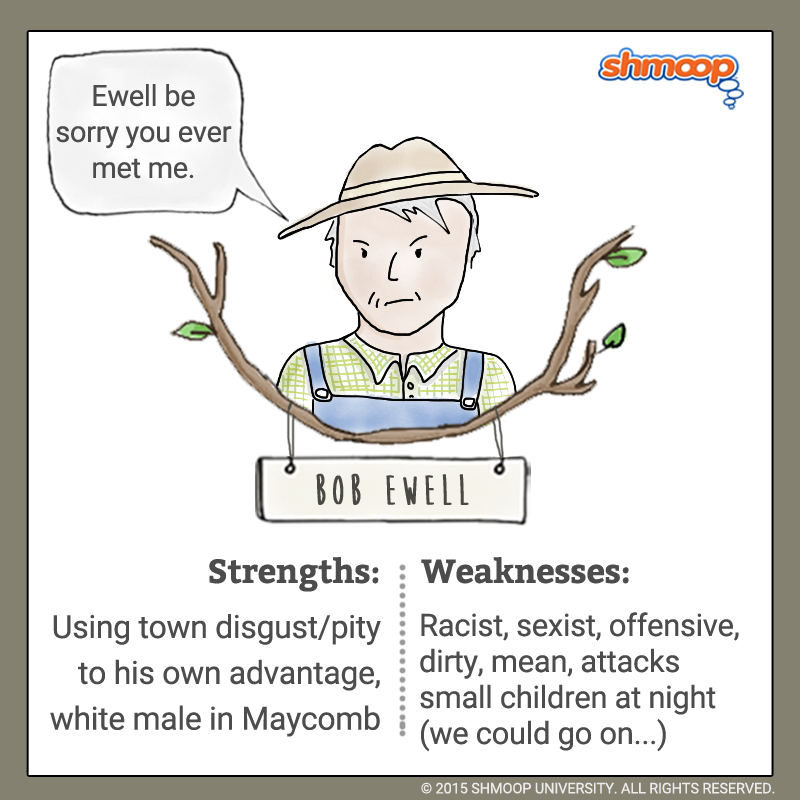
(Click the character infographic to download.)
Respect for others is as foreign to Ewell as personal hygiene. His statement of Tom's supposed crime is couched in the most offensive terms possible, calculated to stir up people's emotions and fears to evidence-ignoring levels of irrationality. (See "Race" in "Quotes and Thoughts" for more on Ewell's accusation of Tom.)
After the trial, Ewell isn't satisfied to have gotten Tom sentenced to death; he wants revenge on those that would give him a fair trial. It's likely that Ewell is the shadow Judge Taylor sees at his house one night, but Atticus and Helen get the brunt of his rage. Atticus doesn't say much about his confrontation with Ewell, so his kids get the Miss-Stephanie-enhanced version: "Atticus was leaving the post office when Mr. Ewell approached him, cursed him, spat on him, and threatened to kill him" (23.2).
Well, when we put it like that, it's probably not enhanced at all. We can definitely buy that Ewell would say that.
While the Maycomb community is happy enough to return to ignoring the Ewells after their day in court, Ewell won't go quietly back to the dump. He's had a taste of power, and he wants to keep asserting it through threats of violence to anyone associated in his mind with Tom Robinson. It's as if what Tom did in Ewell's mind is so horrible that destroying Tom himself isn't enough. Or maybe it's just revenge—after all, Scout and Jem don't have much to do with Tom directly, but attacking them is a powerful way to hurt Atticus.
If we believe Tom's testimony that Mayella approached him, and that Ewell's anger was directed first at her rather than Tom, why is Ewell so determined to prosecute Tom and persecute those involved with him? Especially since it would have been pretty easy just to hush that whole thing up? Scout gives us one clue: "All the little man on the witness stand had that made him any better than his nearest neighbors was, that if scrubbed with lye soap in very hot water, his skin was white" (17.67).
Ewell's "nearest neighbors" are African-Americans, so racism (and sexism) is the only way that Ewell can feel superior to anybody. There's not a single white man in Maycomb who's not above Ewell in the community hierarchy, so he turns venomously on anyone he can put below him: African-Americans and women.
What would it take for Ewell to overcome his background and become a more tolerant person? Short of a miracle, it's hard to say.