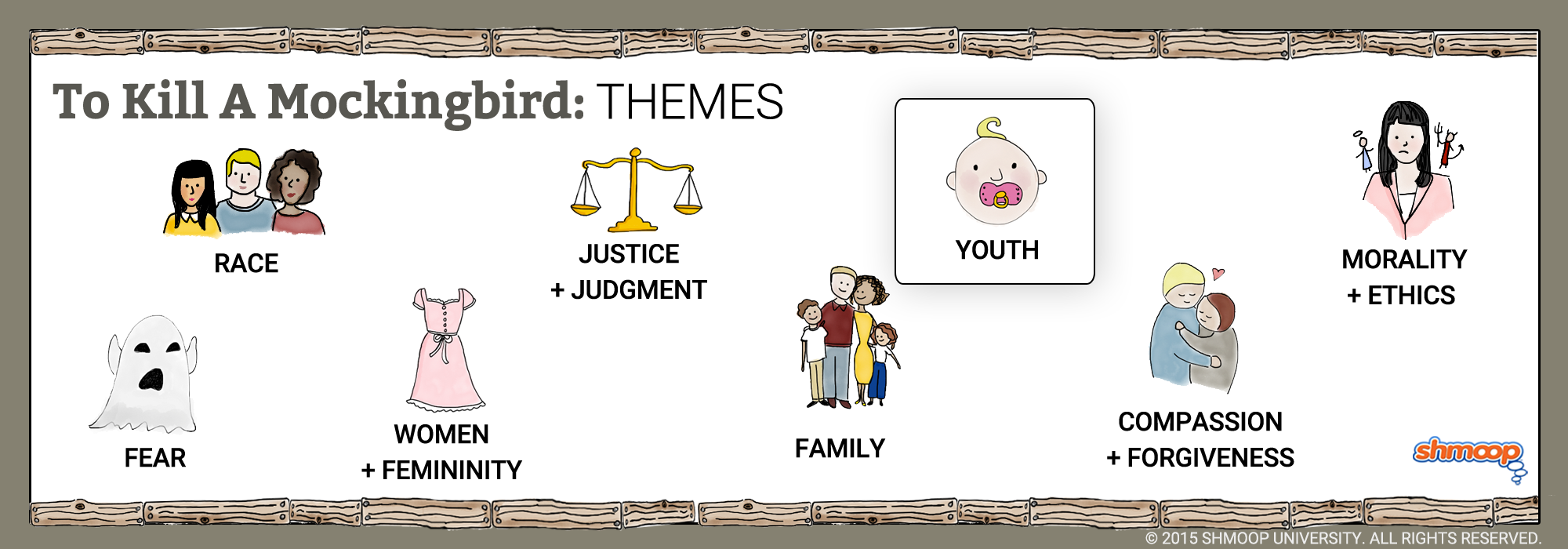
 (Click the themes infographic to download.)
Are kids just the mini-me versions of the adults they will become, or is something substantial lost—or gained—in the transition to adulthood? And how does that process work, anyhow? To Kill a Mockingbird shows a child's perspective on adult events, and suggests that while children aren't just adults in miniature, they also aren't what adults imagine or misremember children to be. You gain a little and you lose a little as you grow up, and some of the abilities that disappear—like fairness, compassion, and a critical way of looking at the world—are well worth trying to keep.

Questions About Youth
- How does the novel think of children as different from adults? Are there any adults who have child-like perspectives? How about children with adult outlooks?
- What difference does it make to the novel that it's narrated from a child's perspective? How would the book be different if an adult perspective was dominant?
- According to the novel, what happens in the process of growing up? What factors determine what kind of adult a child becomes?
- Is identity fixed in childhood, or can it change over time?
Chew on This
The children have an innocent perspective that reveals what the adults don't see.
The novel associates children with fairness to suggest that a sense of justice is innate, not learned, and therefore adults must have learned to be unjust.