There are a lot of useful rules for how to combine integrals, combine integrands, and play with the limits of integration. For some functions there are shortcuts to integration.
For this whole section, assume that f(x) is an integrable function.
Warming Up
Some properties we can see by looking at graphs.
- The integral of the zero function is 0. In symbols, no matter what a and b are,

It doesn't matter what the interval is, because  is the area of a rectangle with height 0. However long the rectangle is, a rectangle with height 0 also has area 0.
- If we integrate an integrable function on a length 0 interval, we get 0. In symbols,
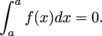
The expression 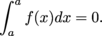 describes the area between f and the x-axis on an interval with length 0. An area with width 0 must be 0.
- If c is a constant, then
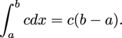
The area between the constant function c and the x-axis is a rectangle with width b – a and "height" c. The weighted area of this rectangle is c(b – a).
- We can change the variable of integration at will:

When we change the variable of integration, all we're changing is the labeling on the horizontal axis. The shape of the function (and the weighted area between the function and the horizontal axis) won't change.

 because the integral of 0 is 0.
 because if we integrate over an interval of length 0 there's no area to accumulate.


 , given that
  .
. , since
  and
and  are the same thing.