ShmoopTube
Where Monty Python meets your 10th grade teacher.
Search Thousands of Shmoop Videos
AP Videos 1345 videos














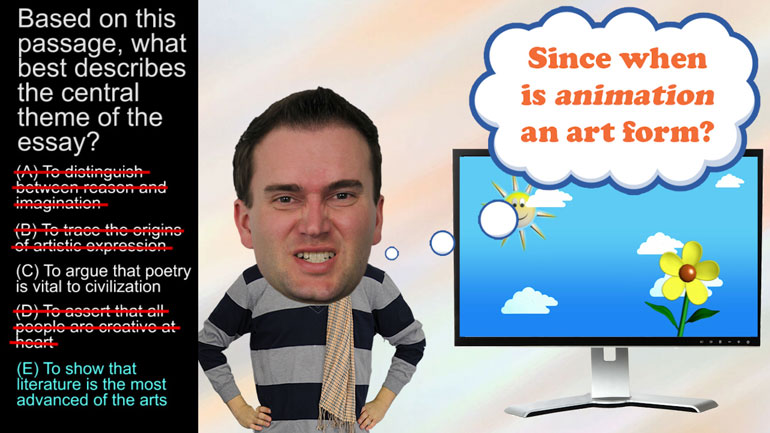
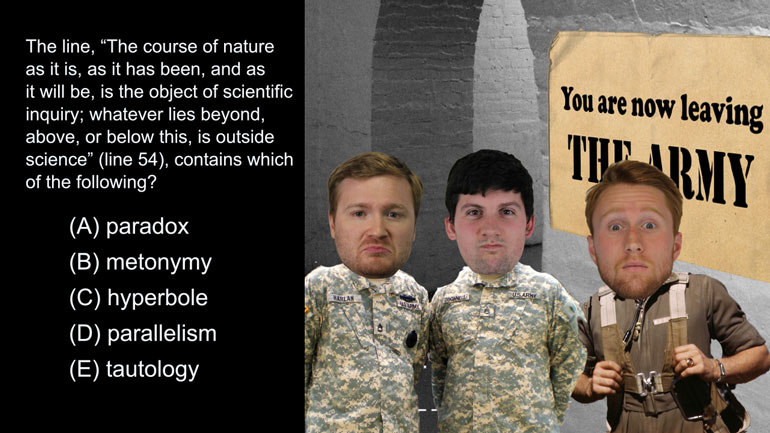






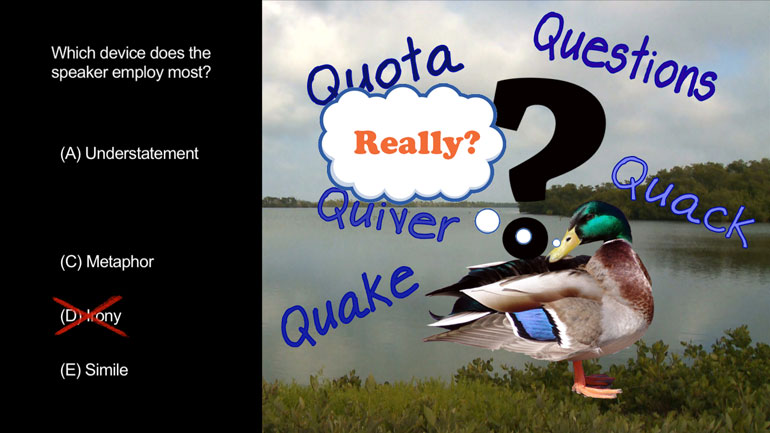
Take a look at this shmoopy question and see if you can figure out which device the speaker employs the most.

We're not going to give you a speech about how answering this Shmoopy AP English Lit question will help you succeed in life, but if we did, we wond...
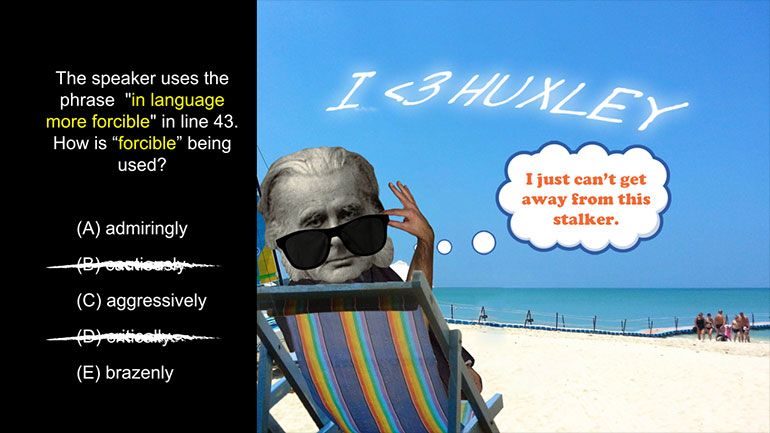
AP English Language and Composition 3.5 Passage Drill. How is "forcible" being used here?
AP Biology 3.2 Evolution 24 Views
Share It!
Description:
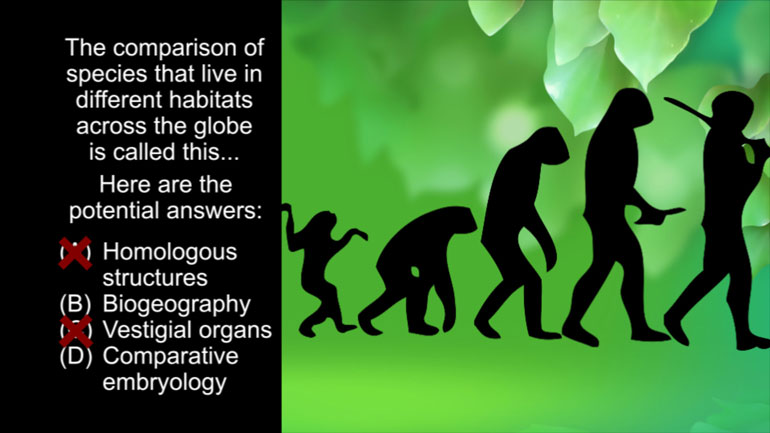
AP Biology 3.2 Evolution. What is the comparison of species that live in different habitats across the globe called?
Transcript
- 00:04
Here’s your Shmoop du jour, brought to you by habitats.
- 00:07
Which technically does include a teenager's bedroom, though we're not sure how anything [Teenage boy in his bedroom]
- 00:11
manages to live in there....
- 00:13
Check out the following statement…
- 00:15
The comparison of species that live in different habitats across the globe is called this.
Full Transcript
- 00:20
And here are the potential answers.
- 00:26
All right, let's start by eliminating answer “A”.
- 00:30
Homology is the existence of shared ancestry between a pair of structures in different [A monkey and a man sitting together]
- 00:35
species.
- 00:36
Such a trait would be most evident if you were to purchase a necktie for your fave giraffe. [Person giving a gift to a giraffe]
- 00:41
Since giraffes have the same number of neck bones as humans do, you could theoretically
- 00:46
get away with buying your giraffe-pal a tie from your local Macy's. [A giraffe wearing a tie]
- 00:50
While that'd be a nice gesture, it wouldn't prove anything about why the giraffe lives
- 00:54
where he lives, so answer “A” is incorrect.
- 00:57
How about answer “C”?
- 00:58
Vestigial organs inhabit the body, but have no functional value to the person. [Human body with vestigial organs]
- 01:04
The appendix comes to mind.
- 01:05
Though to be fair, there's always a chance the appendix will turn into a ticking time [Surgeons removing a persons appendix]
- 01:10
bomb, so at least it has the element of surprise working in its favor.
- 01:13
However, the appendix and other vestigial organs aren't the answer we're looking for.
- 01:17
Moving on.
- 01:18
How about “D”?
- 01:20
Comparative embryology DOES compare species, but only to gather evidence of evolution.
- 01:25
It's a worthwhile field.
- 01:26
It helped us find out the bird evolved from the dinosaur, and that's just...ridiculous. [Diagram of a dinosaur and bird structures]
- 01:31
Hah.
- 01:32
Look at that little dinky bird. [Little bird hopping in the park]
- 01:34
Anyway.
- 01:36
Answer “D” isn't our winner.
- 01:37
That leaves “B”.
- 01:38
And guess what?
- 01:39
The comparison of species that live in different habitats across the globe just happens to
- 01:43
be called biogeography.
- 01:45
Inquiring scientists want to know why marsupials are only found in Australia. [A scientist in the lab and a marsupial bounces past]
- 01:50
How did all the flora and fauna wind up where it wound up?
- 01:55
And why isn't there a duo named Flora and Fauna? [Marsupial and flowers on stage]
- 01:58
We'd buy that album.
- 02:01
B is our correct answer.
- 02:02
If you'll excuse us, we have to work on our next screenplay: Jurassic Park 3: Fuzzy Duck [Advert for Jurassic Park 9]
- 02:08
Snuggles.
- 02:09
Aw.
- 02:10
How cute. [A group of girls cuddle a duck]
Related Videos
AP Biology: Biological System Interactions Drill 1, Problem 1. Complete the sentence about a saturated fatty acid.
AP Biology: Essential Life Process Information Drill 1, Problem 1. If one parent is heterozygous for the sickle cell trait while the other par...
AP Biology: Evolution Drives the Diversity and Unity of Life Drill 1, Problem 1. The first cells on planet Earth were likely what?

AP Biology: Free Energy and Molecular Building Blocks Drill 1, Problem 1. Which statement incorrectly describes the properties of water?
AP® Biology: Evolution Drives the Diversity and Unity of Life Drill 1, Problem 2. What was likely the first genetic material?