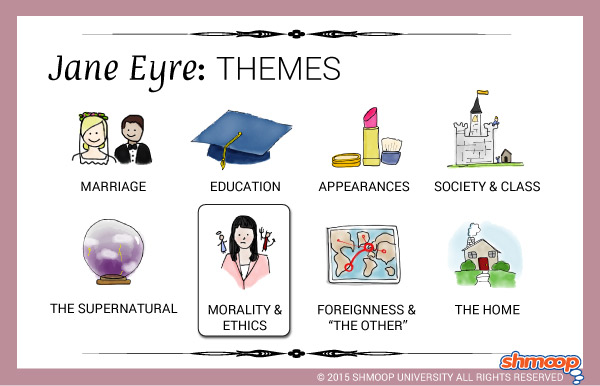
 (Click the themes infographic to download.)
In the strictest sense, Jane Eyre is all about morality—in fact, it’s close to being didactic (it's as if Brontë was trying to teach her readers about ethics). Characters seem to have an innate sense of right and wrong, and it isn’t difficult to tell what decision to make in an ethical crisis.
It is, however, super difficult for these characters to make ethical choices in a world where morality and passion seem to be mutually exclusive. Characters must choose between being right and being happy. Luckily, in the end, circumstances will conspire to get all the ethical obstacles out of the way so that we can have the happy ending we’ve been craving.
Questions About Morality and Ethics
- Does Jane learn her morality from Helen Burns at Lowood, or does she have an innate moral sense of her own that exists before she meets Helen?
- Does Helen change Jane’s mind about what ethical behavior really is, or do Helen and Jane disagree about ethics?
- Is Rochester an immoral person or was he just completely screwed by his circumstances?
- What is the reader’s relationship to the central moral issue of Jane Eyre, Rochester’s attempt to marry Jane while he is already married to Bertha? Where and with whom do our sympathies lie?
- Is Jane Eyre a preachy moral tale that teaches us to respect the rules, or does it make us feel uncomfortable with the rules and think that moral principles could vary, relative to different situations?
- When Jane returns to Rochester at the end of the novel, is her decision a moral one, or is it an emotional one? If it is a moral decision (and it might not be!), then is the moral issue her relationship with Mr. Rochester, or her relationship with St. John Rivers?
Chew on This
Jane’s decision to abandon Rochester when she discovers that Bertha is living in the attic creates a separation between her and the reader; while Jane chooses ethics over passion, the reader is caught up in the romantic plot, rooting for love to triumph over everything, even morality.
The true "moral lesson" for Jane is not that it would be unethical for her to be Rochester’s mistress, but that it would be unethical for her to be St. John Rivers’ wife.