Character Analysis
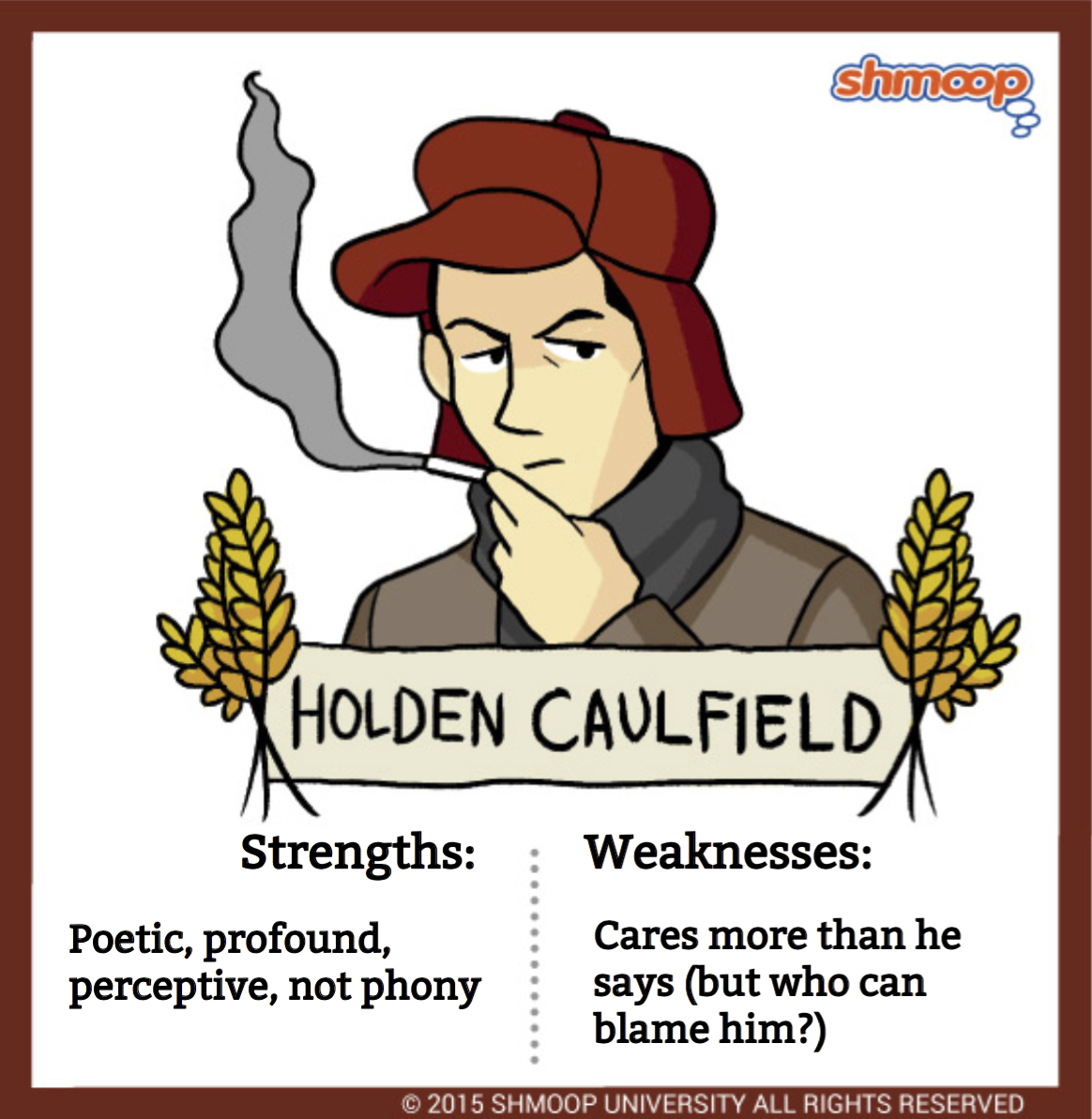
(Click the character infographic to download.)
Oh, Holden. We can’t make up our mind between feeling sorry for him and telling him to just get a grip already. The problem? All he wants to do is connect with someone—anyone—but the boy has high standards. Impossibly high standards. Standards so high that only a precocious fourth-grader can live up to them.
It’s tough being a lonely misanthrope.
Lost in the Crowd
No matter how many times Holden says he’s “lonesome” (it’s a lot), he often can’t even get to the point of reaching out at all. The very first thing the does when he gets off the train in New York is go to a phone booth… and then he leaves twenty minutes later without having even picked up the receiver. We’re going to quote the whole passage, because it’s worth it:
as soon as I was inside, I couldn't think of anybody to call up. My brother D.B. was in Hollywood. My kid sister Phoebe goes to bed around nine o'clock— so I couldn't call her up. […] My parents would be the ones [to pick up the phone]. Then I thought of giving Jane Gallagher's mother a buzz, and find out when Jane's vacation started, but I didn't feel like it. Besides, it was pretty late to call up. Then I thought of calling this girl I used to go around with quite frequently, Sally Hayes, because I knew her Christmas vacation had started already—she'd written me this long, phony letter, inviting me over to help her trim the Christmas tree Christmas Eve and all— but I was afraid her mother'd answer the phone. […] Then I thought of calling up this guy that went to the Whooton School when I was there, Carl Luce, but I didn't like him much. So I ended up not calling anybody. I came out of the booth, after about twenty minutes or so. (9.1)
Every time Holden thinks of someone to call, he ends up deciding not to—usually because he’s afraid he’ll have to interact with someone he doesn’t like. (Like adults.) On the one hand, this is just Holden’s passivity. Over and over again, he decides not to do something.
On the other hand, judging by the interactions that he does have, we… can’t really blame him. Take a look at just a handful of these encounters:
He invites Ackley along to the movies, but Ackley won't return the favor by letting Holden sleep in his roommate's bed. He writes Stradlater's composition for him, and in return gets yelled at (and socked in the nose, but technically that was for different reasons). He even had to type that essay on a junky old typewriter because he had lent his own to the guy down the hall. He lends out up his hound's-tooth jacket, knowing it'll get stretched out in the shoulders. He gets stuck with the tab for the three "moronic" girls' drinks in the Lavender Room at his hotel. He pays Sunny even though he doesn't have sex with her, and ends up getting cheated out of five more dollars (and socked in the stomach, although technically this, too, was for different reasons).
Still, Holden never makes himself out to be a victim. He doesn't seem to notice that he gets taken advantage of over and over and over again. At least, not on a conscious level. (We’re not so sure about his unconscious.). Despite his Judgy McJudgerson exterior, Holden just wants to make friends—like a cute little puppy who keeps on trying.
Holden and the Phonies
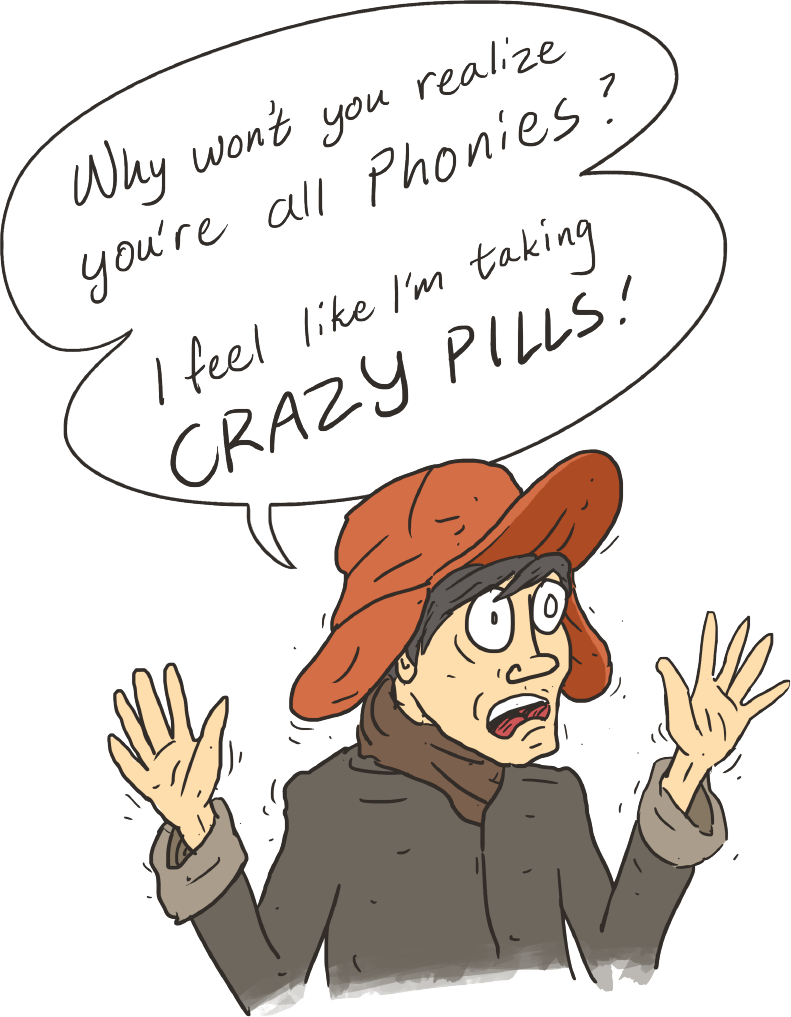
Scratch that: like a cute little puppy with a really bad attitude. Holden may want to make friends, but we’re not sure why: in his mind, everyone is a social-climber, a name-dropper, appearance-obsessed, a secret slob, a private flit (a.k.a gay), or a suck-up. Holden finds any semblance of normal adult life to be "phony." How phony? So phony that he uses the word 33 times—and trust us, that’s a lot of times to use a word like phony. He doesn't want to grow up and get a job and play golf and drink martinis and go to an office, and he certainly doesn't want anything to do with the "bastards" that do.
Except that, really, he sort of does.
We’re not psychoanalysts but here’s our take: if Holden calls everyone a phony, he can feel better when they reject him. You know like making fun of the cool kids so it doesn’t hurt when they don’t invite you to their parties. Who cares if the three girls in the Lavender Room weren't terribly interested in giving him the time of day; they were just phonies who couldn't carry on a conversation. Who cares if Ackley doesn't want to let him stay and chat; Ackley's just a pimply moron. Who cares that Stradlater doesn't want to hang out; he's just a jerk.
Take just this one incident. At the Lavender Room, when he finally convinces the cute blonde to dance with him, the other two “ nearly had hysterics […] I certainly must've been very hard up to even bother with any of them” (10.13). We have to ask: who’s laughing at whom, here? We have a sneaking suspicion that the girls are the ones having a laugh at Holden’s expense—a scrawny little teenager who can’t even get the bartender to serve him.
So, is Holden really an incisive judge of human character who’s too good to be ordinary—or is he just an unlikable, awkward kid with a big chip on his shoulder and a defense mechanism to match?
Let’s Get Physical
Right about now, Shmoop is looking around a little self-consciously. (Maybe you are too.) Holden doesn’t sound too different from any other disaffected, bored kid, us included. But there are definite hints in the text that Holden isn't just another normal teenager.
For one, we know he had to take some sort of "rest" from regular life to go through therapy and get psychoanalyzed. We know he's prone to violent outbreaks, like breaking all the windows in the garage the night Allie died, or tackling Stradlater after his date with Jane, or screaming at Sally in public (he claims he's not yelling, but she repeatedly asks him to "stop screaming" at her [17.55]). He's flunked out of multiple boarding schools. He's depressed all the time. (By our count, 25 times in the course of the novel.)
By the end of the novel, Holden's depression starts to get physical: he's nauseous, he has a headache, he feels dizzy, and he eventually passes out. His comments at the beginning of the novel suggest that his breakdown was in fact physical: he says he "practically got t.b. and came out here for all these goddam check-ups and stuff" (1.10). So we can pretty sure there's something up with Holden—something more than your average teenage emo kid with Dashboard Confessional posters on his walls.
Death to Everyone
So, what went wrong? Was Holden just born this way, or can we blame some sort of trauma for his obsession with phonies, morons, and—yep—death?
We know that Allie’s death was hugely significant for Holden. We learn about it almost right away, and then Allie pops up over and over again. In fact, when Phoebe asks Holden to name just one thing he likes, the first—and almost only—thing he can think of is Allie (22.36). Less significant (but still pretty awful) is the death of James Castle, the boy who jumped to his death wearing Holden’s turtleneck.
But Holden can’t seem to make up his mind about how he feels about death. Sometimes, he seems terrified at the thought of his own death, like when he prays to Allie while crossing the street not to let him disappear. And then sometimes, he's indifferent and objective to the notion, like when he sits in the freezing cold park after looking for the ducks and wonders what his family would think and what his funeral would be like if he got pneumonia and died. And then there are the times he thinks about suicide, or imagines himself bleeding from a gut wound, or claims that, “If there's ever another war, I'm going to sit right the hell on top of [the atomic bomb]. I'll volunteer for it, I swear to God I will” (18.7).
Here’s our thought (just roll with us for a minute): we think Holden is a typical teenager in a lot of ways, but we also think he just might be a representation of a post-World War II America—an America that’s dropped the atom bomb and lost its claim to innocence. (Key piece of evidence: Allie dies of leukemia, the disease that many survivors of the atom bomb got.) When Holden gets disgusted with the phonies, he’s disgusted with the idea that anyone can continue to walk around as though the trauma of war and the bomb hasn’t happened, that life can simply continue on.
Let’s Talk About Sex
In Chapter 9, Holden looks out of his hotel window into other rooms, where he sees a "distinguished-looking" man prancing about in women's clothes, and a couple squirting water or highballs or something into each other's mouths.
Question #1: Why don’t these people close their shades?
Question #2: Does Holden see sex as inherently degrading?
We have no idea about #1, but we think the answer for #2 is … yes. If you really like a girl, he says, you wouldn't want to "do crumby stuff" to her (9.15), and Holden can think of “very crumby stuff.” In fact, he’s “probably the biggest sex maniac you ever saw” (9.15).
But we’re not so sure about that. In fact, it seems to us that he feels like he can’t have a sexual relationship with a girl at all, because it would turn her into an object. This means Holden has to either fulfill his sexual urges with girls he doesn't care about, or not fulfill them at all.
Holden's second problem, he says, is that when he's fooling around with a girl and she suggests they stop, he actually … stops. But, somehow, Holden can't find a balance between respecting a woman (and her saying "no") and taking sexual control of a situation where—maybe—the woman wants him to.
Maybe Holden has good reason to respect boundaries. After all, he does (maybe) experience a come-on at the hands of his former teacher, and he did (maybe) have "perverty" stuff happen to him "about twenty times since [he] was a kid" (24.94). And Jane either did or did not get molested by her stepfather. (One thing to note—Holden uses “about twenty” a lot to indicate large but indeterminate numbers: “I’ve read the same sentence about twenty times” (3); a record from “about twenty years ago” (16); “about twenty sweaters” (16); “about twenty Indians” (16), and so on. So, “about twenty times” could really mean … one or two.)
Why all this ambiguity? Well, an omniscient, third-person narrator could tell us exactly what’s going on. But that’s not what we have. What we have is Holden, a confused, possibly sex-crazed sixteen year old who admits that he "just [doesn't] understand" sex (9.15).
One last thought: could Holden be gay? Is that why he feels confused and alienated? Well, maybe. He does spend a lot of time thinking about Stradlater’s hot bod. He also might read homosexuality where it isn’t, as with Carl Luce or Mr. Antolini. And he's not comfortable with the thought of having sex with a woman. And then there’s his own point that “I know more damn perverts, at schools and all, than anybody you ever met, and they’re always being perverty when I’m around” (24.82).
You know—like maybe they’re picking up on something that Holden can’t even admit to himself?
Phonies Lead to Hate; Hate Leads to the Dark Side
Holden may not understand himself too well, and he may be troubled, but he does come up with some Yoda-like statements that really knock our socks off. Examples:
• "If somebody knows quite a lot about [the theater and plays and literature], it takes you quite a while to find out whether they’re really stupid or not” (15.2).
• "If [girls] like a boy, no matter how big a bastard is, they'll say he has an inferiority complex, and if they don't like him, no matter how nice a guy he is […], they'll say he's conceited" (18.1)
• "Lots of times you don't know what interests you most till you start talking" (24.24).
Now, this isn't exactly Algebra or Ancient Egyptian History, but there's a real emotional intelligence here. Holden understands people: how they think, how they act, and why they do what they do. And he doesn’t like it. In fact, you could even argue that Salinger made Holden too emotionally mature—that a real sixteen-year-old would never have this level of wisdom, even if he thought he did.
One other point to make: Holden’s last name is Caulfield. So what? Well, a “caul” is a little piece of membrane that in rare cases covers the head of a newborn. Babies born with cauls are sometimes said to have supernatural powers, and the caul itself has been traditionally considered good luck. (And also useful protection against drowning, go figure.) So, the “caul” in Caulfield just might indicate that Holden is special—that he has some special insight into people, and that he’s been marked from birth.
Maybe Salinger just liked the sound of the word? Well, maybe. But there’s a famous literary character who just so happens to introduce himself in the first person as having been born with a caul: David Copperfield. And guess who name-checks David Copperfield as the very beginning of his own story? Holden Caulfield, who dismisses “all that David Copperfield kind of crap” (1.1).
Coincidence? We don’t think so.
The Catcher in the Rye
Finally, there’s Holden's grand ambition to be…the catcher in the rye. We talk about the irony a in "What's Up With the Title?,” but here’s the deal: Holden's ambitions = impossible. There are just too many "F*** you" signs in the world.
But why does he have this fantasy in the first place? Why is Holden so obsessed with innocence? Does it have to do with his feelings on and past (bad) experiences with sexuality? Probably. Does it also have to do with the fact that Allie died when he was ten years old? It's highly likely. Is it related to Holden's feelings on adult phoniness, his brewing madness, his emotional intelligence, and his dislike of social constructs? Almost certainly. And, finally, does it have to do with Salinger’s sense of post-World War II America as being a fundamentally corrupt, un-innocent, post-trauma culture?
Almost certainly.
Holden Caulfield Timeline