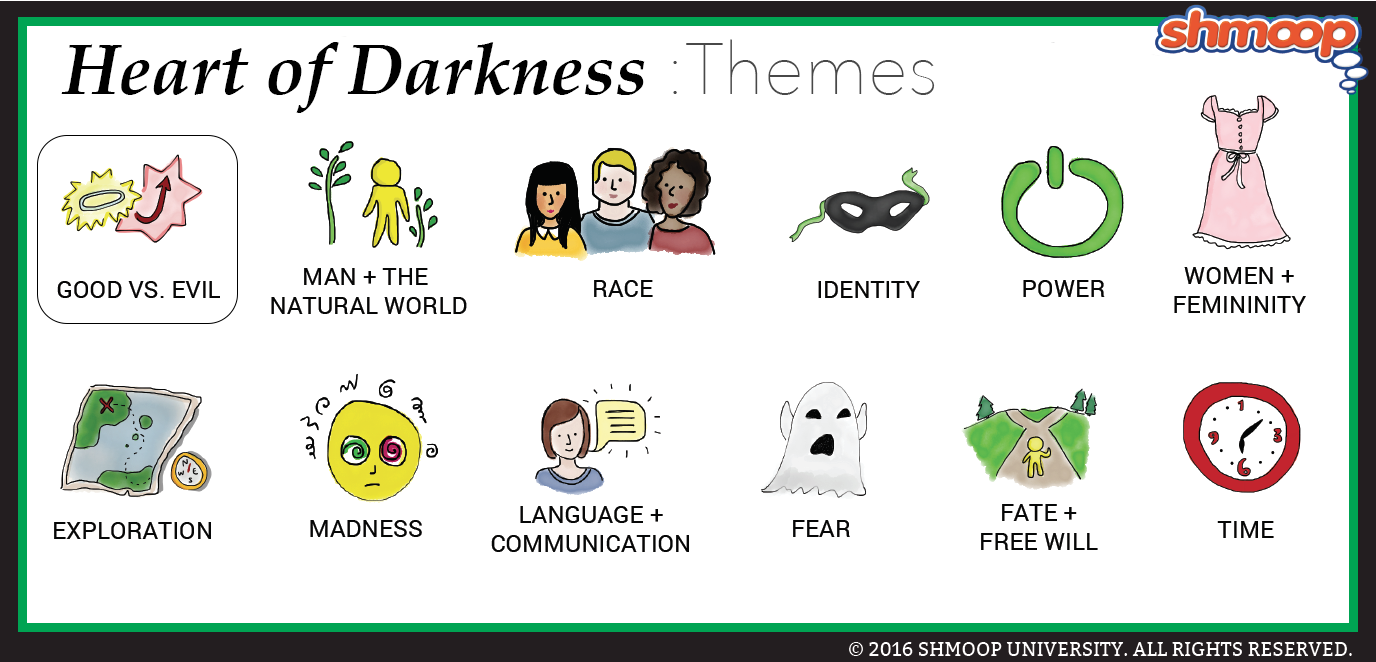
 (Click the themes infographic to download.)
From the minute you wake up in the morning, life is a moral struggle: hit the snooze button, or get up and go for that run you promised yourself you'd take? Put your dishes in the dishwasher, or leave them in the sink for your mom to clean up? Confess that you watched The X-Factor instead of finishing your homework, or lie that your cat had to go to the emergency vet?
Now, imagine that you're sailing up the Congo in a steamboat, and those daily moral struggles take on a whole new gravity. In Heart of Darkness, Marlow's desire to be good and do good becomes increasingly futile as he's plunged into a world where no absolute goodness exists and the best he can do is choose between a selection of nightmares. Eventually, we see that the characters become unable to distinguish between good and evil—or between the River Thames and the Congo, or between black and white—until finally we're left wondering if there's really any difference at all. Spooky.
Questions About Good vs. Evil
- Does Conrad seem to have clear definitions of what constitutes good and evil? What actions does he portray as good or evil?
- Heart of Darkness is full of light and dark imagery. On what different levels do you see this imagery working?
- What abstract concepts might light represent? How about darkness? Do light and dark follow the convention of light representing goodness and dark representing evil?
- What is the "heart of darkness" of the novel's title? Think in terms of abstract concepts as well as of places and characters. Could the "heart" of darkness be a place of light rather than of dark?
Chew on This
For Conrad, good and evil aren't as different as they might seem.
Conrad often uses light, not as a symbol for goodness or enlightenment, but as a foil to a darkness that it eventually collapses into.